Flutter has quietly become one of the most trusted frameworks for building serious mobile products. In 2026, it is no longer just a fast way to launch an MVP. It is a strategic choice for companies that want to move quickly without locking themselves into expensive long-term maintenance.
Still, one question comes up every time a Flutter project is discussed.
What does Flutter app development actually cost in 2026?
If you are building for the US market, the answer is rarely a single number. Cost depends on what you are building, where your users are, how long you plan to scale the product, and how much risk you are willing to take early on.
This guide breaks Flutter app development cost down in a way that mirrors how real projects are planned, budgeted, and delivered.
Why Flutter App Development Services Costs Are Changing in 2026
A few years ago, Flutter was often positioned as a cheaper alternative to native development. That perception does not hold anymore.
In 2026, Flutter is widely adopted by US startups and enterprises because it supports long-term product development. Teams are using Flutter to build apps that handle real traffic, real revenue, and real operational complexity.
Three factors are driving this shift in cost expectations:
Performance parity is no longer optional. Flutter apps are expected to feel native on both iOS and Android
Security and scalability requirements are higher, especially for fintech, healthcare, and enterprise use cases
Post-launch lifecycle now matters as much as the first release. Updates, maintenance, and feature expansion are built into budgets from day one
This is why modern Flutter cost discussions look very different from blogs promising $10,000 apps. Serious products require serious planning.
What Goes Into Flutter App Development Cost
To understand Flutter app pricing, it helps to look beyond feature lists and focus on where effort actually goes.
A well-built Flutter app typically includes the following cost layers:
To understand Flutter app pricing, it helps to look beyond feature lists and focus on where effort actually goes. A well-built Flutter app typically includes the following cost layers:
UI and UX system design that supports reuse, consistency, and future features
Flutter frontend engineering, including state management and performance optimization
Backend and API integration for authentication, data storage, and third-party services
QA, testing, and device coverage to ensure stability across platforms
Deployment, monitoring, and maintenance to support ongoing use and updates
This layered approach is standard for experienced Flutter development services and is a major reason costs vary so widely between projects.
Flutter App Development Cost Breakdown in 2026
Below is a realistic cost calculation model based on current US and global delivery patterns.
Most production-ready Flutter apps in 2026 fall between $30,000 and $200,000 or more, depending on scope, complexity, and regulatory requirements.
This table matters because it explains why costs exist, not just what they are.
App Category Wise Flutter Development Cost
The fastest way to estimate cost is to identify the type of app you are building. Each category carries different technical and operational demands.
This separation matters. A healthcare app and a fintech app may look similar on the surface, but the compliance and security expectations are very different, and so are the costs.
Flutter App Development Cost by Location in the USA
Even in a remote-first world, location still plays a huge role in the final price tag. If you’re hiring a local Flutter team in the US, the "where" often dictates the "how much."
Here is a realistic look at what development costs look like across different tech hubs.
New York
New York agencies tend to be deeply embedded in fintech, media, and enterprise-level corporate tools. You aren't just paying for code here; you’re paying for teams that understand strict compliance, high security, and complex integrations right out of the gate. It’s expensive, but for high-stakes industries, it’s often worth the premium.
Estimated Cost: $90,000 – $250,000+
California
It’s no secret that the Bay Area and LA are the most expensive places to build software. However, the premium you pay here usually goes toward product strategy and world-class UX. California teams are often the best at taking a vague startup idea and turning it into a polished, investor-ready product very quickly.
Estimated Cost: $100,000 – $300,000+
Texas
Texas has quietly become a massive tech hub, especially around Austin and Dallas. It’s widely considered the "sweet spot" for US development right now. You get access to serious engineering talent without the exorbitant overhead of the coasts. It’s a popular choice for businesses that want US-based quality without the Silicon Valley markup.
Estimated Cost: $60,000 – $150,000
Pro Tip: Many US businesses are now playing the "Hybrid Game" keeping their strategy and project management teams local (for example, in New York or Austin) while outsourcing the heavy coding to global teams. It’s a smart way to balance cost and quality.
Startup vs Enterprise Budget Breakdown
Flutter app budgets are allocated very differently depending on whether the product is an early-stage startup app or an enterprise-grade application. The table below shows how priorities shift based on business stage and risk profile.
Both need strong usability, enterprises add accessibility
QA & Testing
8–12%
12–18%
Enterprises require deeper testing and security validation
Strategy & Project Management
8–12%
12–18%
Enterprises need governance, coordination, and risk control
Tools, Hosting & DevOps
5–8%
8–12%
Enterprises invest more in monitoring and scalability
What This Means for Cost Planning
Startups often focus on reaching the market quickly and validating ideas, which pushes more budget toward development and less toward testing and infrastructure. Enterprises, on the other hand, invest more upfront in QA, planning, and DevOps to reduce long-term risk and maintenance costs.
Choosing the right allocation early helps keep Flutter app development cost predictable as the product grows.
Real-World Flutter App Examples & Use Cases
When decision makers evaluate Flutter for a serious mobile project, one of the first questions they ask is this:
“Who else big is using Flutter in production?”
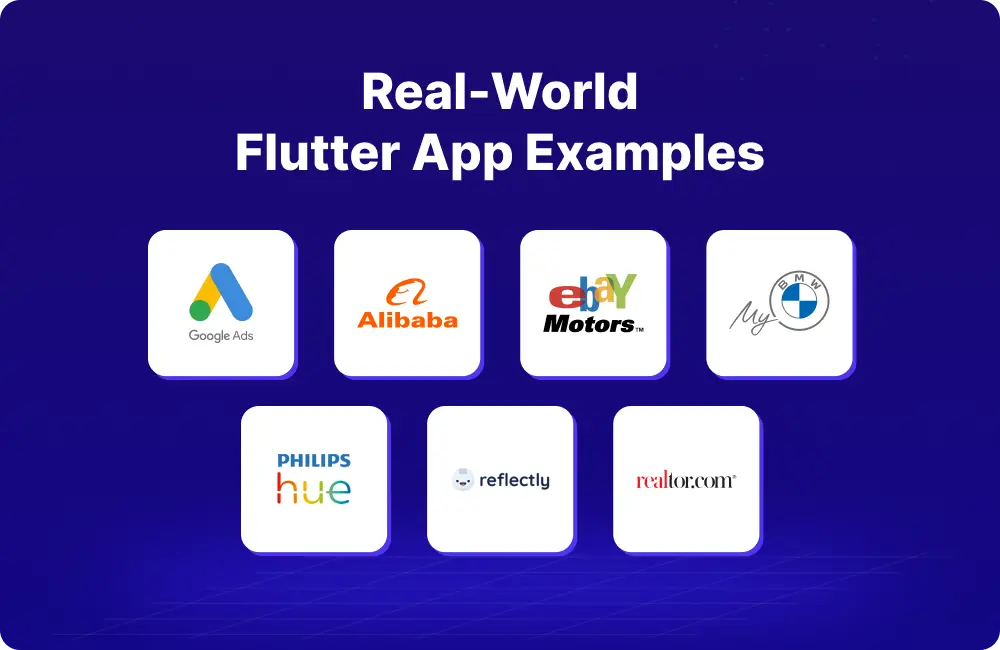
Below are several well-known, real-world apps that either use Flutter fully or for major components. These examples show how Flutter is trusted at scale, from enterprise software to global consumer products.
Google Ads (Ad Management Tool)
Let’s start with the most critical test case. The Google Ads app allows businesses to manage massive budgets, pause campaigns, and view real-time analytics from anywhere.
Why you should care
This is the ultimate "eat your own dog food" scenario. This app manages a huge chunk of Google’s actual revenue. If Flutter was buggy, laggy, or couldn't handle real-time data streams, Google would never risk using it here. It’s proof that the creators trust the framework with their wallet, not just their open-source repos.
Alibaba Xianyu (Marketplace App)
If you still think cross-platform tools can’t handle scale, look at Xianyu. It’s Alibaba’s second-hand goods marketplace, think eBay but with the massive traffic volume of China's mobile ecosystem. They needed a way to move fast on both iOS and Android without maintaining two giant, separate codebases.
Why you should care
It shows that Flutter can survive the stress test of millions of active users. We aren't just talking about a simple to-do list here; this app handles complex inventory, heavy search loads, and instant interactions without stuttering.
eBay Motors (Automotive Marketplace)
Buying a car isn't like buying a toaster; you need high-res photos, videos, and very specific filtering options. eBay Motors used Flutter to build a standalone experience specifically for gearheads and vehicle buyers.
Why you should care
This is a great benchmark for handling complex media. It combines the heavy lifting of an e-commerce catalog with a need for a slick, media-rich interface. It proves you can build a vertical marketplace that feels native and responsive, even when loading hundreds of car photos on a 4G connection.
My BMW (Automotive Experience App)
When you buy a luxury car, you expect the companion app to feel premium, too. The BMW Group uses Flutter for their primary connected car app, handling everything from remote unlocking to checking your electric range.
Why you should care
Reliability is non-negotiable here. If a social media app crashes, it’s annoying. If your car key app crashes, you’re stranded. BMW trusting Flutter for hardware integration and secure APIs is a massive vote of confidence for the framework’s stability outside of just "showing pixels on a screen."
Realtor.com (Real Estate Marketplace)
House hunting is visually demanding. You want maps, 3D tours, and endless photo galleries. Realtor.com migrated key parts of their mobile experience to Flutter to streamline development across platforms.
Why you should care
Real estate apps are notoriously heavy on data and graphics. This case shows that you don't have to sacrifice visual fidelity for cross-platform efficiency. It handles map overlays, geolocation, and high-quality image rendering just as smoothly as a native app would.
Philips Hue (Connected Smart Home Control)
If you have smart lights at home, you’ve likely used this interface. The Philips Hue app controls scenes, colors, and automation for your home lighting systems.
Why you should care
This isn't just fetching data from a server; it’s talking to hardware. Smart home apps live and die by latency, when you press "on," the light needs to turn on immediately. Flutter performs surprisingly well here, handling the real-time feedback loop required for IoT devices.
Reflectly (Consumer Wellness App)
On the other end of the spectrum, we have Reflectly. It’s an AI-powered journaling app, but it’s famous in the developer community for one reason: it is absolutely gorgeous.
Why you should care
While the other apps on this list focus on utility, Reflectly focuses on "feel." It’s packed with smooth transitions, custom animations, and a unique design language. It shows that Flutter isn't just for boring enterprise forms, it’s also a powerhouse for creative, artistic UI design that wins awards.
Flutter vs Native App Development Cost in 2026
When compared to building separate iOS and Android apps, Flutter typically reduces development and maintenance effort by 30 to 40 percent.
For many companies, this translates into faster releases, fewer duplicated teams, and more predictable long-term costs. This is why Flutter App Development Cost discussions increasingly favor Flutter for multi-platform strategies.
Final Takeaway on Flutter App Development Cost in 2026
Flutter app development cost in 2026 is no longer driven by whether you choose cross-platform or native. It is driven by what you are building, how much risk the product carries, and how long you expect it to scale. App category, compliance requirements, location, and post-launch planning now matter more than raw build speed. Teams that budget with these realities in mind tend to avoid cost overruns and painful rebuilds later.
🎙️The Real Cost of Building a Flutter App in the USA (2026)
In this episode, we break down what Flutter app development actually costs in 2026 for US startups and enterprises. From MVPs to fintech and enterprise apps, we unpack where budgets really go, why “cheap Flutter apps” are a myth, and how smart teams plan for scale, security, and long-term maintenance. If you’re budgeting a Flutter app for the US market, this conversation will save you costly surprises.
Estimating Your Flutter App Budget
If you are planning a Flutter app, the most important step is getting a realistic cost breakdown tied to your app category, market, and growth plans. A structured assessment helps clarify what needs to be built now, what can wait, and where investment will have the biggest impact. Working with experienced Flutter development services makes it easier to align budget, architecture, and long-term maintainability from the start.
Frequently Asked Questions (FAQs)
In 2026, Flutter app development typically costs anywhere between $30,000 and $200,000 or more, depending on the type of app, complexity, and market. Simple MVPs sit on the lower end, while fintech, healthcare, or enterprise apps with security and compliance requirements cost significantly more. Most US-focused production apps fall in the $60,000 to $150,000 range.
The biggest cost drivers are app category, backend complexity, security and compliance needs, and post-launch planning. Location of the development team, quality of UI and UX design, and testing depth also play a major role. Feature count matters, but architecture and long-term scalability matter more.
Yes, in most cases Flutter is still more cost-effective than building separate native iOS and Android apps. Flutter usually reduces development and maintenance effort by 30 to 40 percent, since teams work with a single codebase. This makes Flutter a strong choice for businesses aiming to control long-term app development costs.
In the USA, Flutter developer hourly rates generally range from $80 to $150 per hour, depending on experience, location, and project complexity. Senior Flutter engineers with enterprise or compliance experience typically charge on the higher end of that range.
Flutter app development in California is among the most expensive in the US due to high talent demand and operating costs. Most projects range between $100,000 and $300,000 or more, especially for consumer, SaaS, or innovation-driven products built for scale.
Texas offers a more balanced cost-to-quality ratio for Flutter app development. Project costs typically range between $60,000 and $150,000 depending on scope, with cities like Austin and Dallas offering strong Flutter talent and more flexible pricing compared to coastal markets.
New York-based Flutter projects often focus on fintech, enterprise, or regulated industries. As a result, costs are higher, usually ranging from $90,000 to $250,000. Compliance, security, and product rigor contribute significantly to the final budget.
Flutter works best for consumer apps, SaaS platforms, marketplaces, on-demand services, and enterprise tools that need fast iteration across iOS and Android. Apps that require frequent updates, consistent UI, and shared business logic across platforms see the most benefit.
Ongoing maintenance typically costs 15 to 25 percent of the initial development cost per year. This includes bug fixes, OS updates, performance improvements, security patches, and minor feature updates. Apps with integrations or compliance requirements usually sit on the higher end of this range.
The most effective way is to plan properly before development starts. Phased feature releases, reusable UI components, and scalable architecture reduce rework later. Working with experienced Flutter development services instead of choosing the lowest hourly rate also helps avoid costly fixes after launch.
Hitasha is currently working as a Senior Software Developer at VT Netzwelt, with 6 years of experience in software development. She specializes in Flutter and native Android development, with strong expertise in building scalable, high-performance mobile applications and cross-platform solutions. Alongside mobile development, she actively explores emerging AI technologies, tools, and trends to enhance software engineering and accelerate innovation.
Discover 15 ride sharing business ideas for US startups, from medical rides to airport transfers. See niche demand, costs, regulations and launch tips.
See where AI improves ride-hailing dispatch, pricing and forecasting, where deterministic rules belong, and how to add guardrails, audits and human override.
Discover how EV ride hailing dispatch software uses battery data, live charger availability and trip-fit checks to reduce downtime and improve fleet utilization.