The defining question of 2026 is not “Can AI do this?” but “Can this AI be relied on when it matters?”
As 2026 begins, the technology landscape feels noticeably different. Artificial intelligence is no longer framed as a breakthrough waiting to happen. It is now a system already embedded in how organizations operate, decide, and build. The most important shift in the latest AI news this January is not about bigger models or louder announcements, but about accountability, reliability, and real-world outcomes.
Across global technology news, the conversation has matured. Leaders are asking harder questions. Investors are more selective. Enterprises are narrowing their focus to AI systems that can survive contact with scale, regulation, and day-to-day operational pressure. This moment marks a clear transition from experimentation to execution.
What follows is a grounded view of the latest tech and AI updates shaping early 2026, and why they matter now.
After several years of rapid advancement, AI has entered what many industry analysts describe as its accountability phase. Between 2023 and 2025, organizations raced to test generative AI, launch pilots, and explore new capabilities. In 2026, the criteria have changed.
AI systems are now evaluated on stability, governance, integration depth, and cost efficiency. Decision-makers are no longer impressed by what a model can do in isolation. They are focused on how it behaves inside production environments, how failures are handled, and whether outputs can be trusted consistently.
For AI development companies in the USA and globally, this marks a clear inflection point. Enterprises evaluating AI development company in the USA are asking fewer conceptual questions and more operational ones, how systems scale, how data boundaries are enforced, and how AI fits into long-term architecture rather than short-term demos.
CES has long served as a barometer for where technology investment is heading. CES 2026 stands out not because of spectacle, but because of how deeply artificial intelligence is embedded across categorie
AI is no longer presented as a feature layered on top of products. It has become underlying infrastructure, powering adaptive interfaces, on-device intelligence, robotics, and interconnected consumer systems. This shift from visible novelty to invisible capability is one of the most important signals in current technology news.
Robotics demonstrations, multimodal interfaces, and AI-optimized hardware at CES reflect a broader reality: intelligence is moving closer to the edge. Latency, privacy, and efficiency are shaping design decisions as much as raw performance.
What makes this moment notable is restraint. Many of the most compelling systems shown are not ambitious because they promise everything, but because they do one thing well, consistently.
One of the clearest trends in the latest AI news is a narrowing of focus at the enterprise level. Organizations are actively consolidating tools, retiring disconnected experiments, and doubling down on AI systems that integrate cleanly into existing workflows.
High-value use cases continue to cluster around:
This selectivity is reshaping demand for AI development services. Enterprises are no longer looking for generic solutions. They are seeking partners who understand domain constraints, compliance requirements, and long-term system ownership.
This shift is already visible in how widely adopted tools such as ChatGPT, Google Gemini, and Microsoft Copilot are being used inside organizations. Their role has moved beyond experimentation into day-to-day operational support, assisting with drafting, analysis, software development workflows, and internal knowledge access. What matters now is not access to AI, but how reliably these systems integrate with enterprise data, governance boundaries, and existing processes.
Another defining development in global technology news is how AI platform strategy is evolving. Rather than racing to release new foundation models at a rapid pace, leading platforms are focusing on system-level improvements.
Key priorities now include
This reflects a broader industry realization: model capability alone does not create value. Value emerges when intelligence is predictable, composable, and governable inside real systems.
For enterprises, this trend reduces volatility. It allows longer-term planning around AI integration without constant architectural rework.
Behind the scenes, AI’s growth is placing sustained pressure on global infrastructure. Compute availability, energy consumption, and data center capacity remain central constraints as AI workloads expand.
This has led to renewed emphasis on:
Efficiency is no longer a secondary concern. It is increasingly a differentiator. Organizations that treat infrastructure as a strategic component of AI design are finding it easier to scale responsibly.
Despite measurable progress, AI systems in 2026 still struggle with accountability, long-term context retention, and decision ownership in complex environments. Most enterprises continue to keep humans in the loop for judgment-heavy decisions, regulatory interpretation, and high-risk outcomes.
This restraint reflects maturity rather than hesitation. Responsible deployment now means knowing where automation ends and human oversight begins.
Taken together, the latest AI and technology news from January 2026 paints a clear picture. AI is no longer optional, but it is also no longer forgiving. Success depends on disciplined execution.
Organizations moving forward effectively share a few traits:
This is why enterprises increasingly prioritize working with an AI development company in the USA or globally that understands not just models, but systems, compliance, and long-term operational risk.

January 2026 marks a turning point for AI. The focus has shifted from experimentation to accountability, reliability, and real-world impact. This episode breaks down the latest tech and AI updates, enterprise adoption trends, and what businesses must prioritize to make AI work at scale.

The tone of early 2026 is not exuberant. It is deliberate. Artificial intelligence has earned its place as foundational technology but with that position comes responsibility.
For readers following the latest AI news, this shift matters. The most impactful developments this year will not always be the loudest. They will be the systems that woquietly, scale cleanly, and deliver consistent value long after the headlines fade.
That is the real story of AI in January 2026 and it is only beginning.
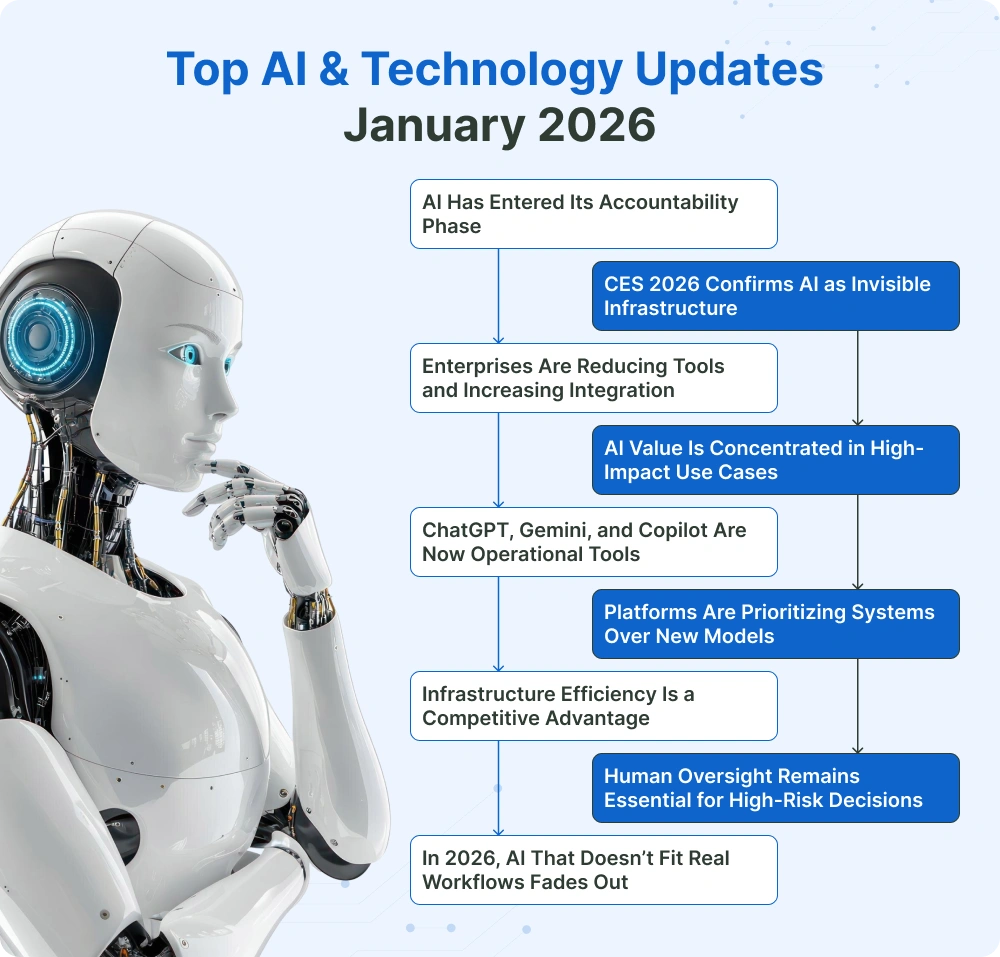
AI has shifted to its accountability phase, with CES 2026 showcasing it as core infrastructure in robotics and devices, while enterprises demand reliable integration into workflows like code acceleration and forecasting.
Businesses are selectively adopting AI, using tools like ChatGPT and Gemini for high-impact areas such as customer support, risk analysis, and internal knowledge access—but only with solid governance and scalability.
Focus on companies delivering scalable, compliant systems that handle real-world ops, data security, and long-term architecture, not just impressive demos or pilots.
Prioritize services for custom workflow integrations, efficient hybrid cloud-edge setups, software development boosts, and domain-specific solutions like forecasting and support automation.
AI normalized as invisible backbone for adaptive interfaces, on-device intelligence, and robotics, emphasizing low latency, privacy, and consistent performance over hype.

Are You Prepared for Digital Transformation?
AI Development
March 2026 was big for AI. GPT-5.4, Claude 4.6 and powerful AI agents just landed. See what these updates mean for businesses.
AI Development
From GPT-5.3 to Claude Opus 4.6, February 2026 delivered real-world AI breakthroughs. Catch up on the latest AI news and shifts redefining tech.

AI Development
Discover real digital transformation examples from leading brands and learn how to choose the right digital transformation company in USA..