February 2026 has been nuts. The tech world isn't playing around with theory anymore, companies are putting stuff out there that actually works. It's not about who has the biggest model now. It's about who can ship something people will pay for.
Everyone's tracking the latest AI news February 2026 for good reason. This month feels different. Companies stopped showing off and started showing results. Let me break down what's actually happening.
The Big Model Drop That Broke the Internet
February 7 was insane. OpenAI and Anthropic both released major updates at basically the same time. Felt like watching two boxers step into the ring together.
What Actually Launched?
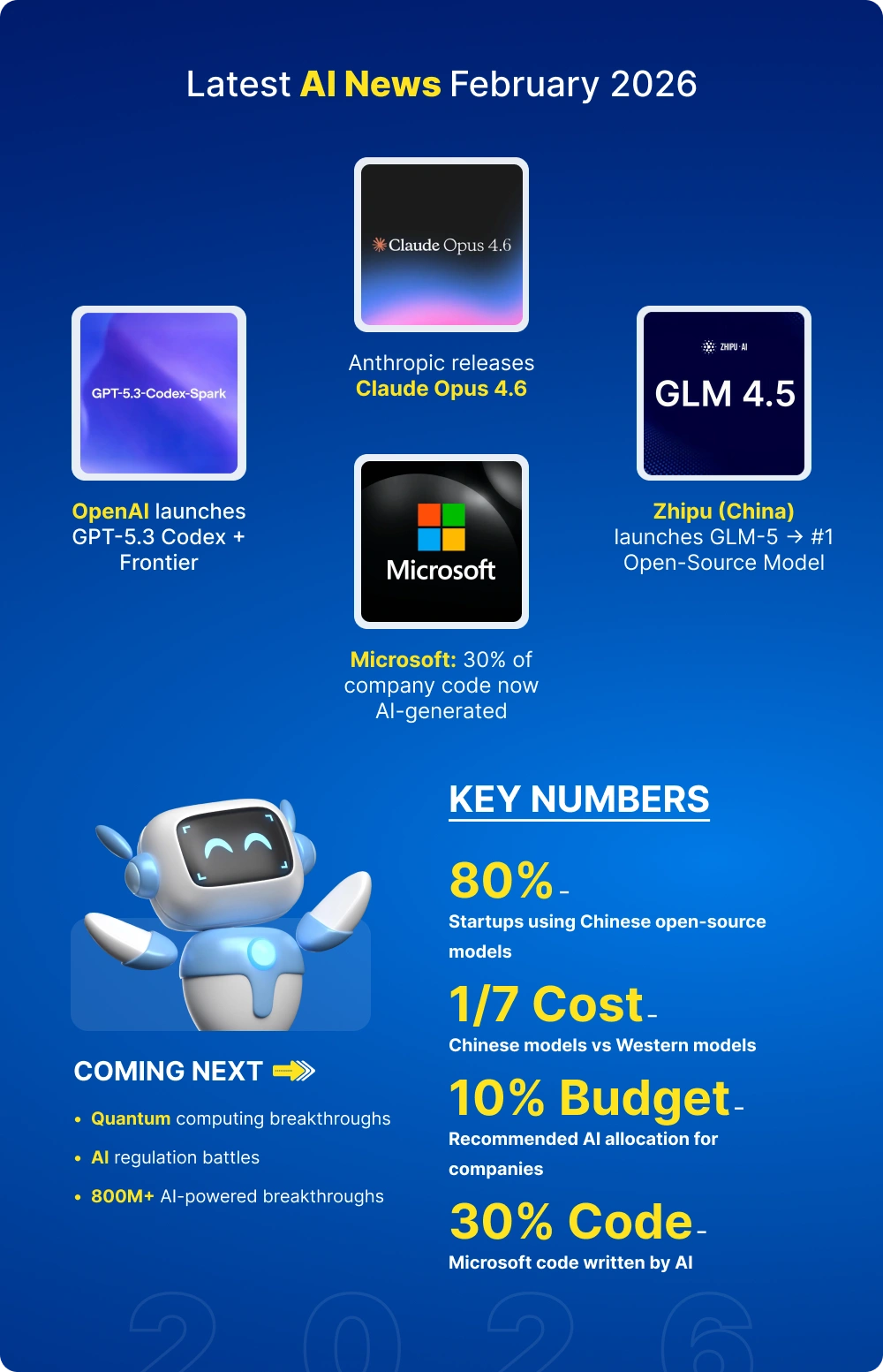
OpenAI dropped GPT-5.3-Codex with this thing called Frontier that helps companies manage AI workers. Sounds sci-fi but it's real.
Anthropic came back with Claude Opus 4.6 sporting a million-token context window. That's massive. Plus it got way better at coding.
Chinese company Zhipu launched GLM-5 and immediately hit #1 on open-source benchmarks. They were so flooded with demand they hiked prices 30%. Their stock jumped 34%.
The China angle is interesting because they're not just competing anymore, they're winning in some areas.
What's Actually Working Right Now?
The AI breakthroughs in February 2026 aren't just incremental updates. Some of this stuff is changing how companies operate.
Area
What's New
Why It Matters
Agentic AI
MCP is now the standard
AI can actually connect to your databases and tools
Coding
GitHub Copilot and friends
Microsoft says 30% of their code is AI-written now
Open Source
Chinese models dominating
80% of startups use them because they're cheaper
Enterprise
Real deployments
Companies want ROI, not demos
Understanding All Developments
Here's the thing, 2026 is when reality hit. Every AI development company in USA and globally realized that the era of just making models bigger is over.
What Changed
We ran out of good training data. Seriously, that's a real problem.
Making models bigger costs too much money
Companies want specialized tools that do one thing really well
Post-training techniques matter more than model size now
IBM's research scientist put it well: this is "the year of frontier versus efficient model classes." Basically, smart beats big.
Agentic AI Goes Mainstream
The Model Context Protocol thing is actually a game changer. Anthropic gave it to the Linux Foundation, and now OpenAI, Microsoft, and Google are all using it.
The Infrastructure Reality Check
Here's what nobody talks about enough: all this AI runs on massive data centers that are causing real problems.
The Issues:
Power bills going through the roof in communities hosting these facilities
Water shortages because cooling systems use tons of water
Constant noise from cooling fans driving people crazy
Air quality taking a hit
AMD and Microsoft are trying to fix this with new chips (Ryzen AI 400 and Maia 200) that use way less power. But it's a race against time.
China's Open Source Takeover
This is probably the biggest story nobody saw coming. Chinese companies are crushing the open-source AI game.
The Numbers:
Moonshot AI's model costs 1/7th what Claude Opus does
Alibaba's Qwen models have more downloads than Meta's Llama
80% of startups building on open-source use Chinese models
MIT confirmed Chinese models passed US models in downloads
Why does this matter? Because open-source means anyone can modify and improve these models. Innovation happens faster when the code is free.
What Businesses Should Actually Do?
If you're trying to figure out your AI strategy, here's what's working:
The Playbook:
Build specialized AI for specific tasks, not general everything-AI
Set up governance from day one
Give someone clear ownership
Put at least 10% of budget toward AI
Demand measurable returns
Peter Steinberger (the guy behind Moltbook) nailed it: "the best AI is specialized rather than generalized." Stop chasing AGI. Build tools that solve real problems.
Quantum computing - IBM says this year it'll beat classical computers on real problems
Regulation fights - Trump vs California over who controls AI rules
Mass adoption - Samsung putting Gemini AI in 800 million phones this year
The regulation battle is going to get messy. But while politicians argue, the technology keeps moving.
The Real Takeaway
February 2026 is showing us what AI is actually about, solving real problems, not making promises.
If you're a running A.I. development service or someone trying to use A.I. in your business, concentrate on things that work. Skip the hype. Ignore the flashy presentations. Ask one question: does this actually help?
The companies that win aren't chasing science fiction. They're building practical tools that deliver results you can measure. That's the game now.
🎙️ AI Breakthroughs February 2026: Models, Money & Market Shifts
February 2026 has been a turning point for AI. From GPT 5.3 Codex and Claude Opus 4.6 to China’s GLM 5 leading open source, real competition is heating up.
Listen in this podcast as we break down what these AI breakthroughs actually mean for businesses and AI development companies.
Turn AI Insights Into Action
February 2026 taught us that practical A.I. trumps demos. We aid companies in building special solutions for solving the real problem. Book a free consultation with VT Netzwelt to find out what AI opportunities suit your business, what really are the implementation costs, and the realistic timeline to start making returns.
Frequently Asked Questions (FAQs)
OpenAI’s GPT-5.3-Codex and Anthropic’s Claude Opus 4.6 both dropped on February 7. China’s Zhipu also launched GLM-5 which topped open-source benchmarks. All three focus heavily on coding.
They’re dominating open-source. Qwen and DeepSeek models get more downloads than US models and cost way less. About 80% of startups now build on Chinese open-source models.
Systems that handle multi-step tasks independently. With Model Context Protocol going mainstream, these agents connect to databases and tools seamlessly, moving from demos to actual production work.
Massive consumption of energy and water resources, noise pollution, and air quality problems from massive data centers. Companies are making more efficient chips to lower the environmental and economic costs.
New methods for retrieval include focusing attention on specialized tools for specific needs. Establish Governance Early, Establish Ownership, maintain budgets for AI-level expenditure of at least 10%, and there should be a demand for and a measurable ROI. Make a transition from pilots to production.
Dushyant Takhar is a Web App Development Expert, passionate about building robust and scalable applications. His focus is on creating innovative solutions that streamline business processes and set companies up for long-term digital success.