Most businesses don't have a strategy problem. They have a gap between strategy and execution. The plan exists somewhere. It's been presented, approved, and filed away. But the tools people use every single day can't support it. That gap is quiet at first. Then it gets expensive.
Enterprise mobile app development is really about closing that gap. Not in theory. In practice. A field tech who doesn't have to call back to the office to check stock levels. A department head who sees real numbers without waiting for someone to pull a report. These aren't big dramatic wins. They're small, repeatable ones. And they add up faster than most leaders expect.
Understanding Enterprise App Development Actually
Enterprise app development means building software around how a specific business actually operates, not how a general consumer browses or shops. These apps handle internal workflows, support teams, manage real data, and connect with the systems a company already runs on. That last part is what makes it genuinely different from other software projects.
A consumer app can stand on its own. An enterprise app almost never does. It needs to talk to the CRM. The ERP. Payroll. Inventory. Sometimes all of them at once, in real time, without breaking when something updates on the backend.
Why It Matters for Growth?
Here's what actually happens when enterprise apps work well.
Information stops getting stuck. Someone has numbers in a spreadsheet. Someone else needs those numbers to make a call.
By the time the data moves through email and chat and back again, the moment has passed. That's not a people problem. It's a systems problem.
Enterprise mobile app development solves this by getting the right information to the right person at the right time.
In context. Without three intermediate steps. When that happens consistently, decisions get faster. Delays shrink. Teams stop operating one beat behind where they need to be.
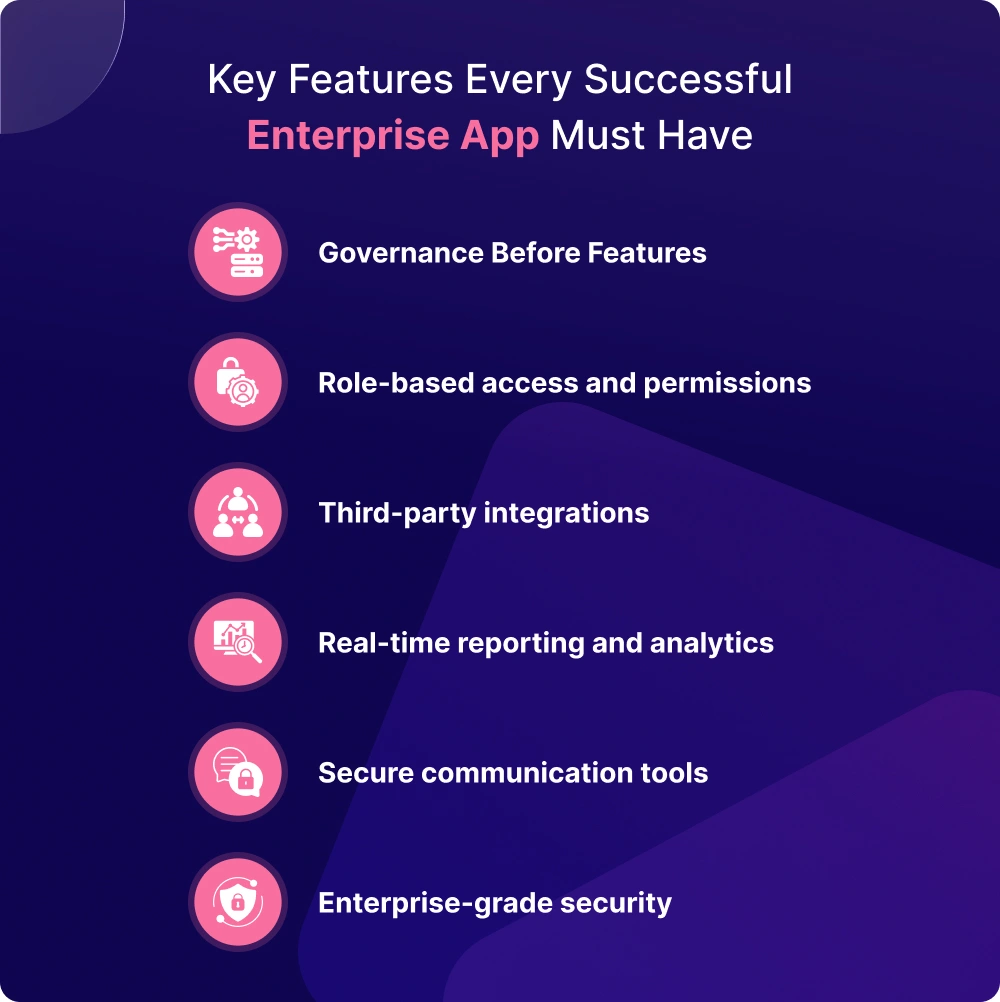
Key Features Every Successful Enterprise App Must Have
Most "key features" breakdowns read like a spec sheet someone copied from a sales deck. Here's a more grounded take on what actually moves the needle.
1. Advanced database system
Everything sits on this. Get it wrong and every feature built on top becomes unreliable. For enterprise use, the database needs to handle serious volume, sync across devices without lag, and stay stable when hundreds of users are hitting it simultaneously. This sounds basic because it is. It also gets ignored more than it should during early planning.
2. Role-based access and permissions
This is more than a security checkbox. When someone opens an app and only sees what's relevant to their role, they work faster and trust the system more. When they see everything, they second-guess what they're looking at. Role-based access done well is both a security feature and a usability feature. Most teams underestimate the usability half.
3. Third-party integrations
A lot of apps claim to integrate with existing systems. Fewer do it cleanly. Real integration means data flows without manual intervention, without formatting mismatches, without someone reconciling two systems on Friday afternoon. This is one of the areas where enterprise app development services earn their fees or lose credibility fast.
4. Real-time reporting and analytics
Making decisions on yesterday's data is a structural disadvantage. Live dashboards let leadership be proactive rather than reactive. That sounds like a small shift. In practice, it changes how quickly problems get caught and how confidently calls get made.
5. Secure communication tools
Alerts, task updates, messaging, notifications. When these live inside the app rather than scattered across email and other platforms, context stays intact. People respond faster because the information and the next action are in the same place.
6. Enterprise-grade security
This is not a finishing touch. Authentication systems, encrypted data handling, permission controls, ongoing monitoring. These shape architectural decisions from the very beginning. Teams that treat security as a late-stage addition tend to find out why that was the wrong call at the worst possible time.
Best Practices for Enterprise App Development Success
A lot of enterprise app projects fall apart not because the code was bad. They fall apart because nobody asked the right questions early enough.
What problem is this actually solving? Who uses it and how often? What does the workflow look like today versus what it should look like when the app exists? These seem obvious. They get skipped regularly.
The development teams that produce the best outcomes tend to slow down at the beginning. They push back on vague requirements. They ask what success looks like six months post-launch, not just at delivery. And they think seriously about adoption, meaning whether employees will actually use the thing once the launch energy fades.
The Enterprise App Development Process
1. Discovery and planning
The most undervalued stage by a wide margin. Everything skipped here costs significantly more to fix later. The goal is real business outcomes, understanding who uses the app and under what conditions, and identifying risks before they turn into project-stopping problems.
2. Technical feasibility
Some ideas are harder to build than they look, especially when older systems are involved. This stage is about being honest about what's actually achievable before anyone starts designing screens or writing code.
3. Wireframing and prototyping
Early prototypes give stakeholders something real to react to. Changing a wireframe takes hours. Rebuilding a developed feature takes weeks. The math on doing this stage well is pretty straightforward.
4. UI and UX design
Enterprise apps don't need to win design awards. They need to be learnable quickly. If employees need a training session every time something in the interface changes, the design isn't doing its job.
5. Development
Backend systems, APIs, databases, and front-end features all come together here. Good development at this stage also means writing code that another developer can pick up and understand a year from now. Clients rarely think about this during the build. They think about it a lot later.
6. Testing and QA
Functional testing is the minimum. Performance under real load, security vulnerabilities, usability under actual conditions. The edge cases that only appear when real users interact with a system in ways nobody predicted.
Top Enterprise App Development Trends in 2026
The trends worth paying attention to aren't necessarily the loudest ones. They're the ones quietly reshaping how enterprise software gets built and maintained over time.
AI integration is showing up everywhere but not in the science fiction sense. Smarter search inside apps, pattern recognition that surfaces relevant information before someone has to hunt for it, automation that handles repetitive steps without human input.
Cloud-native architecture has essentially become the default for new enterprise builds. The question now isn't whether to go cloud.
Instead of one large monolithic application that breaks in unpredictable ways when something changes, smaller components can be updated independently. The payoff on this choice becomes very clear two or three years into a product's life.
Big data handling is getting more attention because the volume of data businesses generate has genuinely outpaced what older systems were designed to process.
How Much Does Enterprise App Development Cost in the USA?
Putting a number on enterprise app development is genuinely tricky and any vendor who gives you a firm quote before understanding your business is probably cutting corners somewhere. That said, most U.S. companies building from scratch spend anywhere from $50,000 on the low end to well north of $500,000 for something complex. The majority of mid-market projects land somewhere in the $100,000 to $300,000 range, which sounds like a lot until you star.t breaking down what actually goes into it.
Enterprise App Development Cost Breakdown
Challenges That Don't Show Up in the Pitch Deck
Every enterprise app project hits rough patches. Knowing about them upfront doesn't make them disappear. But it changes how teams prepare.
Legacy integration is probably the most common source of unexpected complexity. Older systems were built without modern APIs, without clean data structures, sometimes without much documentation at all.
Budget and timeline pressure tends to cut testing and planning first. That's the wrong trade. Those two stages catch the problems that are exponentially more expensive to fix after launch.
The partner a company chooses shapes everything that follows. A strong team navigates scope changes, technical surprises, and shifting requirements without turning every problem into a crisis. A weak one makes ordinary challenges feel catastrophic.
Portfolio depth matters more than portfolio size. Relevant experience beats volume of projects. Case studies that show real outcomes, not just polished screenshots, tell a more useful story about what a team can actually deliver.
The development process deserves a close look. If clear answers to straightforward questions are hard to get during the sales process, that's information too.
🎙️Enterprise App Development Guide: Cost, Features & Strategy
Most businesses don’t struggle with ideas. They struggle with making things work day to day.
In this episode, we talk about how enterprise apps help close that gap, from real features to real-world challenges.
We also break down what it actually costs in the USA and what to get right before you start.
If you're planning to build, this will save you time and mistakes.
Build an enterprise app that actually drives results!
Businesses today need more than just apps. They need scalable systems built with precision and purpose. With expert enterprise app development services, you can streamline operations, improve efficiency, & drive real growth with technology that works for you.
Partner with VT Netzwelt to turn your business vision into a scalable digital reality.
Frequently Asked Questions (FAQs)
No honest single-number answer exists here. Cost depends on scope, complexity, number of integrations, security requirements, and what kind of ongoing support the business needs after launch. A focused app with a clean scope costs a fraction of what a platform connecting multiple backend systems with custom roles, reporting, and compliance requirements would cost.
The ones that hold up under real usage: security built in from the beginning, role-based access that’s genuinely granular, integrations that work cleanly with existing systems, real-time data visibility, and consistent performance under actual load conditions. Without these, an app might demo well but struggle the moment it’s used seriously by a full team.
Scope and complexity drive this more than anything else. A focused app with limited integrations moves faster than most people expect. A platform connecting multiple backend systems, with custom roles and reporting, takes several months. Sometimes longer depending on legacy infrastructure.
Companies looking to apply these capabilities in ways that actually fit their operations, without overcomplicating things, often look to the best mobile app development company in USA to help separate what applies to their situation from what just sounds impressive on paper.
Nitin, in his 18-years long career, has helped various reputed national and international organizations in developing business strategies, incubating new business models and streamlining processes at various capacities. Combining his knowledge and experience, he has designed, developed and delivered, various industry demanding solutions for web and mobile users, whereas the E-Learning and E-Commerce domain are of his particular interest.
See where AI improves ride-hailing dispatch, pricing and forecasting, where deterministic rules belong, and how to add guardrails, audits and human override.
Discover how EV ride hailing dispatch software uses battery data, live charger availability and trip-fit checks to reduce downtime and improve fleet utilization.
Design one app that feels native on iOS and Android. Compare navigation, gestures, design systems, Flutter and React Native, then use the launch checklist.