Quick truth: Most failed prop firms didn't fail at marketing. They failed because their backend couldn't keep up.
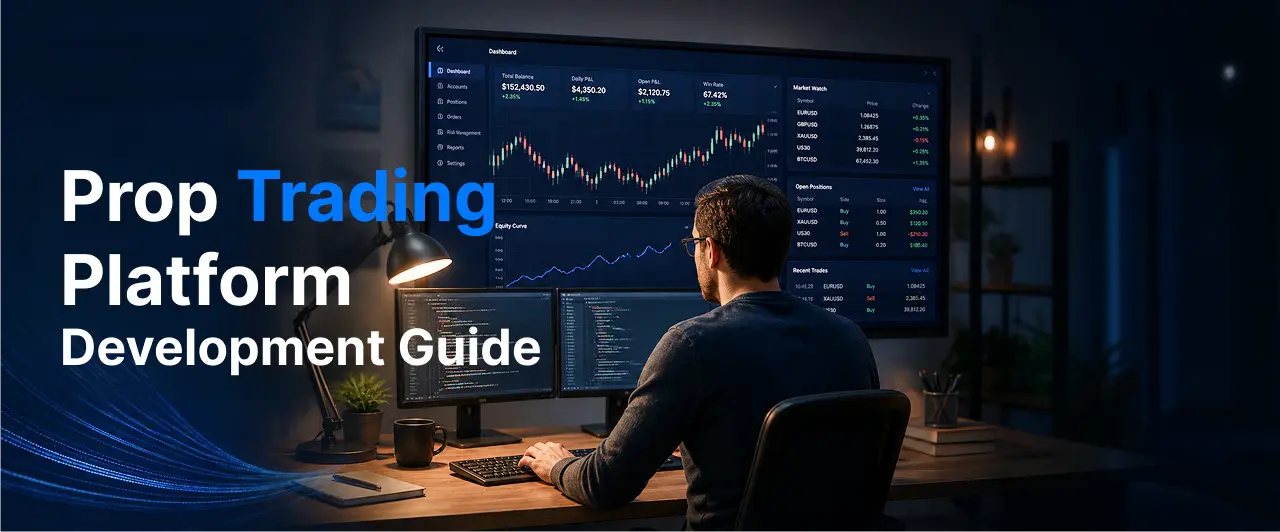
A few years ago, prop trading was something most people in fintech only knew about because they had a friend at Jane Street or Optiver. Today it's everywhere. Retail traders, evaluation models, AI risk engines, and a flood of new founders have turned it into one of the busiest corners of the industry.
What's interesting is who actually wins in this space. It isn't always the firm with the best ad campaigns or the slickest landing page. More often than not, it's the firm whose platform doesn't fall over when traffic spikes, whose risk engine catches breaches in real time, and whose payouts go out on time without drama.
If you're thinking about launching a prop firm, scaling one you already run, or adding a prop desk to a brokerage, you've probably already realised the hard part isn't the idea. It's figuring out how to actually build the thing. What goes into the architecture? Which tech stack will hold up? What's a realistic budget? Should you build it yourself, buy a white label, or do something in between?
This guide walks through all of that. We'll cover what a modern prop trading platform really looks like under the hood, the features you can't skip, the stack we recommend, honest cost ranges, and the compliance and AI trends shaping the industry right now. If you're looking for serious fintech software development advice on prop trading, this should give you a solid mental model to work from.
Quick Answer: A prop trading platform is a multi-layered fintech system combining trading execution, risk monitoring, business operations, and analytics. Building one typically takes 4 to 6 months for an MVP and 9 to 12 months for full deployment. Industry consensus ranges from multiple reported sources put hybrid builds at USD 50K to 150K and full custom platforms at USD 150K to 500K or more. Most teams succeed with a hybrid approach: licensing a proven trading platform like MT5 or cTrader for execution, then building custom CRM, risk engine, and dashboard layers.
A prop trading platform is a fintech system that lets traders pay for evaluation challenges, prove their skills under defined risk rules, and get access to a funded account if they pass. The firm splits trading profits with successful traders, typically with the trader keeping the larger share.
On paper, it's fairly simple. Traders sign up, pay for an evaluation (a "challenge"), and if they pass, they get access to a funded account. They trade, the firm splits the profits with them, usually 70/30 or 80/20, and some platforms now go as high as 90% for top performers.
That's the surface. Underneath, it's a much messier system. You're running a brokerage backend, a SaaS product, a fintech compliance layer, and a real time risk engine, all glued together and all expected to work without missing a beat.
Here's what your platform actually has to do, every minute of every trading day:
That's a lot of moving parts. Let's break it down properly.
A modern prop trading platform is built across four interconnected layers: trading execution, risk and rule enforcement, business operations and CRM, and data intelligence. Each layer handles a specific function, and they all need to work together in real time.
Most well built prop platforms follow this structural logic. Get any one of them wrong and you'll feel it in production.

This is where traders actually place orders. Almost nobody builds this from scratch anymore, and you probably shouldn't either. Most firms license one of the established platforms.
This is the part that does the real work. Every trade, every tick, every price movement gets checked against the trader's rules in real time. If their drawdown breaches, the account locks. If they hit the profit target, they get promoted. If they trade during a news window when they shouldn't, it gets flagged.
The thing nobody tells you when you start: latency between your trading platform and your risk engine matters enormously. Low single-digit millisecond response times are the engineering target serious teams aim for. Anything slower and traders can blow past your limits before you even see what happened. We've seen firms lose serious money to this exact gap.
Trader registration, KYC, payments, payouts, refunds, support tickets, affiliate tracking, lifecycle automation. Basically everything that isn't trading itself. This is your operations team's home base.
BI dashboards, AI driven trader scoring, fraud detection models, revenue forecasting, audit trails for regulators. The firms doing well right now treat this layer as a real competitive weapon. The firms struggling treat it as something they'll get around to "eventually."
Each of the major prop trading platforms has different strengths. Here's a quick comparison based on publicly available vendor information and industry reporting.
| Platform | Vendor | Best For | Key Strength |
|---|---|---|---|
| MetaTrader 5 | MetaQuotes | Forex, CFDs, retail-familiar trader base | Largest trader community, proven reliability |
| cTrader | Spotware | Transparency-focused firms, professional traders | L2 pricing, open API, cAlgo support |
| DXtrade | Devexperts | Multi-asset firms (CFDs, futures, options) | Built-in risk controls, white-label flexibility |
| Match-Trader | Match-Trade Technologies | Firms wanting custom UI on top of solid backend | PWA technology, scalable architecture |
| TradeLocker | TradeLocker | Newer prop firms, mobile-first traders | Modern UI, growing partner ecosystem |
The right choice depends on your asset focus, your trader audience, and how much customisation you need on top of the platform.
A prop trading platform needs trader-facing tools, admin controls, a real-time risk engine, compliance systems, payment infrastructure, and analytics. Not every feature needs to ship at MVP, but every feature needs to be planned for from day one, otherwise retrofitting becomes expensive.
| Category | Must Have at Launch | Phase 2+ |
|---|---|---|
| Trader Portal | Registration, KYC, challenge purchase, dashboard, payouts | Mobile apps, gamification, leaderboards, social features |
| Admin / Ops | Account control, support tickets, basic reports, breach logs | Bulk operations, segmentation, custom dashboards |
| Risk Engine | Drawdown rules, daily loss, profit targets, breach automation | News trading windows, consistency checks, A/B book routing |
| Compliance | KYC/AML, IP tracking, basic fraud rules, audit trails | AI fraud ML, behavioural analytics, regulatory APIs |
| Payments | Card + 1 to 2 regional rails + crypto on ramp | Multi currency, e wallets, instant payouts, payout aggregators |
| Analytics | Core KPIs, P&L, retention basics | Trader scoring, revenue forecasting, cohort analytics |
The mistake we see most often: founders try to ship everything in column three on day one. Don’t. Pick the must haves, get real traders on the platform, see what they actually do, then build accordingly. A focused MVP development approach saves you from building features nobody uses.
The best tech stack for a prop trading platform balances real-time performance, regulatory reliability, and developer availability. Most modern builds combine React or Next.js for the frontend, Node.js or .NET for backend services, Python for AI/ML, AWS for cloud infrastructure, and licensed trading platforms like MT5 or cTrader for execution.
| Layer | Recommended Technologies |
|---|---|
| Frontend (Web) | React + Next.js, TypeScript, Tailwind CSS, TradingView Charting Library |
| Mobile | Flutter or React Native for cross platform |
| Backend Services | Node.js with NestJS, .NET 8, Go for low latency, Python for ML |
| Real time / Streaming | Apache Kafka, Redis Streams, WebSockets, FIX protocol bridges |
| Databases | PostgreSQL, TimescaleDB or InfluxDB, Redis, MongoDB |
| Trading Platforms | MT5, cTrader, DXtrade, Match Trader, TradeLocker, Rithmic |
| Cloud and DevOps | AWS (EKS, RDS, MSK), Terraform, Kubernetes, GitHub Actions, Datadog |
| Security | Cloudflare WAF, HashiCorp Vault, OAuth 2.0/OIDC, MFA |
| Payments | Stripe, Adyen, regional rails, Coinbase Commerce, payout aggregators |
| KYC / AML | Sumsub, Onfido, Jumio, Veriff |
| AI / ML | Python, TensorFlow, scikit learn, AWS SageMaker |
This isn't a stack we picked because it sounds good in a pitch deck. Every component on this list has been hammered in production by real teams running regulated, high volume digital engineering workloads. When real money is moving and traders are watching their P&L, "trendy" is the last thing you want.
For most new prop firms, a hybrid approach works best: license a proven trading platform for execution, then build your CRM, risk engine, dashboards, and analytics as custom software. This balances time-to-market, cost, and long-term differentiation.
This is the first big decision most founders face, and a lot of them get it wrong. Here's how the three options actually stack up:
| Approach | Time to Market | Cost | Best For |
|---|---|---|---|
| Pure White Label | 4 to 8 weeks | Low setup, recurring license fees | Speed, brokers testing the model, lifestyle scale firms |
| Hybrid ⭐ (usually the right call) | 3 to 6 months | USD 50K to 150K + licenses | Founders who want a branded UX, custom risk logic, and IP ownership without rebuilding execution |
| Full Custom | 6 to 12+ months | USD 150K to 500K+ | Established firms, multi asset visions, long term defensibility |
Cost ranges above are industry consensus drawn from multiple reported sources, including Spotware, TradeInformer, and Finance Magnates industry reporting.
The pattern we see again and again: founders go with white label because it's the fastest and cheapest option. They launch, things go well, they hit a stage where they need to differentiate, and then they realise they can't. Their challenge rules are the same as everyone else's. Their dashboard looks like five other firms. They want to build something custom but they have thousands of traders on the platform and migration becomes a nightmare.
The smarter move for most teams is the hybrid. License a proven trading platform like MT5 or cTrader for the execution side, where there's no real benefit to reinventing the wheel. Then build your CRM, risk engine, dashboards, and analytics yourself. You ship fast, you own the layers that make you different, and you don't end up trapped.
Building a prop trading platform typically costs USD 50K to 150K for a hybrid build (licensed trading platform plus custom CRM and risk engine), and USD 150K to 500K or more for a fully custom platform. Pure white-label setups can launch for as little as USD 5K to 30K, but with limited differentiation.
Here's a module by module breakdown for a hybrid build, drawn from industry consensus across multiple reported sources:
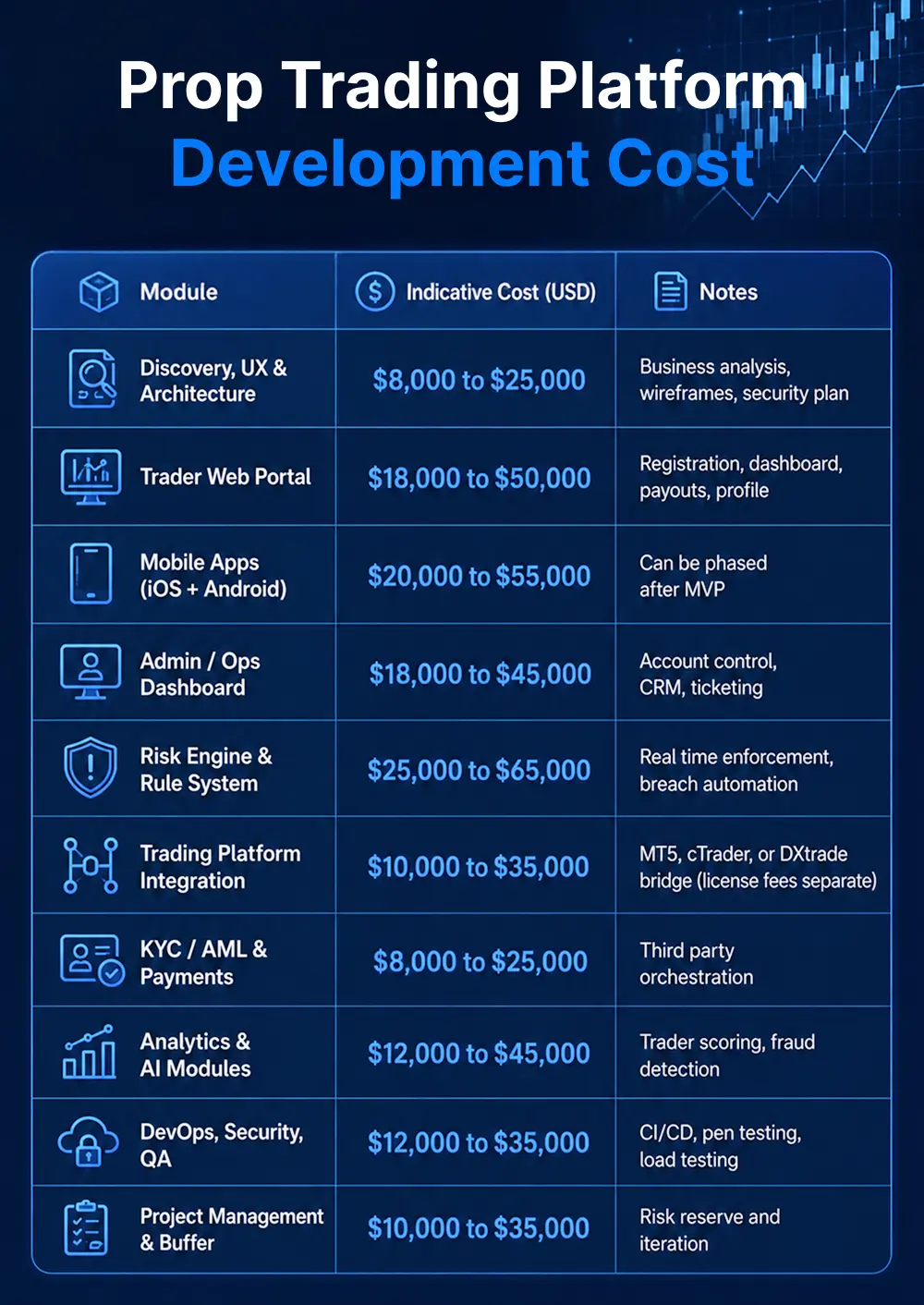
Ranges shown are industry consensus based on publicly reported figures from prop firm technology vendors and consultants, including PropAccount, Spotware, TradeInformer, and Brokeret. Actual project costs vary based on scope, geography, and team composition.
A solid MVP usually takes 4 to 6 months. A full V1 with mobile apps and advanced analytics runs 6 to 9 months. Multi-asset, AI-enabled, multi-region deployments take 9 to 12 months or more.
One important note on cost. The numbers above are for development. They don't include the costs that always sneak up on founders, things like liquidity arrangements, MT5 or cTrader licensing fees, ongoing AWS bills, security audits, and the capital reserve you'll need backing your payouts. Founders should plan a meaningful additional buffer for year-one operational costs on top of pure development spend.
Prop trading currently sits in a regulatory grey zone in most jurisdictions, but oversight is tightening. Authorities including ESMA in the EU, the FCA in the UK, and the CFTC and SEC in the US have all signalled increased scrutiny is coming. Standardised drawdown methodologies, mandatory disclosure APIs, and connections to licensed trade surveillance are all on the table.
The firms that survive that transition will be the ones who built compliance into the platform from the start, not the ones scrambling to retrofit it.
What that means in practice:
Compliance used to be seen as a cost centre. Right now, it's becoming a moat. The weaker operators won't be able to keep up, and the well built platforms will pick up their traders.
The biggest shifts in prop trading software right now are AI-driven risk and fraud detection, predictive trader scoring, composable API-first architectures, and crypto-native multi-asset platforms. These are the genuine differentiators replacing yesterday's table stakes.
Rule based fraud detection catches the obvious stuff. Machine learning catches the rest. Modern AI systems build a behavioural baseline for each trader and flag anomalies, things like coordinated hedging, multi account collusion, and arbitrage exploitation. The trader-ring fraud cases that affected several major prop firms in recent years have pushed the industry toward this kind of behavioural ML approach.
Time series models can be trained to identify which challenge purchasers are likely to pass, which funded traders are likely to stay profitable, and which traders show patterns associated with drawdown breaches. This drives capital allocation decisions, retention campaigns, and even dynamic challenge pricing. The accuracy depends heavily on your data volume and model design, so this is an area where building genuine ML capability matters more than buying a feature.
The monolithic platforms are dying off. The new model is best of breed components, risk from one vendor, CRM from another, payments from a third, all connected through clean APIs. Faster to evolve, cheaper to maintain, and you don't get stuck with a single vendor's roadmap.
Most existing prop firms layered crypto on top of forex era infrastructure. The next generation is being built crypto native from the ground up, with support for tokenised real world assets and dozens of instruments under one risk framework.
The most expensive mistakes in prop trading platform development are manual risk monitoring, weak fraud detection, vendor lock-in, underinvested admin tooling, treating compliance as a cleanup task, and skipping mobile.
Some patterns worth knowing before they cost you serious money:

Honestly, prop trading platforms aren't a project where domain experience is optional. Building a CRM is one thing. Building a CRM that has to talk to a real time risk engine, a regulated KYC vendor, an MT5 bridge, and a payout processor, all without dropping a beat during market hours, is a completely different sport.
VT Netzwelt has the profile for this kind of work:
Whether you're scoping the MVP for your first prop firm or rebuilding a creaking white label setup that's outgrown its provider, we can take you from architecture diagram to launched platform, and stay with you through the scale curve afterwards.
Ready to map out your platform? Get a free 30 minute consultation with our fintech architects. We'll review your business model, recommend the right architecture path, and give you a real budget range. No obligation. Schedule a consultation

Successful prop trading firms are built on much more than sleek dashboards and fast execution. Behind the scenes, real-time risk monitoring, automated rule enforcement, seamless payouts, and secure compliance systems work together to create a stable and scalable trading ecosystem.
In this episode, we explore the fintech infrastructure that powers modern prop firms—from trading platform integrations and AI-driven fraud detection to backend architecture designed for performance, reliability, and long-term growth in a competitive market.
Prop trading is one of the most exciting fintech verticals heading into 2026. Strong margins, growing retail demand, and a maturing regulatory environment that's starting to reward well engineered platforms. The gap between "we have an idea" and "we have a platform that scales" is mostly a technology gap. The architecture, stack, build approach, and compliance posture you choose in the first 90 days will shape your firm's economics for years.
Build it with intent, ship it with discipline, and stay focused on the layers that actually make you different. Risk, data intelligence, trader experience. The rest is infrastructure that should just work.
When you're ready to put it together, we'd love to talk.
A solid MVP usually takes 4 to 6 months. A full V1 with mobile apps and advanced analytics runs 6 to 9 months. Multi asset, AI enabled, multi region deployments take 9 to 12 months or more.
Industry consensus ranges from multiple reported sources put hybrid builds at USD 50K to 150K (white label execution plus custom CRM and risk), and USD 150K to 500K or more for a fully custom platform. Pure white label can launch for under USD 30K but you give up most differentiation.
MT5 has the largest community and trader familiarity. cTrader is preferred for transparency and L2 pricing. DXtrade is gaining ground in crypto and futures. Most firms support two platforms and let traders choose.
You really shouldn’t. Risk enforcement is the single most important component of a prop platform. You can use vendor provided engines, but you need real time monitoring, automated breach handling, and audit trails. These are non negotiable.
Not at MVP, but plan for them in phase two. Mobile usage among traders is growing steadily, and apps drive higher engagement and retention than mobile web.
Build compliance into the architecture from day one. KYC/AML, GDPR, audit trails, version controlled rule configs. Engage legal counsel early to figure out what licensing you need in your target jurisdictions. The regulatory environment is tightening, and well built platforms will benefit while weaker operators get squeezed out.

Are You Prepared for Digital Transformation?
Software Development
Discover the best low-code development platforms and real-world use cases helping USA businesses build custom software faster.

Fintech
Explore how fintech software is built in the USA, from core features and compliance to architecture, development costs, and the latest trends driving financial innovation.

Software Development
Ready to build smarter real estate tech? Discover how PropTech software can boost efficiency, streamline workflows, and meet U.S. market demands. Let’s get started!