Most Android apps don’t fail because the idea was bad.
They fail because the wrong people were hired to build them.
At first, hiring Android developers feels simple. You scan profiles, compare rates, look at a few portfolios, and move forward. But Android is a complex ecosystem. It runs on thousands of devices, updates roll out constantly, and users expect apps to be fast, secure, and increasingly smart. One rushed hiring decision can quietly turn into missed deadlines, performance issues, or an app that never quite feels right.
That’s why hiring for Android app development services isn’t just about finding someone who can write code. It’s about choosing people who understand how Android apps perform in the real world and how they evolve after launch.
If you’re planning to hire Android developers, this guide will walk you through what actually matters. From skills and hiring models to costs and common mistakes, it’s designed to help you make a confident decision and build an app that lasts.
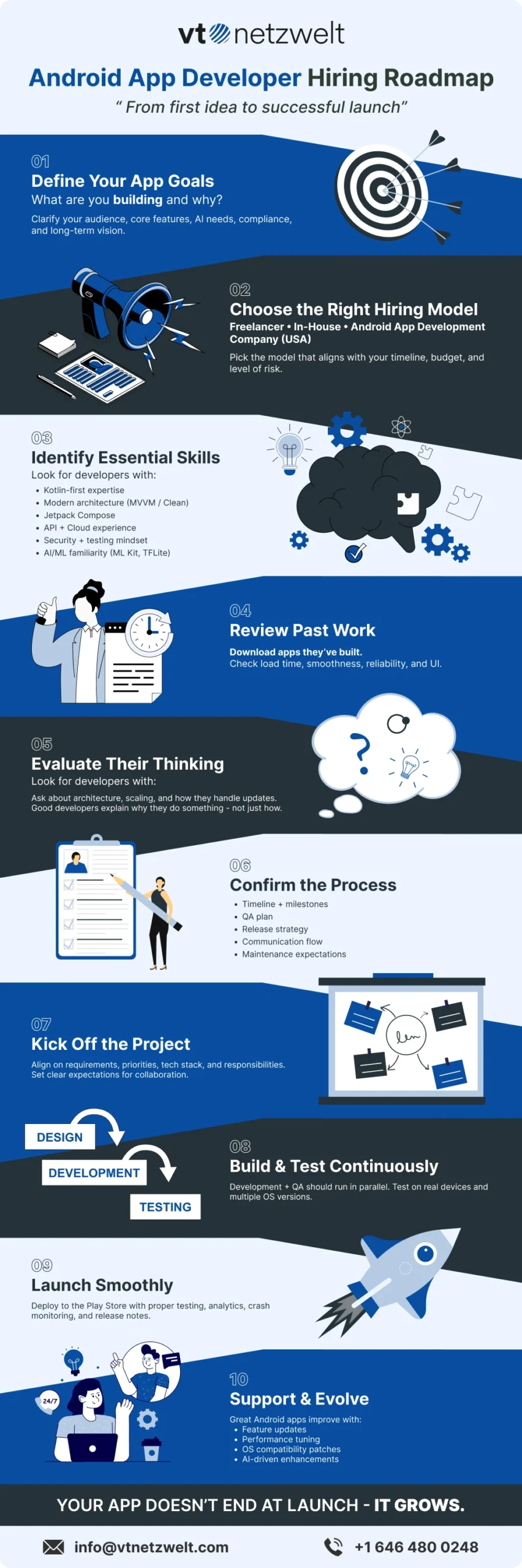
Before Hiring Anyone, Get Clear on What You’re Building
This is where most projects go wrong, not during development, but before it even begins.
Ask yourself a simple question: what role does this app play in your business?
Is it a lightweight utility app? A revenue-driving customer product? Or a platform expected to scale over time?
Once that’s clear, the rest becomes easier. Start outlining:
Who the app is for and how often it will be used
Whether it needs offline access or real-time updates
If it will handle payments, personal data, or sensitive information
Whether AI features like personalization, recommendations, or automation are part of the roadmap
If your app sits in regulated industries like healthcare or fintech, security and compliance aren’t optional. Developers need experience working within those constraints, not learning them mid-project.
Many teams rush this step and start interviewing developers too early. Taking time to define scope, expectations, and future growth doesn’t slow things down. It prevents expensive rewrites and mismatched hires later. This is also the stage where reviewing mobile development strategy or AI-in-mobile insights can help sharpen your requirements before hiring.
What Actually Matters When You Hire Android Developers
Not every Android developer is right for every project. The goal isn’t to find someone who can “get it done,” but someone who can build something that lasts.
At a technical level, modern Android development is Kotlin-first. Developers should be comfortable building new features in Kotlin while still understanding Java for older codebases. This balance matters more than many businesses expect.
How developers structure an app is just as important. Strong Android developers rely on clean architecture patterns like MVVM. This keeps the codebase flexible, easier to test, and far less fragile when requirements change, which they always do.
User experience is another big indicator. Android apps run on an enormous range of devices, so developers need to understand tools like Jetpack Compose and how UI decisions affect performance, accessibility, and battery life. Good UI isn’t just about how the app looks, it’s about how it behaves.
Most Android apps also depend heavily on backend systems. Experience with APIs and cloud platforms such as Firebase, AWS, or Google Cloud is essential. Real-world development means planning for network failures, data syncing issues, and edge cases.
Finally, future-ready skills add long-term value. Developers familiar with ML Kit or TensorFlow Lite can support AI-driven features without hurting performance. Combined with strong security practices like encryption, secure authentication, and awareness of OWASP mobile risks, this is what separates average apps from reliable ones.
How to Evaluate Android Developers Beyond Portfolios
Portfolios are useful, but they don’t tell the full story.
A better approach is to use the apps developers have already built. Download them. Use them. Pay attention to load times, responsiveness, offline behaviour, and battery usage. These details quickly reveal build quality.
During conversations, ask why decisions were made.
Why this architecture?
How are updates handled?
What happens when requirements change?
Developers who can explain trade-offs clearly tend to have real-world experience, not just textbook knowledge.
Soft skills matter just as much. Clear communication, curiosity, and the confidence to question unclear requirements are signs of maturity. You don’t want someone who only executes tasks. You want someone who helps protect your product vision.
Choosing the Right Hiring Model for Your Android App
Once you know what you want to build, the next big decision is how you want to build it.
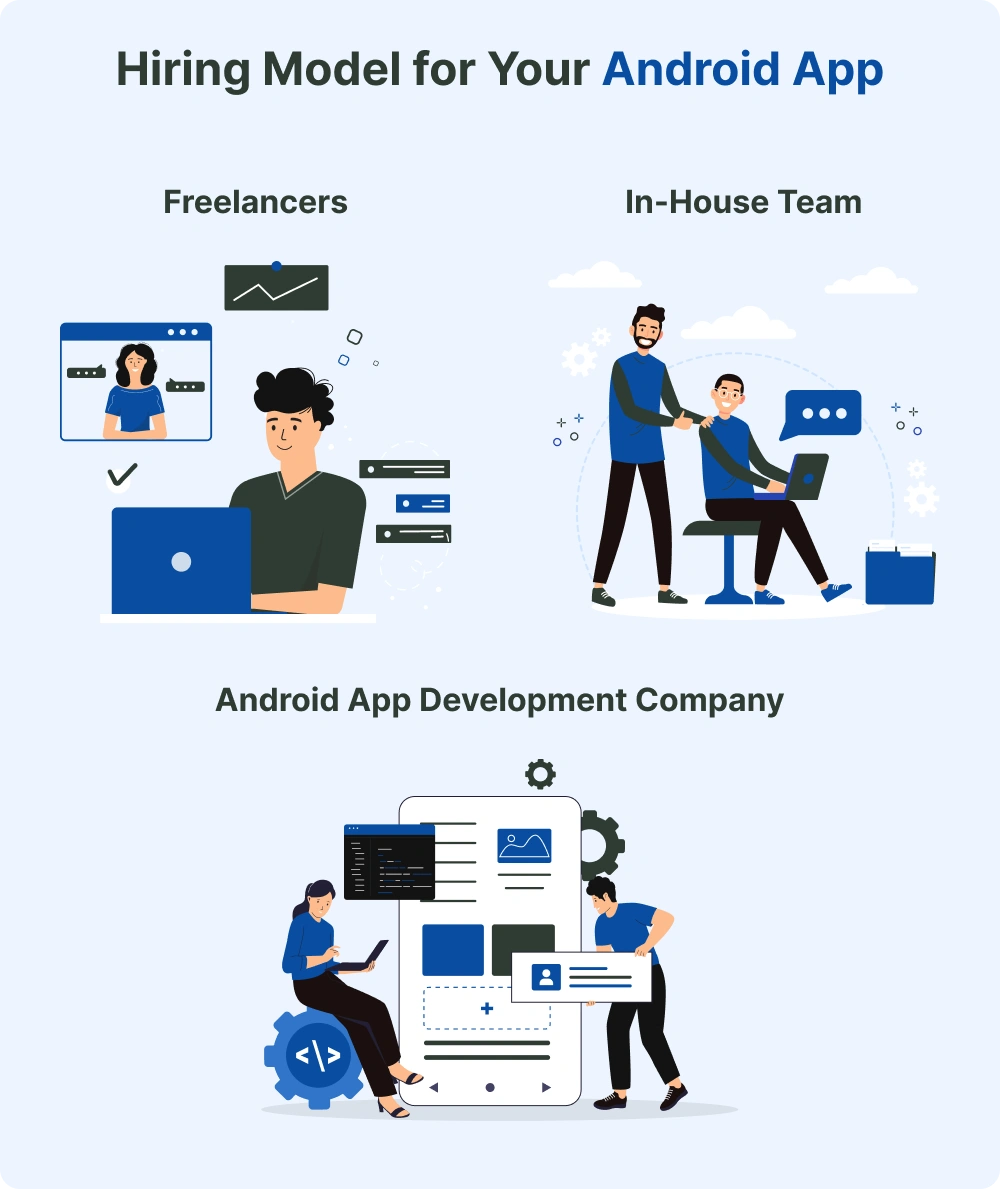
Do you hire Android developers as freelancers? Do you grow an in-house team? Or do you hand the build to a specialist android app development company in USA?
You’re not just choosing a hiring path here. You’re choosing how much risk, responsibility, and control you want to keep on your side.
Freelancers
If you’re building a small utility app or just validating an idea, a freelancer can work well.
You get started quickly.
There’s usually less paperwork and lower upfront cost.
But there are trade-offs you can’t ignore:
One person is handling everything from development, testing, and to sometimes even design.
If they get busy, sick, or move on, your project slows down with them.
Long-term support is often unclear once the “final build” is delivered.
For short-term or low-risk projects, this can be fine. For anything that needs to evolve, it can feel fragile.
In-house team
Bringing developers in-house gives you full control. They live and breathe your product, sit with your team, and can support new releases whenever the roadmap changes.
This makes sense if:
Your app is central to your business model.
You’re building a platform that will keep growing over several years.
But it’s not a light decision:
Salaries, benefits, hardware, and tooling add up.
Hiring the right mix of skills (Android, QA, DevOps, product) takes time.
If one key person leaves, knowledge gaps can slow everything down.
For some companies, that investment is worth it. For others, it’s more overhead than they actually need.
Android App development company
This is where a specialist android app development company in USA often becomes the most practical choice, especially for growth-focused or complex apps.
Instead of hiring one or two people and hoping they can cover everything, you get:
A team of Android developers who already work well together
Designers who understand mobile UX patterns
QA engineers who test on real devices, not just emulators
Project managers and DevOps support to keep releases on track
The upfront investment is higher than a single freelancer, but you’re not gambling on one person. You’re buying a process, a team, and a track record.
This is also what separates a generic build from a well-managed android app development service:
clear communication, predictable delivery, ongoing support, and a product that doesn’t fall apart the moment you ship version one.
How Much Does It Cost to Hire Android Developers in 2025?
Costs vary based on experience, location, and app complexity, but common ranges look like this:
Freelancers: $25–$60 per hour
USA in-house developers: $100K–$150K per year (plus benefits)
Android app development companies in the USA: $30K–$250K+
Pricing is influenced by factors such as AI integration, security requirements, native integrations, and ongoing maintenance. One important rule: avoid cutting costs on architecture, security, or testing. These shortcuts almost always show up later as expensive fixes.
Different Apps Need Different Hiring Approaches
Not all Android apps are built the same, and hiring should reflect that.
Matching the app type to the right hiring model alone prevents many costly mistakes.
What Happens After Hiring Matters Just as Much
When you hire Android developers that fit right, it is only the beginning. Long-term success depends on the process.
Clear documentation, consistent QA across OS versions and devices, analytics-driven improvements, and transparent communication all play a role. The best results come from partnerships designed for continuity.
So… What’s the Smartest Move Here?
Hiring Android developers isn’t just a step in the project plan, it’s the decision that sets the tone for everything that comes after. The right team brings stability, speed, and confidence. The wrong one brings delays, fixes, and frustration. When you take the time to define your app clearly and choose a hiring model that actually fits your goals, the path forward becomes lighter. Your app stops being a gamble and starts becoming something you can genuinely grow.
And that’s the real win, an Android app that feels good to build, good to launch, and even better to scale.
🎙️ Podcast: How to Hire Android Developers Who Build Apps That Scale
Hiring Android developers isn’t just about Kotlin skills or portfolios. This podcast explores what truly matters: architecture choices, hiring models, cost trade-offs, and how to evaluate developers beyond resumes. It’s ideal for founders and product teams planning serious Android app development.
Your Next Android App Deserves the Right Team Behind It
If you’re exploring your options and want to work with an android app development company in USA that understands modern Android development, real-world product challenges, and where mobile is heading with AI, VT Netzwelt can help you make the right start. Sometimes the smartest decision isn’t hiring faster, it’s choosing a partner who helps you build an app you’ll be proud of months from now.
Frequently Asked Questions
Download and test their Play Store apps first, that shows real capability. Ask them to explain past technical decisions and trade-offs. Check if they’ve shipped production apps and handled real incidents. Verify their security practices. Assess communication skills. Finally, pick the right model: freelancers for quick work, in-house for long-term products, or an Android app development company for accountability and compliance expertise.
It depends on your project. Junior developers (0–2 years) work for simple apps and MVPs. Mid-level (2–5 years) handle e-commerce and real-time features, this is the sweet spot. Senior developers (5+ years) manage complex systems, AI features, and regulated compliance. Must-haves in 2025: Kotlin, Jetpack Compose, Firebase/AWS, and security awareness.
Freelancers charge $25–$65/hour depending on experience. In-house hires range from $62K–$89K (junior) to $119K–$170K+ (senior) annually. Android app development services cost $30K–$60K for simple apps, $60K–$150K for medium complexity, and $150K–$500K+ for complex or compliance-heavy projects. Cheaper hires often cost 2–3x more in rework.
The average is $61/hour as of December 2025. Entry-level developers charge around $54/hour, while experienced developers run $70–$78/hour. Senior specialists and those in tech hubs (San Francisco, NYC) command $80–$100+/hour. Rates below $35/hour signal quality concerns; $50–$85/hour is the realistic sweet spot for quality work.
Manmeet Batra is a Mobile App Development Expert who thrives on transforming complex ideas into smooth, high-performing mobile applications. He is driven by the challenge of crafting apps that not only meet user needs but also create meaningful business value.
Building a telehealth app isn’t just coding video calls. It’s about secure, compliant, and user-friendly care platforms. Learn features, costs, and real-world tips to build smarter telemedicine apps.