Choosing the appropriate platform now is like having to choose the engine before assembling a race car. And the wrong one slows things down later on. With evolving mobile app development platforms, businesses must ensure speed, performance, and scalability to balance the business from day one.
In 2026, the landscape remains divided between cross-platform efficiency or native precision. The right decision has a direct impact on time-to-market, hiring, long-term cost and user experience.
Top Mobile Development Platforms to Watch in 2026
The ecosystem has matured; however, there is still a different role for each platform depending on the product goals, team expertise, and performance expectations.
Flutter
Dart runs once, ships everywhere. That is the core idea behind Flutter and in practice it actually holds up. Android, iOS, web, desktop, all covered from a single codebase. Teams that used to maintain separate projects for each platform suddenly find themselves working very differently, and for most of them that shift is a relief.
The rendering approach is what makes Flutter genuinely unusual. It does not touch native UI components. It draws everything through its own Skia engine, which means a button or a scroll animation looks pixel identical on a Galaxy phone, an iPhone, and a browser. Anyone who has chased a layout bug that only shows up on one device knows exactly why that matters.
Hot reload sounds like a small thing. It is not. You adjust something in the UI, it reflects instantly, app state still intact. No rebuild cycle, no waiting. Across a full development timeline that adds up to meaningful time saved.
pub.dev has grown into a properly useful ecosystem at this point. Payments, maps, auth, device integrations, the coverage is solid enough that teams are not starting from scratch on the basics anymore.
The right fit is teams where cross platform visual consistency is a business requirement and fragmenting the engineering team across native codebases is not a viable option.
React Native and Expo
Most product teams already know JavaScript. That one fact explains a lot of why React Native keeps getting picked. The transition from React on the web to React Native on mobile is genuinely smaller than it looks from the outside. Similar patterns, overlapping concepts, familiar syntax. Hiring becomes easier because the talent pool is large. Onboarding moves faster because developers are not starting from zero.
Expo solved a lot of the problems that used to make React Native frustrating to work with. Native configuration headaches, fragile build setups, painful deployment workflows, Expo handles most of that now. Teams get managed builds, OTA deployment, and device testing infrastructure without having to build or maintain any of it themselves. Third party library coverage is wide, especially for analytics, payments, CRMs, and anything API heavy.
The over the air update capability through Expo EAS is worth calling out separately. Bug fixes reach users immediately, no App Store review required. In production environments where issues need resolving in hours not weeks, that is a meaningful operational advantage.
Startups, agencies, teams focused on MVPs and fast iteration cycles, this is generally the framework that makes the most practical sense for them.
Kotlin and Compose Multiplatform
The philosophy here is different from Flutter or React Native. Instead of abstracting everything into one layer, Kotlin Multiplatform takes a targeted approach. Business logic, data models, networking code get shared across platforms. The UI stays native where platform behavior actually matters to users. It sounds like a smaller claim but it is often the more sensible one.
Kotlin is a well designed language and working in it daily makes that obvious. Null safety eliminates entire categories of runtime crashes. Coroutines handle async operations without making the code unreadable. The overall developer experience is better in ways that become more apparent the larger and longer-lived the codebase gets. JetBrains built it, Google endorses it, the long term support picture is as solid as anything in mobile development.
Compose Multiplatform takes Jetpack Compose beyond Android and lets teams share UI components across iOS and desktop while keeping the flexibility to go fully native on any platform where that makes more sense.
For enterprise scale projects with complex domain logic, multi module structures, and teams working across the codebase in parallel, this holds together in ways that more aggressively abstracted frameworks often do not. Experienced teams that want real code reuse without architectural shortcuts will find it fits well.
SwiftUI and Jetpack Compose
Native frameworks, and the results show it. Camera, biometrics, notifications, widgets, health data, all accessible directly without any translation layer sitting between the code and the platform. Whatever Apple or Google shipped in their latest release is available immediately rather than waiting on a third party maintainer to add support for it.
Both animation systems are physics based and capable of the kind of fluid gesture responsive interactions that separate the best apps from the rest. Building those same interactions on a cross platform abstraction is possible in theory but tends to be harder than it should be in practice.
Two platforms means two codebases. That part is unavoidable. Two specialist skillsets, double the QA surface, feature parity overhead across every release. It is a significant ongoing cost and anyone evaluating this path should think through that carefully.
When user experience is genuinely the primary differentiator, when the target audience cares deeply about platform native conventions, and when the budget supports parallel development teams, nothing else achieves the same result. Outside of those conditions the tradeoff rarely makes sense.
.NET MAUI, Uno Platform and the Microsoft Ecosystem
Organisations already on Microsoft infrastructure will recognise why MAUI appeals. C# and .NET 8, one codebase covering mobile, desktop, and web. No language change, no toolchain change, no retraining. Developers already working in .NET can contribute to cross platform mobile projects without a significant ramp up period.
Azure connects naturally throughout. Cloud services, serverless, Active Directory, enterprise data pipelines, they integrate cleanly because the whole stack was designed to work together. Uno Platform pushes the reach further still, covering WebAssembly and embedded targets without requiring teams to step outside .NET at any point.
Internal enterprise tooling is where this stack performs at its best. Field service apps, operations dashboards, line of business tools where Microsoft stack cohesion and developer familiarity matter more than expressive UI capabilities. For those contexts it is a strong and low friction option.
Consumer facing products competing on design experience are not really the target here. But that is a relatively narrow slice of what enterprise development teams spend most of their time building.
Unity
Unity belongs in a separate category from everything else on this list. It is a real time 3D engine capable of running AAA console titles that also operates efficiently on mid range mobile hardware. Comparing it to general app development frameworks is not really meaningful because the use cases barely overlap.
Physics engine, particle systems, animation tooling, all of it is built specifically for interactive immersive experiences. The visual fidelity accessible through Unity is not something standard mobile frameworks can approach architecturally. Deployment covers iOS, Android, Windows, macOS, PlayStation, Xbox, WebGL, and XR platforms from a single project without separate codebases for each distribution channel.
AR and VR support is production ready. ARKit, ARCore, Meta SDK, and OpenXR integrations are all native. Studios and companies already building in Unity are reasonably well positioned as spatial computing continues to develop.
Games, AR experiences, industrial simulations, interactive 3D training, Unity is the clear choice for all of it. For a standard business application or any kind of data driven interface, it is simply the wrong tool and that does not change regardless of how the project is scoped.
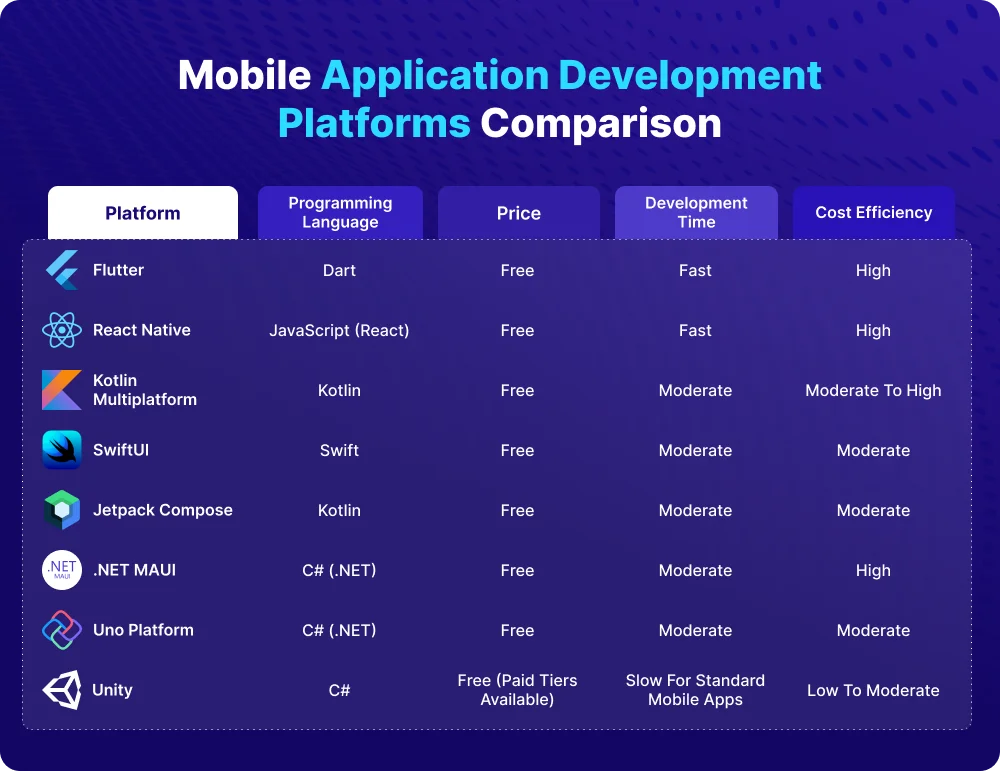
Mobile Application Development Platforms Comparison
Conclusion
There is no winner in this day and age of mobile app development platforms. Flutter stands out in terms of UI shot-driven cross-platform apps, and Kotlin Multilateral is on the way up for distributed logic with performance. Native stacks are all on-chip power performance in terms of platform first experiences.
If you are looking to build a high-performing app on the right foundation, then partnering with a mobile app development company in the USA can help you avoid costly missteps while speeding up your journey.
Why Moving to the Right Platform of Mobile Application Development is Critical in 2026?
The platform that you use influences everything after that. It determines how fast you are able to launch, how well your app performs, and how easily your apps are able to scale. This puts the impact on the hiring costs, maintenance effort, and the overall user experience.
Modern development is under the influence of cross-platform frameworks, tools for AI assistance and changing native architectures. For US businesses, the way to be competitive is faster with little or no sacrifice to quality.
🎧The Platform Decision That Defines Your App’s Success
Choosing a mobile app platform isn’t just technical, it shapes how your app performs and scales.
In this episode, we break down Flutter, React Native, and native approaches to help you make the right call for 2026.
Choose the right platforms for High-Performance Apps
Choosing the right platform is only the first step toward building a successful mobile product. With our mobile app development services, we help businesses select the right framework, optimise performance, and create scalable apps that are built for long-term growth across iOS and Android.
Whether you are planning a new MVP, upgrading an existing app, or launching a feature-rich mobile solution, the right development strategy can save significant time, cost, and future rework. Schedule a meeting with our team or contact us today to discuss the best-fit platform, architecture, and roadmap for your app idea.
Frequently Asked Questions (FAQs)
The best ones are Flutter, React Native, Kotlin Multiplatform and native, such as swift UI and Jetpack Compose. These mobile app development platforms combine performance, scalability, and development rate depending upon your needs.
Startups from the US region tend to prefer React Native or Flutter because of faster development and lower cost. These are fairly regarded as the optimal mobile development platform selection when it comes to building and testing MVPs in a short duration of time.
Choose depending on how complex your app is, your budget and timeline and performance needs are. Consulting mobile app development company in usa can help to align the platform with your long run business goals.
Low-code platforms are fine for relatively simple apps and internal tools, but can sometimes be insufficient to handle more complicated products. For scalable solutions professional mobile app development services are often more suitable.
Jetpack Compose with Kotlin is the best in android because of the native integration and deeper integration. It’s desirable where performance and platform-dependent functionality is important.
SwiftUI is the prime option for iOS app development and provides perfect integration with the apple’s ecosystem. It ensures high performance and the possibility of accessing the latest iOS features.
Manmeet Batra is a Mobile App Development Expert who thrives on transforming complex ideas into smooth, high-performing mobile applications. He is driven by the challenge of crafting apps that not only meet user needs but also create meaningful business value.