- B2B and B2C capabilities in harmony
- Seamless connections with ERP, CRM and PIM
- Flexibility for global operations
- Rapid development and deployment with control
Enterprise commerce choices don't go wrong due to features. They fail because the platform isn't a fit given the way the business works.
When considering adobe commerce vs shopify, teams focus first on features and cost, but really it's all about control, scalability and total cost of ownership. Here's how to compare the two of them as a team would in 2016.
Today, enterprise commerce isn't about commerce at all. It is about system integration, big data and customer experience. Today, enterprise customers expect:
An enterprise ecommerce platform is not the best because of what it does. It's the one that fits your internal processes and model of growth under the adobe commerce development services.
Each of these platforms has its own philosophy, and both work for enterprise clients. One is designed for control, and the other is to be swift.
Adobe Commerce upfits for businesses looking for customisation and control. It is suited for businesses with intricate catalogues, business processes, and connections. Key strengths:
These are the reasons why Shopify Plus vs Adobe Commerce debates favour Adobe for the enterprise sector.
Shopify Plus is focused on simplicity, speed and hosting. It includes quick launch and low maintenance. Key strengths:
When it comes to adobe commerce vs shopify, Shopify Plus is simpler to operate.
The table below shows enterprise teams how the teams assess the common factors in real use cases. It's more about the operational and financial effects, rather than just the feature set.
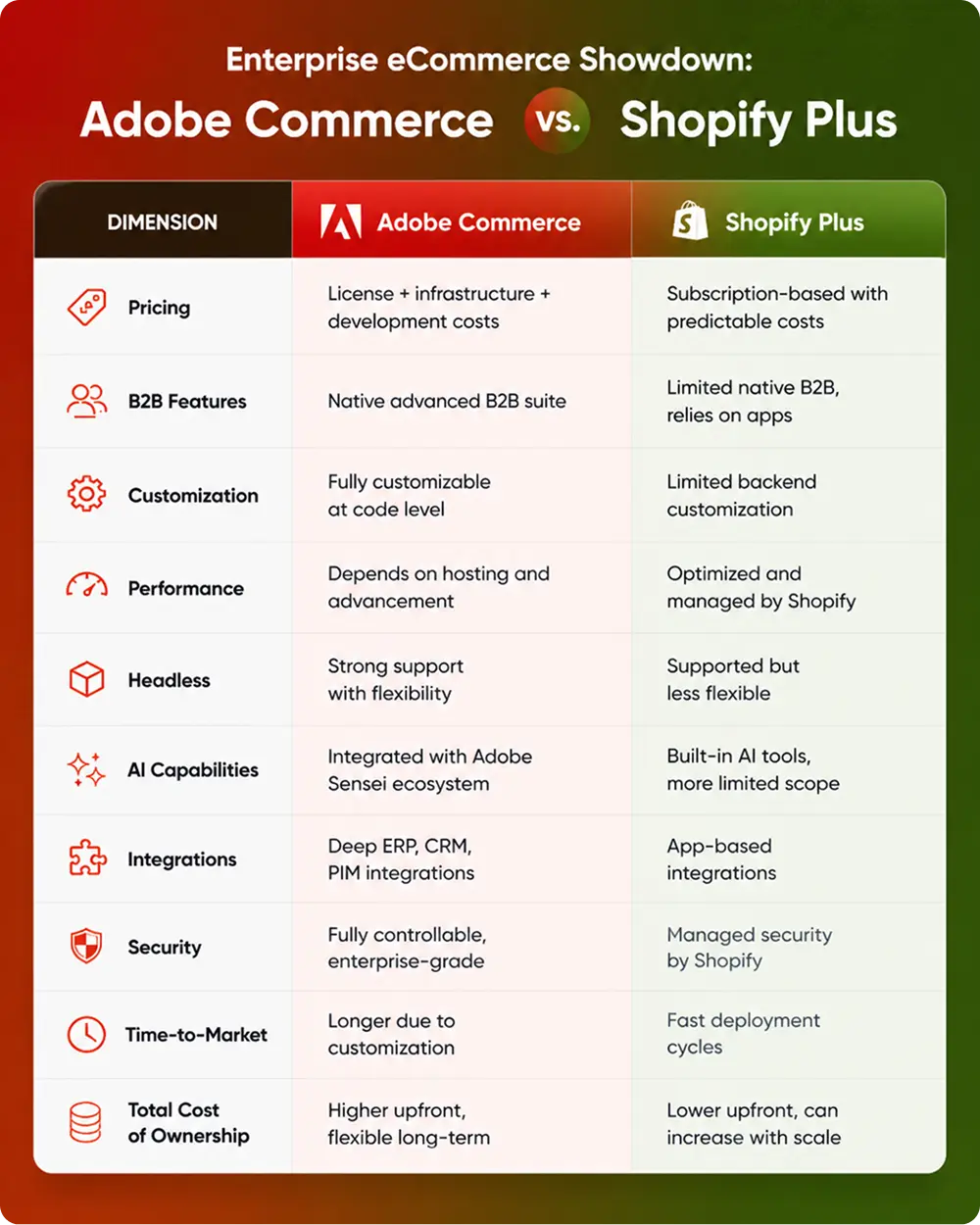
It's key to the shopify plus vs adobe commerce decision-making process.
Customization is how and how much you grow. It also sets how much customization your employees can make.
No longer is B2B an option. It's now an imperative for enterprise retailers.Adobe Commerce comes with built-in B2B capabilities such as company accounts with hierarchical structures, custom catalogs and pricing, and a structured quoting and approval workflow. These features allow businesses to manage complex relationships and transactions without relying on external tools.
With Shopify Plus, similar B2B functionality often requires third-party apps and additional setup. For more advanced or complex needs, custom development is usually needed, which can add to both time and operational effort. This is one of the issues evident when determining the best enterprise ecommerce platform for a hybrid B2B or B2C model.
Speed impacts revenue, capacity impacts business. The approach to this is different. Adobe Commerce scales based on how well the underlying infrastructure is planned and managed. It requires technical expertise to maintain performance, but it handles complex catalogues and large product structures with ease when set up correctly.
Shopify Plus auto-scales with demand, making it reliable during traffic spikes without requiring hands-on management. It efficiently handles high traffic volumes, though it offers less control over the underlying infrastructure. The shopify plus vs adobe commerce war boils down to "great power or great ease".
Start-up cost is only a part of the cost. It's important to consider ongoing operational costs. Adobe Commerce typically requires a higher upfront investment, especially for development and infrastructure. However, it offers greater flexibility over time, with fewer built-in limitations and costs that scale based on the complexity of your business.
Shopify Plus has a lower entry cost and predictable monthly pricing, which makes it easier to budget initially. As the business grows, additional expenses can come from apps, integrations, and scaling requirements.It's important to look past year one in selecting the best enterprise ecommerce platform 2026.
There is no one-size-fits-all solution when choosing an enterprise ecommerce platform. The right choice depends on your business model, operational complexity, and long-term goals.
Adobe Commerce is a strong fit if you deal with complex requirements, run advanced B2B use cases, or need full control over your architecture. It allows you to shape the platform around your business rather than adjusting your business to the platform.
Shopify Plus works well if you prioritize fast deployment, prefer a managed service, and operate with relatively standard workflows. In the end, when it comes to shopify plus vs adobe commerce, the answer always depends on what your business truly needs.
Migration isn't technical, operations and strategy.When planning a migration, businesses need to ensure a smooth transfer of products, orders, and customer data while rebuilding customized workflows and processes. It is also critical to preserve SEO rankings through proper URL mapping and to onboard teams effectively on the new system.
At the same time, there are risks to account for, such as temporary performance dips during transition and longer development timelines. Integration with existing applications can also present challenges, especially if systems are deeply interconnected. Businesses only start the adobe commerce vs shopify debate when they reach limitations with Shopify.
Use cases show what comparisons do not. They reveal how platforms behave under real operational pressure.
The Petmate B2B implementation on Adobe Commerce highlights how complex enterprise requirements can be translated into scalable systems. It required:
Managed complex B2B operations with custom distributor pricing and multi-level account structures in one system. Delivered tailored buyer workflows with scalable catalog management for growing product lines. Integrated seamlessly with existing back-end systems to ensure smooth data flow and operations
This level of business is never a one-size-fits-all when it comes to Shopify Plus, and that's why decision making progresses throughout the scale of your business. With our services, you can also hire adobe commerce developers in New York as well.
What makes the difference is the way you run your business. If you need flexibility, customisation and multiple workflows in your growth, you'll have control with Adobe Commerce.
If simplicity, predictability and speed are important to you, then Shopify Plus will help to scale your business. Ultimately, the choice to go with Adobe Commerce vs Shopify comes down to control.

Choosing an ecommerce platform isn’t just about features. It’s about how your business actually runs.
In this episode, we break down Adobe Commerce vs Shopify Plus from a real enterprise perspective, including control, scalability, integrations, and total cost of ownership.
We also talk about where businesses usually get this decision wrong and what to evaluate before you commit.

Get clarity on your architecture, integrations, and growth roadmap without guesswork. A focused review of your business helps you choose the right path in adobe commerce vs shopify.
Connect with VT Netzwelt to discuss your requirements and next steps. Our team will guide you with practical insights tailored to your business.
Adobe Commerce is highly customizable and offers a high degree of control, whereas Shopify Plus is fast and easy to use. It’s a factor of complexity and in-house know-how.
Adobe Commerce is better for B2B as it has built-in features such as custom pricing and workflows. Shopify Plus may need apps to achieve this.
Shopify Plus is cheaper initially, but can be costly over time if scaling with apps. Adobe Commerce has higher upfront costs, but is flexible.
Yes, Shopify Plus can easily handle spikes in traffic with its hosting. Adobe Commerce is suitable for bigger brands.
Yes, Adobe Commerce is very flexible for headless. It has complete options and architecture.

Are You Prepared for Digital Transformation?
Adobe Commerce Development
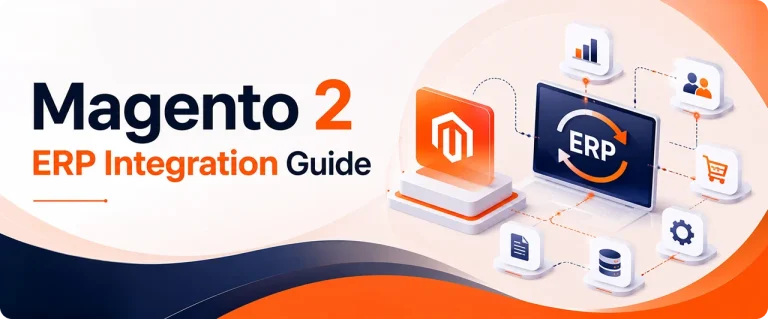
A practical guide to Magento 2 ERP integration for growing brands. Compare connectors, middleware, and custom builds. See real results from our Oracle ERP project.
Adobe Commerce Development
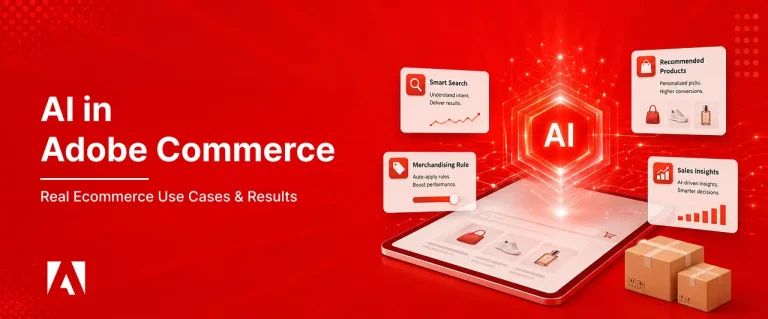
See how Adobe Sensei and AI in Adobe Commerce improve personalization, search, merchandising, and ROI with real US use cases, costs, and results.

eCommerce
Slow Magento store killing sales? See how Hyvä theme boosts speed, Core Web Vitals, and conversions in this guide.