Then someone asks one awkward question: who pays for the first thousand rides?
That question sinks more ride sharing business ideas than any competitor ever will. Get a good answer, though, and there's still real room in the US market for a new player. Let's find yours.
Quick answer. The strongest ride sharing business ideas right now sit in niches where an institution pays: Medicaid medical rides (NEMT), school transport, senior rides, microtransit for cities and employer shuttles. Consumer niches like intercity, airport, pet and campus rides can work with a tight local launch. Taking on Uber, Lyft and robotaxis in everyday city rides is the one move we'd talk you out of.
The one question every ride sharing business idea must answer
First, a reality check on who you're up against.
Uber handled 3.9 billion trips and had 208 million monthly active users in Q2 2026 alone (Uber Q2 2026 results)
Lyft posted a record 262 million rides in the same quarter (Lyft Q2 2026 results)
Intimidating? Sure. But look at what those networks are built for: fast, anonymous, one-off city trips.
Now think about a dialysis patient who needs the same ride three times a week. A 9-year-old who needs a vetted driver. A county that can't afford a bus route. Those riders don't shop for the cheapest fare, and the bill often goes to a school district, a health plan or an employer.
That's your opening.
Heads-up. The big apps keep turning startup pitches into features. Uber Women Preferences went nationwide in the US in March 2026. If your idea could be a toggle inside the Uber app, assume it will become one.
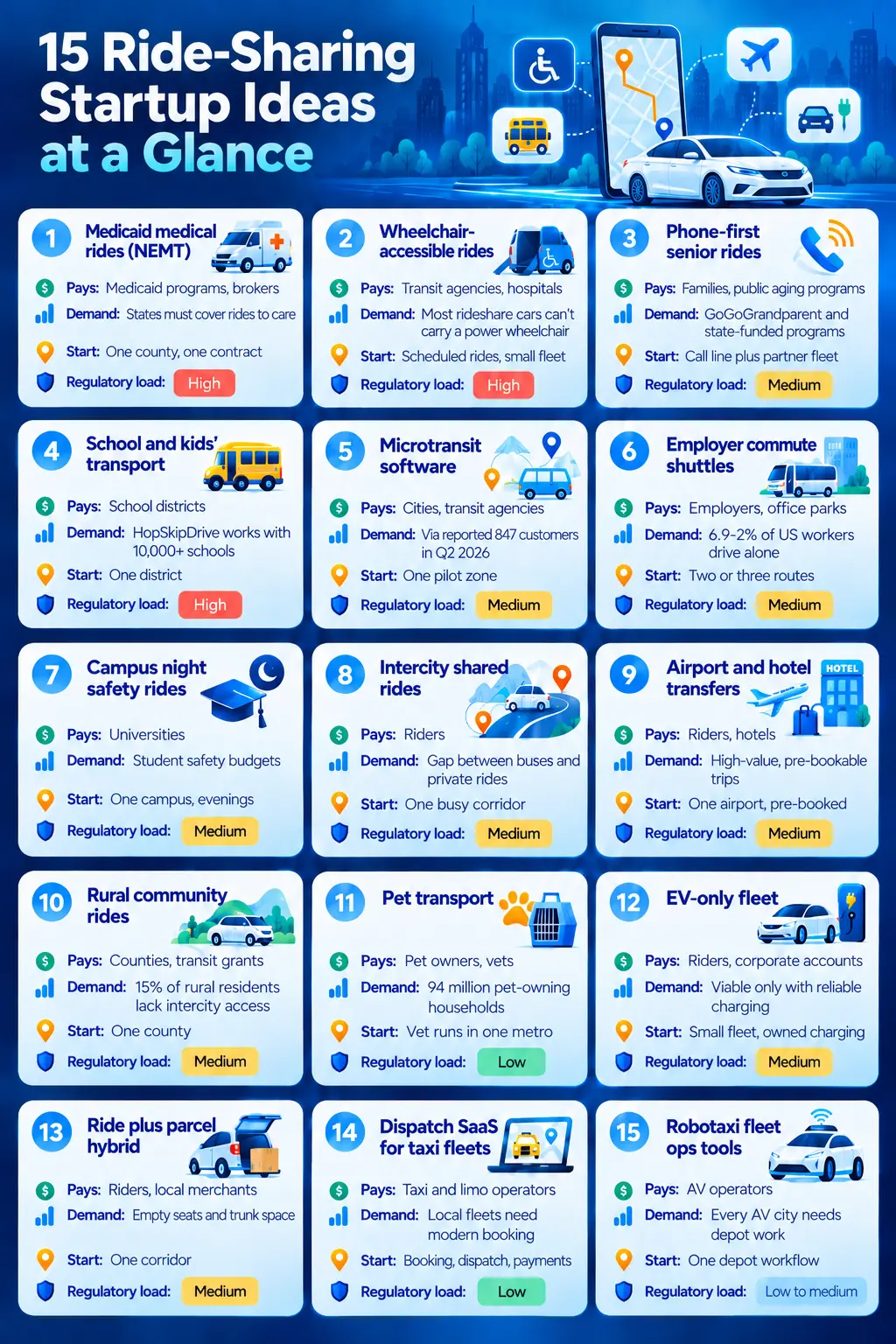
15 ride sharing startup ideas at a glance
Shortlist here first. "Regulatory load" is our rough read of the licensing and vetting work between you and your first paid ride.
Some of these look boring on paper. Boring is good. Boring usually means someone has a budget for it.
Healthcare rides where reliability matters more than price
Here's where generic apps struggle most. These rideshare business ideas serve riders who need more than a car, and that extra care is your moat.
Medical rides that Medicaid pays for (NEMT)
A missed ride here means missed treatment. 5.8 million people in the US delayed medical care in 2017 because they had no way to get there (American Journal of Public Health).
Who pays: state Medicaid programs, which must make sure members can get to covered care (CMS NEMT resources)
The opening: dependable local transport providers and better scheduling tools for brokers and health systems
What to build: standing orders for recurring trips, trip verification, driver credential tracking, audit-ready logs
Watch out: thin per-trip rates and slow payments
Start with: one county and one broker or health system contract, running scheduled trips first
Even big players get squeezed. Modivcare, a major NEMT company, filed for Chapter 11 in August 2025, pointing to labor cost inflation and declining state Medicaid reimbursements. Model your cash flow before you sign anything.
Rides for wheelchair users
Try booking a rideshare for a power wheelchair user and you'll see the gap fast. ADA paratransit exists, but riders often have to book a day ahead.
Who pays: transit agencies, hospitals, senior living communities
What to build: booking that records each rider's mobility needs (chair type, ramp or lift), dispatch that matches trips to the right vehicle, and live updates for riders and caregivers
Watch out: accessible vans cost more to buy and run, and every driver needs proper wheelchair securement training
Start with: scheduled trips and a small van fleet. Full on-demand service needs more vehicles than most early budgets allow.
Reliability is the whole product here. A late pickup can mean a missed treatment, and agencies remember who let their riders down.
Rides seniors can book with a phone call
Not everyone wants an app. Plenty of older adults would much rather pick up the phone, and GoGoGrandparent built a service around exactly that.
Proof that public money follows: in September 2025, New York State expanded free GoGoGrandparent rides for adults 60 and over in five Hudson Valley counties
Who pays: families paying for the service, and public programs for older adults
What to build: a call-handling tool, a dispatcher dashboard and a billing layer. The rider might only ever see a phone number.
Watch out: trust is earned slowly with this audience, so a friendly human voice and clear prices matter more than app polish
Start with: one metro, one phone line and an existing driver network behind it
Rides that schools, cities and employers pay for
Healthcare rides lean on public budgets. The next group leans on institutional ones, and those come with something rideshare rarely gets: multi-year contracts.
Safe rides for kids and students
Districts still have to get students with special needs to school, whether or not a bus route covers them.
Who pays: school districts, under service contracts
What to build: driver credential tracking, trip approval for district staff, live tracking and alerts for parents and schools
Watch out: districts buy on yearly budget cycles, so expect long sales and a pilot before any big contract
Why it's defensible: all that compliance keeps casual competitors out
Start with: special-needs routes in one district
On-demand transit for small cities and towns
Do cities pay for on-demand transit? Ask Via. It went public in September 2025, earns over 90% of its revenue from government customers and reported 847 customers in Q2 2026.
Smaller cities, campuses and airports still need affordable options. Your call is how much you take on.
Model
Upside
Downside
Software only
Better margins, easier to scale
Agency must find vehicles and drivers
Software plus operations
Wins more small-town contracts
Capital-heavy, harder to staff
Who pays: city and county transit agencies, campuses, airports
What to build: zone-based booking, ride pooling, accessible vehicle support and ridership reports an agency can show its board
Watch out: public buying is slow and paperwork-heavy
Start with: one pilot zone, with success measures agreed before launch
Shuttles that get employees to work
69.2% of US workers drive alone, and 9.3% spend an hour or more getting to work each way (Census Bureau, 2024 American Community Survey). Employers pushing return-to-office, and sites running shift work, have every reason to fix that.
What the buyer wants to see in your app:
On-time performance by route
Seat utilization and cost per employee
Driver vetting records and incident logs
Live tracking and seat booking for staff
Watch out: routes live and die by shift times. One schedule change at the client can empty a shuttle overnight, so stay close to their HR or facilities team.
Start with: two or three fixed routes for one large employer.
Safe late-night rides on college campuses
Women-only ride apps get pitched a lot. In the US they raise questions under anti-discrimination rules, which helps explain why Uber built Women Preferences as an option inside its main app.
So here's a sharper angle: a university-funded night safety service.
Who pays: the university, through safety or student services budgets, so students never see surge pricing
What to build: student ID login, verified drivers, safe-walk handoffs and campus police integration
Watch out: demand drops during breaks and summer, so price the contract for the full academic year
Start with: one campus, evening hours only
Trips the big ride apps don't serve well
So far, institutions have been paying. These next four sell to riders directly, which is harder. They work when the trip itself is awkward for an on-demand network to serve well.
Shared rides between nearby cities
Trips between nearby cities sit in an awkward middle. A private ride is pricey, and the bus schedule rarely fits.
Who pays: riders, per seat
What to build: fixed departures, seat booking, set pickup points and space for luggage notes
Watch out: one-way demand. Friday trips out and Sunday trips back can leave cars driving empty the other way.
Good first corridors: two college towns, or a state capital and its nearest big metro
Start with: one route. Win it before you add a second.
Pre-booked airport and hotel rides
High-value trips that people happily book in advance. One catch: curb access.
Who pays: travelers, plus hotels and travel agents booking for their guests
What to build: flight tracking to adjust pickup times, clear meeting-point details and fixed upfront prices
Watch out: flight delays scramble your schedule, so build buffers into every driver's day
How to launch it:
Talk to the airport's ground transportation office first. Pickup zones usually need permits and fees.
Launch pre-booked only, at a single airport.
Add hotel concierges and travel agents as booking channels.
Rides for rural areas the bus never reaches
About 15% of rural residents lacked reasonable access to intercity transportation in 2021, according to the Bureau of Transportation Statistics.
Fares alone rarely cover rural trips. This works when public money fills the gap and your software makes every trip count.
Who pays: counties and transit agencies, through public transit budgets or grants
What to build: pooled, scheduled rides for medical visits, groceries and work, phone booking for riders without smartphones, and reports for funders
Watch out: long distances and few riders per trip make every ride expensive
Start with: one county and a few fixed service days each week
Pet rides beyond "bring my dog along"
Back to our dog owners. 94 million US households own a pet (American Pet Products Association), but a casual "bring my dog along" option is easy for big apps to bolt on. The specialist work is harder to copy:
Vet and emergency vet runs with crates and trained drivers
Recurring groomer and daycare pickups sold as subscriptions
Long-distance pet moves for relocating families
Who pays: pet owners, plus vets and groomers who book for their clients.
What to build: pet profiles (size, crate needs, temperament), pet-trained drivers and photo updates during the trip.
Watch out: cleaning time between trips eats into every vehicle's working hours. Start with: vet and groomer runs in one metro.
Behind-the-scenes ideas for fleets and EVs
Want to skip the hardest part of rideshare, which is finding riders? These ride sharing startup ideas never put a passenger in your car. You sell to the people who do.
Who pays: riders, plus corporate accounts that want electric trips
What to build: dispatch that knows each car's battery level and the nearest free charger. Our EV ride hailing dispatch guide shows how, with simulation results.
Watch out: cold weather and charging queues both cut into the hours each car can earn
Start with: a small fleet based near chargers you control
Only go EV-only with guaranteed charging, owned or under contract. Public chargers alone turn utilization into a guessing game.
Rides that also carry parcels
Every empty seat and trunk is the capacity you've already paid for. Why not fill it?
Who pays: riders per seat, and local shops per delivery
What to build: one booking flow for seats and parcels, photo proof of delivery and routes that work for both
Local play: pair passenger trips with parcel runs for pharmacies, florists and auto parts shops along fixed corridors
Watch out: parcels must never delay passengers, so set firm limits on detours
Start with: one corridor and a handful of regular shop customers
Booking software for local taxi companies
If a local taxi or limo operator still takes bookings by phone, they're your customer. Even Lyft sees value in taxi supply: it expanded its partnership with taxi app Curb to New York City in 2026.
Who pays: taxi, limo and NEMT operators. A monthly fee per vehicle is simple for them to budget.
What to build: booking app, driver app, payments, corporate accounts
Charge more with:AI taxi dispatch software features like demand forecasting and smarter driver matching
Watch out: owners used to phone dispatch need hands-on onboarding, and so do their drivers
Why it's lower risk: no cars and no drivers on your payroll
Start with: one operator, then build the features they ask for most
Software for the work robotaxis still need
Here's the twist. Robotaxis remove the driver, but they still need people. Someone has to clean, charge, inspect and reposition every vehicle. Lyft says its 80,000 sq ft AV depot is due to open in October 2026.
That makes depot software a quiet B2B opening that grows with every new robotaxi city.
Who pays: robotaxi operators and the fleet partners running their depots
What to build: depot scheduling, cleaning checklists, damage reports with photos and charging queues
Watch out: there are few buyers, each one large, so expect long sales cycles
Start with: one workflow, such as cleaning and damage checks, at one depot
Which of these ideas fits you best?
You don't need the "best" idea on this list. You need the one that fits what you already have.
If you have...
Look at
Why it fits
Healthcare or caregiving experience
Medical rides, wheelchair rides, senior rides
You already speak the language of clinics, brokers and families
A knack for B2B sales
School rides, employee shuttles, campus rides
These contracts get won across a table, one meeting at a time
Owning cars and employing drivers makes expansion expensive
Run these numbers before you build anything
Every idea on this list lives or dies on a handful of numbers. Get rough answers to these five before you spend a dollar on an app.
Revenue per trip or contract. What will your payer pay, and is it per ride, per hour or a flat monthly fee?
Trips per vehicle per hour. Empty driving is where rideshare margins quietly disappear.
Driver cost per hour. Count onboarding, screening and any local pay rules, too.
Days to get paid. Agencies and health plans can pay slowly, so plan cash for the gap.
Cost to win one customer. Winning one school district and winning a thousand app downloads are very different bills.
If the numbers don't work in a spreadsheet, they won't work in an app.
How to start a ride sharing business in the US
Picked a niche? Good. Here's how to start a ride sharing business without wasting your first year. Rules vary by state, but the order of work rarely changes.
Name your payer. Who pays for ride one, and ride one thousand?
Choose your model. A transportation network company (TNC) connects riders with drivers using their own cars. Owned fleets, NEMT and charter services follow different rules.
Get licensed. California, for example, requires a CPUC permit for TNCs. Cities and airports often add their own.
Insure every trip period. Under the NAIC model most states follow, coverage runs at least 50,000/100,000/$25,000 while a driver waits for a request, and $1 million liability once a ride is accepted (NAIC).
Plan driver classification. Massachusetts certified the first rideshare drivers' union in the US in May 2026, and the US Department of Labor proposed a new independent contractor rule in February 2026. Bring in employment counsel early.
Set up vetting. Background checks, driving records and vehicle inspections, plus extra screening for niches like school or medical rides.
Launch one market. One city, one corridor or one contract. Prove it there.
Recruit drivers before riders. Supply is the bottleneck in nearly every niche.
We're not lawyers, and licensing rules change often. Use this as a planning checklist and confirm the details with counsel in your launch state.
Should you build, buy or white-label your app?
This is where most founders overspend. The right path depends on where your edge lives: in the software, or in the market.
Route
Planning cost
Time to launch
Pick it when
White-label
About $15,000 to $90,000 over three years
2 to 8 weeks
Your edge is local supply and contracts
Custom MVP
About $60,000 to $150,000
4 to 5 months
Your dispatch, pricing or compliance logic is the product
Enterprise platform
$150,000 to $500,000+
8 to 12 months
You're running multiple markets with complex billing
Ranges from our ride hailing app development guide. Treat them as planning numbers. Your feature list and integrations will move the final figure
What building an EV charging app taught us about launching small
Our Ambare-e project sits right next door to ride-hailing, and it taught us lessons every ride app founder should hear.
Client: a Brazil-based EV charging network
The problem: chargers ran custom firmware with unreliable connections, and three charger types (home, apartment and public) each needed their own access rules and pricing
What we built: a Flutter driver app on AWS (API Gateway, Lambda, Cognito, IoT Core over MQTT, DynamoDB) with Stripe payments, supporting Bluetooth, Wi-Fi and QR connections, live availability, remote start and stop, and scheduling
Published result: drivers no longer lose 10 to 15 minutes hunting for a charger
What this means for your ride app:
Design for bad connectivity from day one
Treat access rules and pricing as settings you can change, because every contract will want its own
Podcast: How to Build a Ride Sharing Business With Real Customer Demand
What if the next successful ride sharing business isn't another Uber? In this episode, we explore 15 ride sharing business ideas for US entrepreneurs, from medical transportation and senior rides to airport transfers, EV fleets, and AI-powered taxi dispatch. Discover niche opportunities where startups can meet real transportation needs.
We also discuss what it takes to turn an idea into a viable business, including startup costs, licensing, revenue models, and app development options. Whether you're launching your first venture or exploring new mobility services, learn how to choose the right niche, find paying customers, and start small.
Your next step toward a ride sharing business
Remember the dog owners? Their idea wasn't bad. It just started with the wrong question.
The ride sharing business ideas that last serve trips that are recurring, regulated or awkward. And they bill someone who values reliability over the cheapest fare.
So keep it simple:
Pick one niche, one market and one buyer
Talk to that buyer before you write a line of code
Build the smallest product that gets their rides there on time
Want a second opinion on your idea, the numbers or the build? Our automotive and mobility software team is happy to talk it through.
Contract-funded niches tend to hold up best: NEMT, school transport, microtransit software and employer shuttles. Institutions pay on multi-year deals, so you skip the fare war. Margins still depend on tight operations.
Pick a niche and a paying customer first. Then get your state permit and trip-period insurance, choose your software, vet drivers and launch in one market. Our step-by-step checklist covers the order.
Roughly $15,000 to $90,000 over three years for white-label, or $60,000 to $150,000 for a custom MVP. Multi-market enterprise platforms often run $150,000 to $500,000 or more.
In everyday city rides, almost never. In niches, yes. Small startups win on trips the giants handle poorly: recurring medical rides, vetted rides for kids, rural trips and contract shuttles. The same “go narrow” thinking runs through our mobile app ideas for startups list.
All four, for different reasons:
NEMT: reliable local providers are hard to find, and margins are thin
Corporate: mid-size employers have few commute options built for them
Airport: high-value and pre-bookable, though curb permits take work
Rural: about 15% of rural residents lacked reasonable intercity transport access in 2021
White-label if your edge is local supply and contracts. Custom if your dispatch, pricing or compliance logic is the product. Many founders start white-label, then rebuild once volume justifies it. Our AI vs rule-based dispatch comparison helps you judge when smarter dispatch is worth paying for.
Usually a state TNC permit (or a taxi, charter or NEMT license, depending on your model), any city and airport permits, and commercial ride-sharing insurance for each trip period. NEMT adds Medicaid driver and provider requirements. Confirm the specifics with counsel in your state.
Gurpreet Singh is a seasoned Software Professional with over 16 years of experience in project planning, software development, and delivering complex web and mobile applications using Agile methodologies. He has extensive experience with Scrum and Kanban across eCommerce, Healthcare, Event Management, and Ride Aggregation domains, along with expertise in client interaction, requirement gathering, invoicing, project planning, and solution design. Gurpreet is proficient in Node.js, PHP, Python, JavaScript, MySQL, MariaDB, and MongoDB, with hands-on experience integrating third-party APIs, developing API endpoints, and designing AWS-based microservices architectures.
See where AI improves ride-hailing dispatch, pricing and forecasting, where deterministic rules belong, and how to add guardrails, audits and human override.
Discover how EV ride hailing dispatch software uses battery data, live charger availability and trip-fit checks to reduce downtime and improve fleet utilization.
Design one app that feels native on iOS and Android. Compare navigation, gestures, design systems, Flutter and React Native, then use the launch checklist.