A driver drops a rider at the airport with 22 percent battery. The next offer is a 31-mile run downtown. She takes it, because declines hurt her acceptance rate, then spends the drive guessing which fast charger near the dropoff will still have a free stall.
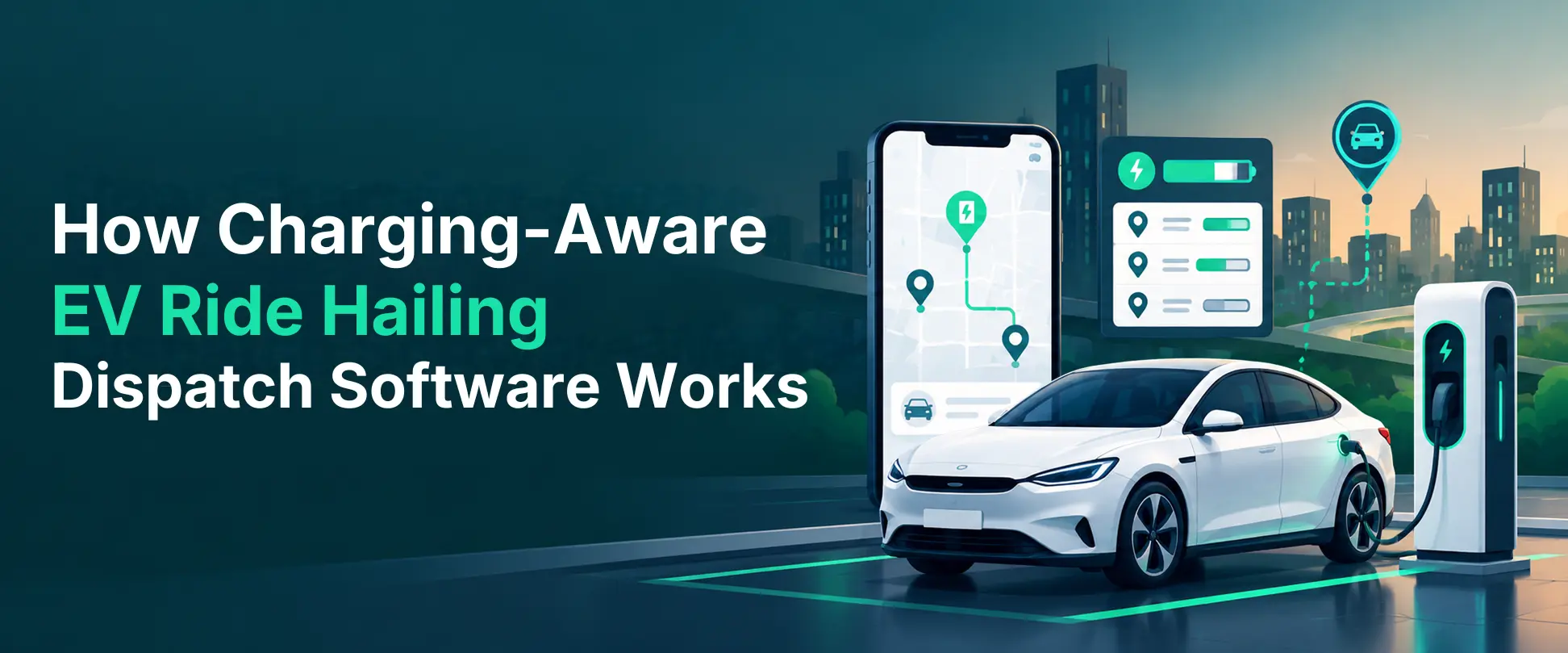
That guess is what EV ride hailing dispatch software should take off her hands. Charging-aware dispatch checks each trip offer against the car's battery, a safety buffer and live charger status near the dropoff. Then it sends the trip, pairs it with a charging stop, or hands it to a car with more charge.
Uber put a spotlight on the problem on September 23, 2026, when it said it is developing Battery-Aware Matching for its driver app. Operators running their own fleets need the same logic, and they have to build or buy it themselves.
Quick answer. Charging-aware dispatch is a matching layer that treats battery level and charger availability as constraints on every trip offer.
It runs on five inputs: live state of charge, a range buffer adjusted for conditions, real-time charger status, predicted wait at each charger, and the driver's own charging preferences. Build it in stages and start with reliable battery data, because every later decision depends on it.
What charging-aware EV ride hailing dispatch software does
Conventional dispatch matches a rider to the closest suitable car and optimizes for pickup time. Fuel barely registers, since a gas car refuels in five minutes on almost any corner.
EVs break that assumption. A fast charge takes 20 minutes to well over an hour, chargers cluster in some neighborhoods and skip others, and a stall that looked free at trip start can be taken by arrival.
So every match picks up three extra decisions:
Can this car finish the trip and still reach a working charger with its buffer intact?
Should it charge now, or stay online through the demand peak ahead?
Where should it charge, given predicted waits, prices and where riders will be when it unplugs?
The first question protects the rider. The other two protect utilization, and utilization is where an EV fleet makes or loses money.
What changed for electric ride-hailing in 2025 and 2026
Battery-aware matching has moved from pilot to platform roadmap in under three years. The timeline below tracks the moves that matter for anyone building dispatch.
Utilization at its hubs rose from 21% in early 2023 to 45% in early 2025, helped by an Uber deal that sent drivers there
Q1 2026
Uber reported its first-ever decline in US and Canada EV mile share
Mixed gas and EV fleets will last longer than many operators planned
September 2026
Uber said it is developing Battery-Aware Matching and in-app charging recommendations, backed by $800 million for driver electrification
Riders and drivers will start to expect battery-aware offers as standard
The numbers behind that third row come from Uber's electrification report. Zero-emission vehicles completed 9.1 percent of on-trip miles in the US and Canada in Q1 2026, against 17.9 percent in Europe. Uber linked the US dip to the phase-out of federal EV purchase tax credits.
Regulation still pulls the other way. California's Clean Miles Standard requires large transportation network companies (TNCs) to reach 90 percent electric vehicle miles traveled by 2030. A fleet chasing that target cannot have EVs idling in charger queues at rush hour.
If your ride hailing fleet management software was built for gas cars and gained EV support later, check one thing first. Does it apply range before matching, or after? A filter bolted on after matching is where stranded cars come from.
State of charge is the input everything else depends on
Every later decision assumes you know how much energy is in the pack right now. In practice that number arrives late, rounded, or not at all.
State of charge (SoC) usually comes from one of four places, and your choice caps how smart dispatch can get. The freshness figures below are typical planning estimates, so confirm them per vehicle make during integration.
SoC source
Typical freshness
Accuracy
Main limitation
OEM connected-car API, directly or through an aggregator
A few seconds to 15 minutes, by make
High
Coverage varies by manufacturer and model year, and rate limits apply
Aftermarket OBD-II telematics
Near real time
Medium to high
Hardware cost per car, and some EVs expose little over OBD
Driver app linked to the vehicle
Only while the app runs
Medium
Gaps when the phone sleeps or the app closes
Driver-entered percentage
Whenever someone remembers
Low
Stale within an hour and easy to game
Uber's own rollout shows the connected-car route in practice. Drivers who link a Tesla can turn on battery-aware matching and only see requests within the car's range.
Two design rules follow from the table:
Store every SoC reading with a timestamp and source, so matching can discount one that is 20 minutes old.
Model consumption between readings from speed, temperature and elevation, so the system still has a credible estimate when the feed goes quiet.
Range buffers that flex with weather, traffic and battery age
"Never drop below 15 percent" is easy to explain. It is also wrong most days: too cautious on a mild afternoon, too thin on a freezing night with the heater on.
A dynamic buffer adjusts the reserve to conditions the software can measure. Treat the adjustments below as starting points, then calibrate them per vehicle model against your own trip data.
Condition
Starting buffer adjustment
Why it matters
Temperature below freezing
Add 5 to 15 percentage points
Recurrent's data puts average winter range loss under 30%, but 16% to 46% depending on the model
Highway-heavy trip, such as an airport run
Add 3 to 8 points
Energy use climbs noticeably at sustained highway speeds
Dropoff far from the charging cluster
Add the distance to the nearest reliable charger
Trips end where riders want, and that may be a charging desert
Battery state of health (SoH) below 85 percent
Scale the buffer up in proportion
Older packs hold less energy and their SoC readings drift
Night shift with few 24-hour chargers
Add 3 to 5 points
Fewer fallbacks if the first charger fails
Keep one hard floor that nothing can lower. It is there for the rider in a car that dies on a highway ramp, and no utilization target is worth trading it.
A charger map built for dispatch decisions
A driver's charging map answers one question: where is the nearest plug? Dispatch needs to know which plugs will work for this car, when it arrives, at a price the fleet accepts.
So each charger record needs more than a pin:
Connector type and fit for each vehicle model, including NACS (SAE J3400) and CCS adapters
Rated and observed power, because a 150 kW DC fast charger (DCFC) that delivers 60 kW changes the plan
Live status per port, refreshed every minute or two
Price structure and any fleet discount
Reliability history, meaning failed or offline sessions over the last 30 days
Access rules, such as depot-only, fleet-reserved or public
Status, tariffs, remote start and stop, and an optional booking module in version 2.3.0
Charge point operators (CPOs) you connect to directly or through a roaming hub. OCPI 3.0 is in draft, targeted for mid-2027
OCPP from your own chargers
Full control of sessions, power and scheduling, including smart charging to limit utility demand charges
Depots and fleet-owned sites
That integration work is the plumbing behind good EV fleet charging management. It usually takes longer than the dispatch logic itself, so budget for it early.
What we learned building a charger app
Our team met the same data problem from the driver's side on the EV charging driver app for Ambare-e in Brazil. The app shows chargers on a map with real-time availability, pricing and compatibility, plus a fast-charger filter and the distance to each site.
The hard part sat below the screen. Ambare-e's chargers ran custom firmware with no standard protocol, so we built a real-time link through AWS IoT Core and MQTT and kept the design open for OCPP later.
Fleet dispatch needs that same live picture, with a matching engine reading it for every car at once.
Predicting the queue before the driver gets there
"Available" now says little about the stall 25 minutes from now. Ride-hail drivers favor the same few fast-charging hubs near airports and downtown, so queues build fast and unevenly.
The fix is to predict wait per site and hour, then route to the lowest total time cost:
Total charging cost = drive time to the charger + predicted wait + charge time at that site's real power
Useful inputs for the prediction:
Your own fleet's charging sessions, which you see in full
Historical occupancy from live status feeds
How many of your cars are already heading to each site
Reservation data, where the network supports booking
Against the weakest benchmark policy, it reported up to 19.3% more profit and a 20% higher service rate.
Against the strongest benchmark, gains were about 4 to 5 percent.
Those are simulation results, but even the smaller figure matters in a thin-margin business.
Your fleet can easily become the main cause of queues at its favorite chargers. Send six cars to a four-stall hub and dispatch has created the wait it was meant to avoid.
Keeping drivers in control of when they charge
Most US ride-hail drivers are independent contractors. They choose when to log off and, often, where to charge. Order them to a charger and many will ignore it, and in some markets you invite worker-classification questions.
A recommendation with visible reasons works better. Show why a site is suggested ("4 minutes predicted wait, cheaper after 9 pm"), let the driver pick another, and learn from the choice. Uber's September 2026 plan follows the same pattern, recommending when and where to charge based on price, charging time and traffic.
Patterns that hold up:
A personal minimum SoC, set by the driver above the fleet floor
Saved charging sites and home charging windows
A "heading to charge" status that pauses long trips but still accepts short ones on the way
A clear reason whenever a trip is hidden because of battery, which eases range anxiety more than a silent filter does
Fleets with employed drivers can enforce more. Even there, drivers who can see the logic tend to follow it.
Trip fit and the math behind every offer
Trip fit is the check an electric vehicle dispatch system runs before any offer goes out. Does the energy to reach the rider, finish the trip and then reach a viable charger fit inside current energy minus the buffer?
A worked example, with hypothetical figures:
Current energy. A 72 kWh usable pack at 38 percent holds 27.4 kWh.
Consumption today. Baseline is 0.30 kWh per mile. It is near freezing, so the model applies a 1.25 multiplier, giving 0.375 kWh per mile.
Distance needed. 3 miles to pickup, 24 miles of trip, and 5 miles from dropoff to a charger with a short predicted wait. Total is 32 miles.
Energy needed. 32 miles at 0.375 kWh per mile is 12.0 kWh.
Buffer. Today's dynamic buffer is 10 percent of the pack, or 7.2 kWh.
Decision. 12.0 plus 7.2 is 19.2 kWh, under the 27.4 kWh available. The trip fits, and the car reaches the charger at about 21 percent.
Now start the same car at 25 percent, or 18 kWh. Only 6 kWh would be left against a 7.2 kWh buffer, so the check fails. The system can offer the trip to a better-charged car, give this driver a shorter one, or suggest a charge first.
Good EV fleet route optimization software looks two or three trips ahead as well. That stops a car from being steered through short hops that leave it at 12 percent, far from a charger, just as the evening peak starts.
Charging incentives that move drivers to the right plug
Incentives are the softest lever you have over when and where drivers charge. Designed badly, they reward exactly the wrong behavior.
Incentive
What it fixes
What to watch for
Off-peak charging discount
Moves charging away from demand peaks and onto cheaper time-of-use rates
Drivers logging off at busy times because cheap charging beats trip earnings
Credit at underused chargers
Spreads the fleet across hubs and shortens queues
Credits that pull cars far from demand and add deadhead miles
Discounted or free charging in airport waiting lots, part of Uber's September 2026 plan
Turns queue time into charge time
Stalls occupied by cars that are already full
Peak-hour bonus for cars above a set SoC
Rewards drivers who charged ahead of the rush
Topping up to 100 percent, where charging slows and ties up stalls
Negotiated fleet rate with a network
Cuts energy cost per mile
Lock-in to one network's footprint
Tie each incentive to a KPI before launch. If an off-peak discount grows off-peak charging while trips per EV fall, it costs more than it saves.
Exceptions the dispatch engine has to handle on its own
Plans break daily. A good system recovers without a dispatcher picking up the phone.
Build and test a response for each case before launch:
Target charger goes offline mid-route. Reroute automatically and show the driver the new wait.
SoC feed goes stale. Fall back to the consumption model and widen the buffer until a fresh reading arrives.
Session fails to start. Retry once, then move the car to the next-best site and log the port as unreliable.
Long trip that fits only on paper. Offer it with a planned charging stop, or pass it to a car with more margin.
Cold snap or heat wave. Apply the weather adjustment fleet-wide and recheck cars already on trips.
Payment error at the plug. Keep a fallback fleet card on the account.
Car drops below the hard floor mid-trip. Alert operations and the driver, then route to the closest working charger on any network.
That last case should be rare. If it shows up more than a handful of times a month, the buffer model or the SoC feed needs attention.
KPIs that prove charging-aware dispatch is working
Record a baseline before switching anything on. Without one, every gain is an anecdote.
KPI
How to calculate it
Direction you want
Low-battery events
Cars below the hard floor per 10,000 trips
Down, close to zero
Battery-related rejections
Offers declined or blocked for battery, as a share of offers
Down
Average charger wait
Minutes from arrival at a site to plug-in
Down
Charging deadhead miles
Empty miles driven to and from chargers, per shift
Down
Online hours lost to charging
Share of shift spent driving to, waiting at or plugged into a charger
Down
Completed trips per EV per shift
Trips per EV shift, compared with gas cars in the same zones
Up, closing the gap
Off-peak charging share
Share of fleet kWh bought at off-peak rates
Up
Energy cost per mile
Charging spend divided by total miles
Down
Electric miles share
EV miles as a share of all fleet miles, the basis of California's eVMT targets
Up
Two rows matter most to the P&L. Trips per EV per shift shows whether EVs earn like the rest of the fleet. Online hours lost to charging usually explains why they don't.
Features to demand from electric fleet management software
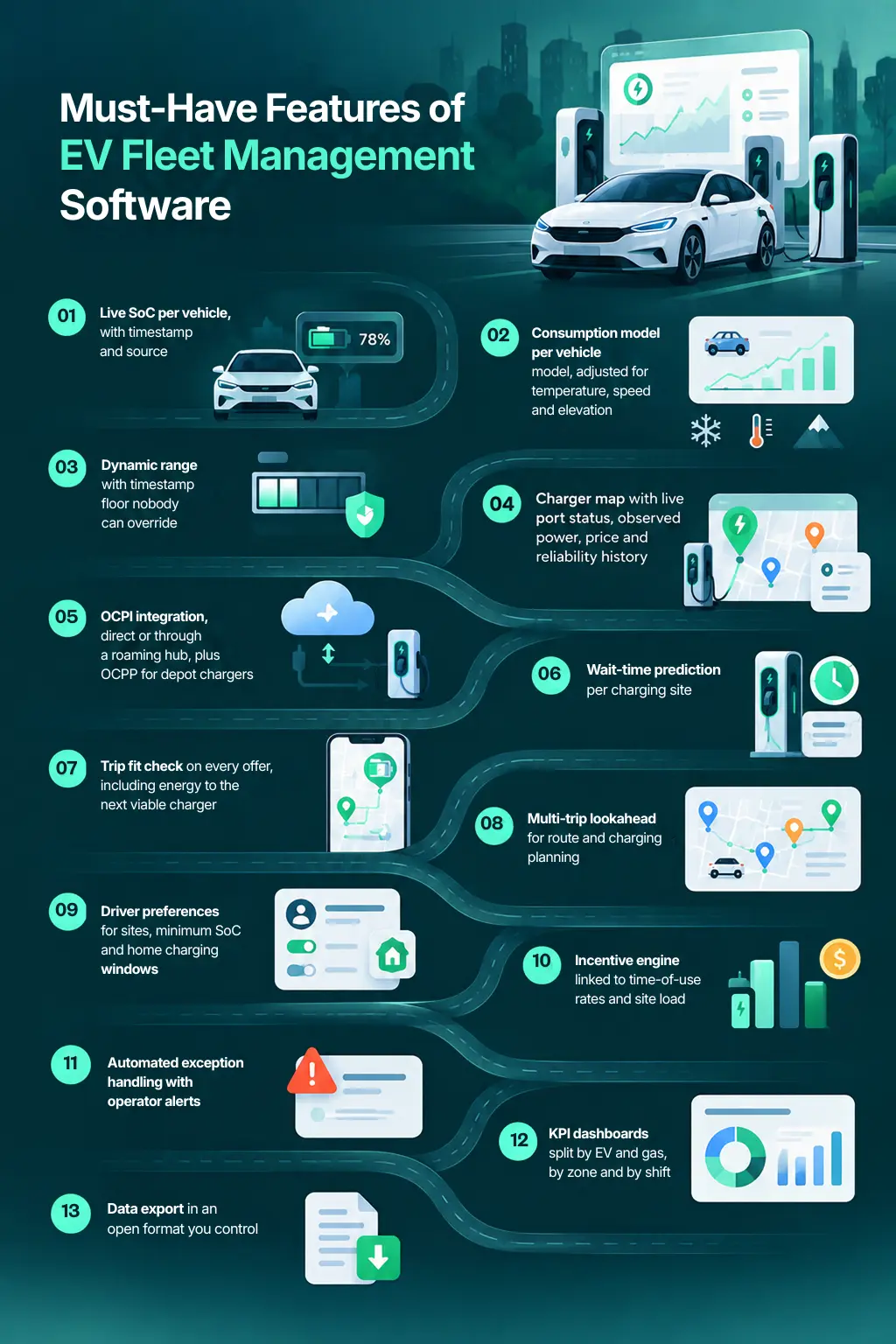
Build, buy or white-label, the checklist is the same. Take it into vendor demos and ask to see each item working on live data.
A features page can claim all thirteen. The demo shows which ones run on real data. Our build vs buy vs white-label ride-hailing framework explains why licensed platforms guard dispatch logic closely, which matters if charging-aware matching is how you plan to compete.
How the architecture fits together
Charging-aware dispatch is a set of data services feeding the matching engine you already run. A practical layout:
Component
Job
Typical inputs
Vehicle data service
Normalizes and timestamps SoC and location
OEM APIs, telematics, driver app
Charger data service
Keeps live status and a reliability score per port
OCPI feeds, federal APIs, OCPP from depots
Energy model
Estimates consumption and sets the dynamic buffer
Trip history, weather, elevation, battery health
Queue predictor
Forecasts wait per site and hour
Live status, occupancy history, fleet intent
Matching engine
Runs trip fit and ranks offers
Pickup time, trip fit margin, charging impact
Driver and operator apps
Explain recommendations and surface exceptions
All of the above
Streaming vehicle and charger events calls for a message layer built for high volume and low latency. MQTT on a managed IoT service is a common choice, and it is the pattern behind the Ambare-e charger link.
Roll it out in stages. Each one produces the data the next depends on.
Instrument first. Get reliable SoC and charger status flowing, and record baseline KPIs for at least four weeks.
Add trip fit as a guardrail. Block only clearly unsafe offers. It targets low-battery events directly and is the easiest stage to validate.
Add charger recommendations. Suggest sites by predicted total time, and track how often drivers follow them.
Introduce incentives. Start with off-peak pricing, measure trips per EV, then adjust.
Move to predictive planning. Add multi-trip lookahead and fleet-level charging schedules once the data is trustworthy.
The tempting shortcut is jumping to step five. A forecasting model fed stale SoC data and a patchy charger map makes confident, wrong calls.
Planning an EV ride-hailing platform, or adding charging awareness to one you already run? Talk to our team. We'll review your fleet mix, charging footprint and dispatch stack, then lay out what to build first.
Podcast: How to Build Charging-Aware Dispatch for EV Ride-Hailing
An EV can be close to a rider and still be the wrong car for the trip. Before sending an offer, dispatch needs to know whether the vehicle can reach the pickup, complete the ride and get to a working charger with a safe battery reserve.
This episode explains how to build that decision into a ride-hailing platform. We cover live battery data, energy estimates that adjust for weather and driving conditions, charger availability and predicted wait times.
We also walk through a practical rollout: start with reliable data and a trip-fit check, then add charging recommendations, driver preferences and predictive planning. Along the way, we identify the fleet measures that show whether the software is reducing downtime.
A way of matching riders to electric cars that treats battery level and charger availability as constraints on every trip.
Before a ride is offered, the system checks that the car can reach the rider, finish the trip and still get to a working charger with a reserve. It also suggests when and where each car should charge, so the fleet stays online through demand peaks.
It runs a trip fit check on each offer. Live state of charge goes in, along with estimated energy for the pickup, the trip and the drive to the nearest viable charger.
A buffer sits on top and grows in cold weather or on highway-heavy routes. Cars that pass get the offer. Cars that fall short get a shorter trip or a charging suggestion.
The core is live state of charge, a per-vehicle consumption model, dynamic range buffers, a live charger map, wait-time prediction, trip fit checks and driver charging preferences.
After that, look for incentives tied to time-of-use pricing, automated exception handling and KPI reports that split EVs from gas cars. Good electric fleet management software also exports your data in an open format. The full checklist is above.
Mostly by cutting time spent waiting at chargers and driving empty to reach them. Queue prediction steers drivers toward shorter waits, and spreading the fleet across hubs stops it from causing its own congestion.
Trip fit helps too. Uber said early testers of its battery-aware matching were less likely to run out of battery or cancel trips that were too long.
Yes. Most integrations use OCPI, the open roaming protocol, either directly with each network or through a roaming hub. Version 2.3.0 covers live port status, tariffs, remote start and stop, and optional booking.
In the US, federally funded chargers must also publish live status and price through an API. Chargers you own connect over OCPP. Network integrations usually take longer than the dispatch logic, and our ride-hailing app development guide covers how that shows up in budgets.
Start with completed trips per EV per shift and the share of online hours lost to charging. Together they show whether EVs earn as much as the rest of the fleet.
Then add charger wait, deadhead miles, low-battery events per 10,000 trips, off-peak charging share, energy cost per mile and electric miles share, all split by EV and gas.
Any ride hailing fleet management software you shortlist should produce these without spreadsheet work. Our mobility software team builds that reporting into the operator console.
Gurpreet Singh is a seasoned Software Professional with over 16 years of experience in project planning, software development, and delivering complex web and mobile applications using Agile methodologies. He has extensive experience with Scrum and Kanban across eCommerce, Healthcare, Event Management, and Ride Aggregation domains, along with expertise in client interaction, requirement gathering, invoicing, project planning, and solution design. Gurpreet is proficient in Node.js, PHP, Python, JavaScript, MySQL, MariaDB, and MongoDB, with hands-on experience integrating third-party APIs, developing API endpoints, and designing AWS-based microservices architectures.
Design one app that feels native on iOS and Android. Compare navigation, gestures, design systems, Flutter and React Native, then use the launch checklist.
Compare build, SaaS, and white-label ride-hailing software by 5-year TCO, control, compliance, data ownership, and exit risk to choose the right model.