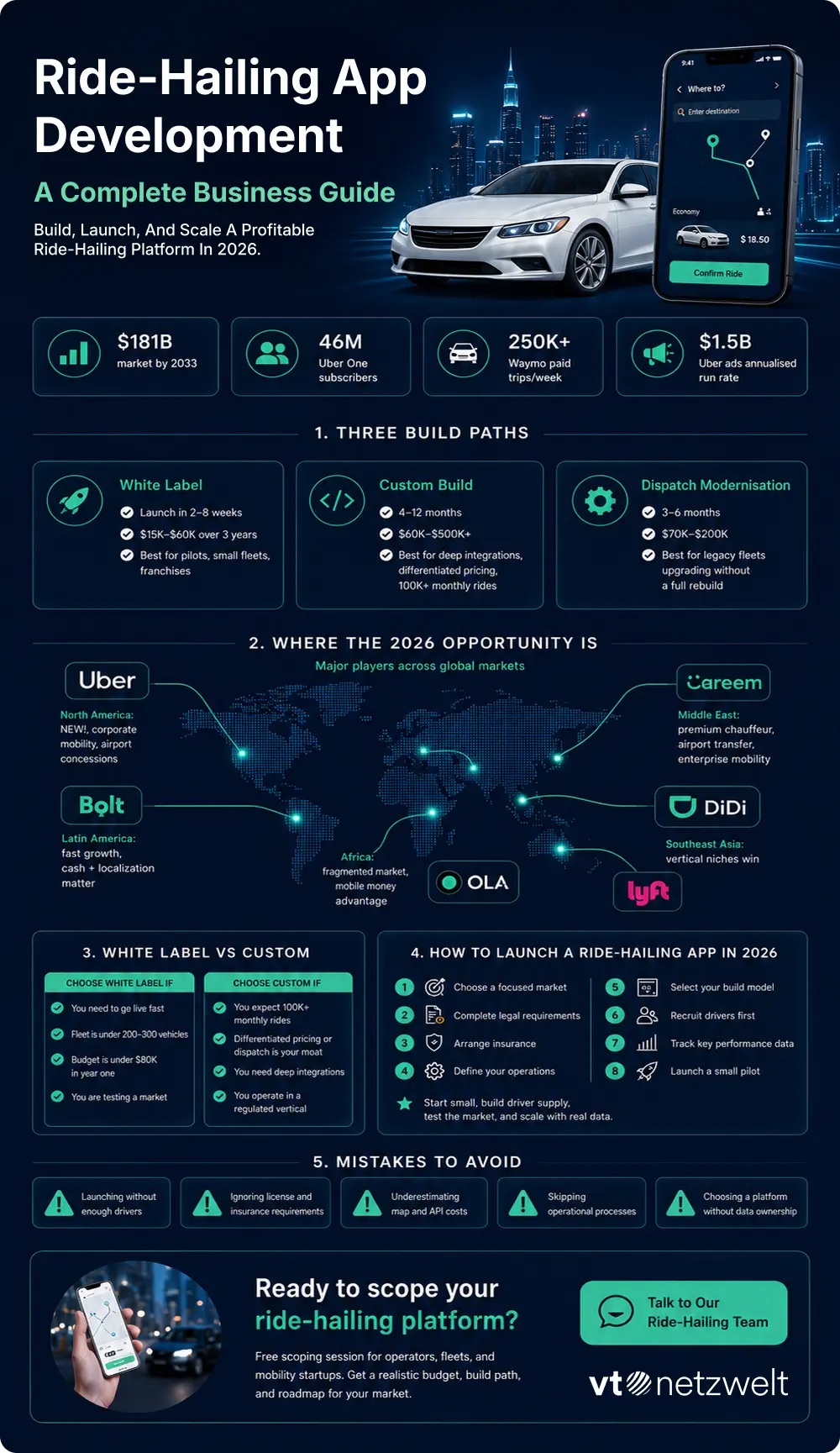
If you are weighing a ride-hailing platform in 2026, you have picked an interesting moment. The global market is on track to hit around $181 billion by 2033, corporate mobility is rebounding as return-to-office normalises, and Waymo has crossed 250,000 paid autonomous trips a week in the US. Meanwhile Uber One counts 46 million subscribers and Uber's ad business alone is on a $1.5 billion annualised run rate. The interesting question is not whether there is room. It is which slice you want and how you plan to build for it.
This guide walks through how our team scopes and ships taxi platforms for operators across North America, Europe, and the Middle East. It covers what a white label build really gives you, when custom is worth the money, how the regional opportunity looks in 2026, and the launch sequence that stops most projects from stalling.
The 60-second version
White label gets you live in 2 to 8 weeks for $15K to $90K over three years. Good for pilots, small fleets, franchises.
Custom takes 4 to 12 months, $60K to $500K+, and pays back when you need differentiated pricing, deep integrations, or you are chasing 100K+ monthly rides.
Dispatch modernisation is the third path most people miss. If you already run a fleet on legacy software or a white-label you have outgrown, replacing the engine underneath is often cheaper than a rebuild.
Region shapes the build. The 2026 opportunities sit in the Gulf, Africa, and Southeast Asia, where the market is fragmented and incumbents are thin.
What Is Custom Ride Hailing App Development?
Custom ride hailing app development means building the four apps (rider, driver, admin dashboard, partner or merchant console) and the backend from scratch, tuned to your business model. You own the source code, the database, the dispatch logic, and the roadmap. It takes longer, costs more upfront, and pays back when you need to differentiate on things vendor defaults cannot handle.
A modern custom build in 2026 usually involves a microservices backend in Node.js or Go, a real-time layer using Kafka or Redis pub/sub for driver location streams, Uber's open-source H3 hexagonal index for nearest-driver queries, native Swift and Kotlin for the driver app (battery life matters when a driver runs the app for ten hours a day), Flutter or React Native for the rider app, and a machine learning layer for ETA prediction, surge pricing, and fraud scoring. Google Maps or Mapbox handle the mapping, though at scale most operators self-host OSRM to keep API bills from ballooning to $8,000 a month by year one.
Where custom is the right call
You are targeting 100,000+ monthly rides within 24 months and know your unit economics need bespoke pricing.
You need deep integration with a hospital patient system (NEMT), a corporate travel platform, or a financial services API.
You are venture-backed and your investors want to see IP rather than a rebranded SaaS agreement.
You are building for a regulated corridor (Medicaid transport, school runs, airport terminals) where requirements shift.
Custom does not mean starting with the full platform on day one. Most of our engagements begin as an MVP: rider app, driver app, admin dashboard, and a working dispatch flow shipped in four to five months, then hardened for scale.
Rule of thumb. If your business model looks anything like Uber's, buy. If your business model looks like something Uber cannot copy in a weekend, build.
Where the real margins sit, corporate and enterprise mobility
Most consumer ride-hailing markets are saturated. The unsaturated adjacent segment is B2B: corporate transport booking apps, chauffeur booking platforms, employee shuttle systems, airport concession fleets, and executive travel programmes. Deal sizes are 3 to 5 times larger, driver economics are calmer (fixed contracts beat piecework), and switching costs are higher once integrated with an enterprise's HR, expense, or facilities system. If you are choosing between "another consumer app" and "a specialised platform for one enterprise segment," the second is usually the shorter route to profitability.
Taxi dispatch software sits at the centre
Whether you go white label or custom, the piece of the platform that decides whether you make money is the taxi dispatch software. Naive dispatch picks the geographically closest driver and stops thinking. Modern dispatch weighs driver acceptance rate, destination match (does this driver want to head toward home?), rider lifetime value, and vehicle type. The best pool two or three ride requests over a short window and solve them together, which lifts fleet utilisation by 8% to 15% in dense cities.
Alongside the matching engine, a good dispatch platform gives your ops team a live map, a pricing rules editor they can change without a deploy, and a manual override for the moments when the algorithm is wrong (heavy rain, VIP client, a stranded rider). Budget for a human dispatcher for every 200 to 300 concurrent rides, no matter how good the AI gets.
White Label vs Custom Taxi Platform, How to Decide
The white label vs custom taxi platform decision is where most founders get stuck for weeks. The honest answer is that most operators do both in sequence. Start on white label to prove the market. Migrate to custom once your ride volume, driver economics, or regulatory exposure justifies owning the stack. Here is the side-by-side that helps you place yourself.
Pick white label if
You need to be live in under two months
Fleet is under 200 to 300 vehicles
Total budget is under $80K in year one
You are testing a market or a corridor
No in-house engineering team
Pick custom if
You expect 100K+ monthly rides in 24 months
Differentiated pricing or dispatch is your moat
You are VC-backed and IP matters
NEMT, school transport, or airport concession
You want to switch business models yearly
The third path most operators overlook: dispatch modernisation
If you are already operating (200 to 2,000 vehicles, ten years of driver relationships, a legacy dispatch system your ops team knows inside out), starting over is rarely the right call. Legacy taxi software modernisation replaces the engine underneath your existing operation. You keep the drivers, the brand, and the customer base. You swap out the dispatch, matching, pricing, and rider app for a modern stack. Typical scope: 3 to 6 months, $70K to $200K, with parallel running so you never stop taking bookings.
This is the play for fleet groups that outgrew their white label, taxi associations sitting on radio dispatch, and corporate mobility teams whose current system cannot handle new integrations. Ask any prospective partner whether they have run a migration before (not just a greenfield build). The two are entirely different problems.
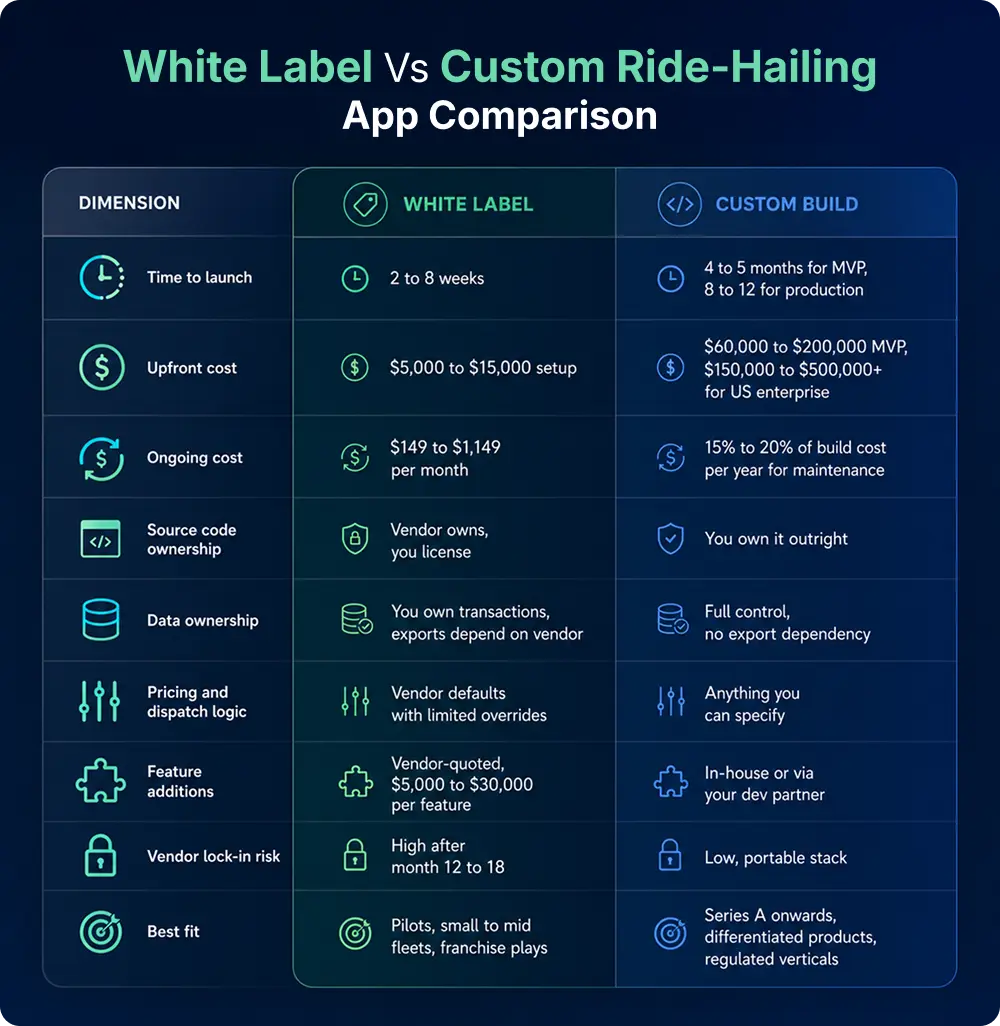
White Label vs Custom Ride-Hailing App Comparison
Cost ranges vary widely because five variables move the number: development geography, number of platforms (iOS, Android, web admin), payment and regulatory complexity, dispatch sophistication, and whether you need offline-first support. The ranges above are drawn from published build-versus-buy benchmarks and 2026 development-cost breakdowns. For platform-level detail, our own breakdowns on iOS app cost in 2026 and Flutter app development cost in the USA cover the module-level math.
The trap we see repeatedly. A fleet launches on white label, grows to 400 vehicles, decides it wants a corporate billing module, and gets quoted $22,000 by the vendor with a three-month lead time. By the time the operator realises they should have started migration a year earlier, the switching cost (data export, driver re-onboarding, brand disruption) has become prohibitive. If you can see custom features in your 18-month roadmap, plan the exit ramp on day one. Ask any white label vendor for a full data export sample before you sign.
The Hybrid Approach: White Label Pilot to Custom Platform
Ship a white label pilot in one city to prove demand. Instrument every ride event, cancellation reason, and driver acceptance metric. Use the first 90 days of data to write a real product spec, then start the custom build in parallel. Migrate riders zone by zone once the new platform is stable. This is how most well-funded operators de-risk both the market question and the technical one. Our Uber clone app development practice runs both tracks so operators do not have to switch partners mid-journey.
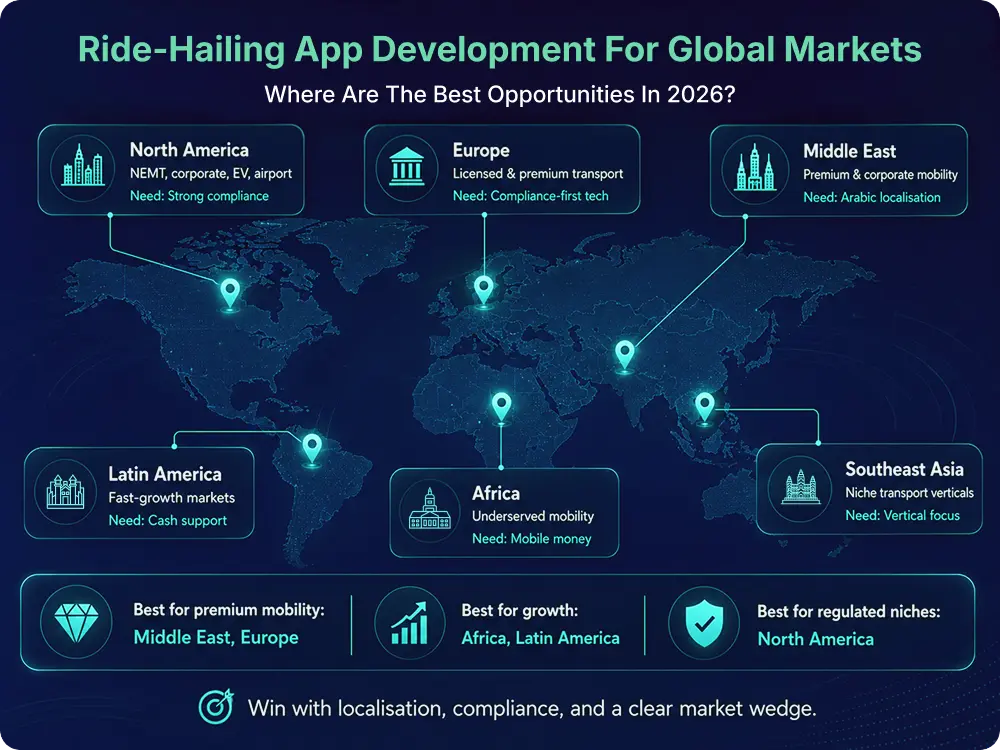
Ride-Hailing App Development For Global Markets, A Regional Opportunity Guide
Ride-hailing is not one market. It is six or seven markets that happen to use the same word. Where you launch shapes your business model, your pricing, and often your tech stack. What follows walks through the regions where we see the most real opportunity in 2026, starting with the ones the incumbents have not locked down.
"Ride-hailing is not one market. It is six or seven markets that happen to use the same word."
Middle East (Gulf)
The Gulf is the highest-value ride-hailing corridor we see for new operators in 2026. Careem (now part of the Uber group) still holds close to 90% share in UAE consumer ride-hailing, but that is not where the money is. Saudi Arabia's Vision 2030 spend has opened licensed tenders across transport, chauffeur, airport transfer, and enterprise mobility. Dubai, Riyadh, Doha, and Abu Dhabi all have thin coverage in premium chauffeur, hotel and hospitality transport, corporate booking, and tourism-tier mobility. Purchasing power is high, procurement is contract-based, and English works for business dealings. The trade-off: procurement cycles are longer, and Arabic localisation for driver apps and rider communications is not optional.
Africa
The most underserved ride-hailing market on the planet, and one where new operators have a genuine shot. Bolt leads across South Africa, Nigeria, Kenya, Tanzania, and Ghana, but "leads" here means single-digit market share of a rapidly growing pie. Uber holds urban strongholds. inDrive is competitive in Kenya and Nigeria. What sets the region apart: mobile money is native (M-Pesa in Kenya, MTN Mobile Money across West Africa), taxi and shuttle operations are still heavily fragmented, English is the business language, and cost per acquisition is a fraction of Western markets. Any platform launching here needs first-class mobile-money integration, USSD fallback for feature-phone rider access in secondary cities, and driver payout logic that handles multiple currencies. The margin story is being written right now.
Southeast Asia
Grab is the super-app benchmark, operating across eight countries with roughly 90% share in Singapore and deep footprints in Malaysia, Thailand, Vietnam, and the Philippines. Gojek concentrates on Indonesia. Asia-Pacific accounts for something like 38% to 45% of global ride-hailing revenue. New entrants lose the horizontal war and win in verticals: hospital transport, workforce commute, tricycle and two-wheel mobility in the Philippines, tourism-tier premium rides. Business English works well in the Philippines and Malaysia, which lowers execution friction. If you cannot afford a super-app strategy, do not try to fight one. Pick a vertical Grab does not care about and own it.
Latin America
The fastest growing region on paper at roughly 16.4% CAGR. Brazil is the main battleground, where 99 (owned by DiDi), Uber, and inDrive compete on price. Cabify holds the corporate and premium tier across Chile, Colombia, and Peru. inDrive's rider-driver bid model has taken share in cost-sensitive cities where surge pricing meets resistance. Cash still moves a meaningful share of trips, so any platform launching here needs a serious cash reconciliation and driver-payout module. Spanish and Portuguese localisation is table stakes, which is why most operators enter this region through a local partner rather than direct.
North America
Uber and Lyft together take close to 30% of global ride-hailing revenue with the strongest per-ride economics on earth, and Lyft holds roughly a third of the US market by trips. Head-on competition is a losing game. What opens up sits underneath them. NEMT (non-emergency medical transport) under Medicaid is a fragmented, underserved $15 billion segment where compliance is a moat. Corporate mobility is back after five slow years as hybrid work stabilises. EV-only fleets are pulling incentives in California, New York, and Washington. Airport corridor concessions in mid-sized US metros still get awarded to operators who can show a working platform and TNC compliance. The play is a vertical wedge rather than a broad consumer app.
Europe
Bolt is the credible alternative across Eastern and Central Europe, and FREE NOW consolidates the taxi-licensed segment in Germany, France, Italy, and the UK. Yango operates in Southern and Eastern Europe. The regulatory picture is heavier than in the US. Worker classification cases in Spain, France, and the UK have pushed platforms toward employee-driver models, and the EU Digital Services Act adds transparency requirements around algorithmic dispatch. Europe rewards operators who build compliance into the platform from day one rather than as a retrofit. New entrants tend to succeed in premium chauffeur and corporate segments, or by acquiring a licensed taxi network and modernising the tech.
What this means for your build decision.
A platform meant for the US only needs Stripe, Google Maps, and a TNC-compliant driver module. A platform meant to expand into three regions needs a payment abstraction layer, a rules engine that swaps commission and pricing logic per country, and a compliance module that supports different KYC and driver-verification workflows. That is the difference between a $150,000 build and a $400,000 one. Decide before you scope.
How to Launch a Ride-Hailing App in 2026
The sequence below works whether you are white label, custom, or hybrid. Skip a step at your peril.
Pick your wedge. One city, one vehicle type, one rider segment. Do not launch four cities on day one. "Corporate cabs in downtown Austin" is a wedge. "A ride hailing app" is not.
Register your entity and secure permits. In the US, TNC registration at the state level (California CPUC, Texas TDLR, New York TLC in the city), plus any local operating permit. In the UK, Private Hire Vehicle Operator licensing per council. In Germany, KBAG registration for driver dispatch. Wherever you are, permits run in parallel with development for six to twelve weeks.
Get insurance in place before day one. Commercial auto liability, contingent liability that covers period-one (driver online, no ride accepted), and umbrella coverage. In the US, TNC insurance minimums vary by state, often $1 million per incident during active rides. Do not accept a single paid ride until proof of coverage is filed with your regulator.
Write your operations SOP before the software. Driver onboarding checklist, KYC document flow, escalation matrix, refund policy, safety incident protocol. If these are not written down, the app cannot enforce them.
Choose your build path. White label to pilot, custom for scale, or a planned hybrid. If you are between the two, the honest answer is often "white label for six months while we specify the custom build properly."
Ship the driver app first. Recruit 150 to 200 drivers before your rider app hits the store. Empty apps kill launches faster than bugs do. Driver acquisition typically costs $50 to $250 per verified driver in mature markets.
Instrument everything from day one. Ride funnel, cancellation reasons, driver acceptance rates, ETA accuracy per zone. Without these, month two is a guessing game.
Run a closed pilot, then open one zone at a time. Two weeks with employees, friends, and one corporate account. Fix the top ten complaints before you open the app store listing. Then density beats coverage: 10,000 rides a day in one neighbourhood is a business, 200 rides across a city is a science project.
If you are still specifying, an MVP-first engagement gives you a testable product in the market before you commit to a full custom platform.
5 Mistakes to Avoid When Launching a Ride-Hailing App
Launching the rider app before recruiting drivers. Empty maps kill trust in one session.
Under-budgeting for map API calls. Google Maps bills at scale surprise founders at the $8K a month mark.
Treating surge as a revenue lever. It is a supply lever. Model it accordingly.
Skipping the ops SOP. If the process is not written down, the app cannot enforce it.
Signing a white label deal without a written data-export clause. That single omission has cost operators six-figure migration fees.
"Empty apps kill launches faster than bugs do. Recruit 200 drivers before your rider app hits the store."
How VT Netzwelt Builds Ride-Hailing Apps for Global Operators
VT Netzwelt is a global ride hailing app development company shipping platforms for taxi operators, corporate fleets, NEMT providers, and mobility startups across the Gulf, Africa, Southeast Asia, and North America. We work across all three paths: new custom platform builds, legacy taxi software modernisation for fleets already in operation, and white-label taxi app engineering for operators who want a fast pilot with a clear upgrade route. Our Uber clone app development practice covers the white-label and custom sides, with the modernisation work often layered on top for clients who arrive already running something.
What we do well is the boring part. We make dispatch policy legible to your ops team, we keep map API bills sane as you scale, we handle regional payment and compliance integrations (mobile money, UPI, corporate billing, Arabic and Spanish localisation), and we build the migration path when a client outgrows their first platform. If you want to see how we have done it before, our case studies and broader mobile app development work give a sense of the range.
Podcast: How to Build a Ride-Hailing App in 2026
Your global guide to building a ride-hailing app in 2026. Costs, tech stack, build paths, launch steps, and the regions where new operators still have a shot. Listen now if you're scoping a taxi or mobility platform anywhere in the world.
Conclusion
Ride-hailing looks like a solved problem from the outside because Uber and Lyft exist. From the inside, it is a market where a subscription-fee bike taxi upstart just overtook two decade-old giants on user counts in a major market, where Waymo is turning autonomous rides into a real revenue line, and where corporate mobility, EV fleets, NEMT, and vertical transport are still underserved in almost every city we have measured. The question is not whether there is space. It is whether you are building the platform that can bend when the market bends. White label to test, custom to differentiate, or a hybrid path in between: the operators who win in 2026 are the ones who treat their taxi app as a business system with a mobile front end rather than a mobile project pretending to be a business.
What to Prepare for a Ride-Hailing App Scoping Call
A first conversation goes twice as far when you show up with the basics ready. Even rough answers get you a real estimate instead of a range.
Fleet size today and target size in 24 months
Current dispatch system, if any (radio, WhatsApp, white-label vendor, in-house)
Driver model (owner-operator, employee, subscription, commission)
Payment methods you need (cards, mobile money, UPI, cash, corporate invoicing)
Integrations that matter (payment gateway, accounting, HR, insurance, ERP)
Target launch date and budget band
Ready to scope your ride-hailing platform?
VT Netzwelt runs a free scoping session where we map your operations, walk through the build, buy, or modernise decision against your fleet size and timeline, and give you a realistic budget and roadmap for your market. No slide deck, just answers you can act on. Talk to our ride-hailing team
Frequently asked questions
Buy if you are validating a market, running under 200 vehicles, or need to be live in under two months. Build if you have a differentiated pricing model, expect 100,000+ monthly rides within two years, or operate in a regulated vertical like NEMT. Most successful operators do both in sequence: white label to pilot, custom to scale.
A white label app is a licensed platform you rebrand and launch fast. You do not own the code, you rent it. Custom is a from-scratch build you own outright, tuned to your business model. White label is faster and cheaper upfront but caps how far you can differentiate. Custom takes longer and costs more but scales with your ambition.
A white label deployment runs $15,000 to $90,000 over three years including subscription. A custom MVP built with a mid-market agency lands at $60,000 to $150,000 for four to five months of work. A full enterprise-grade platform built by a US agency runs $150,000 to $500,000+. Ongoing costs (cloud, map APIs, driver acquisition, support) usually add another 40% to 60% in year one.
Two to eight weeks for a white label launch, and most of that time goes to compliance rather than engineering. Four to five months for a custom MVP with rider, driver, admin, and core dispatch. Eight to twelve months for a production-grade platform ready for tens of thousands of daily rides. If someone quotes five weeks for a from-scratch custom build, ask what they mean by custom.
On the rider side: one-tap booking, live tracking, multi-payment, fare split, and in-app safety with SOS. On the driver side: ride offer with payout preview, turn-by-turn navigation, earnings dashboard, and document management. On the admin side: dispatch console, pricing rules editor, fraud detection, and finance reconciliation. The differentiators sit in the backend: a matching algorithm you can tune per city, a pricing engine your ops team can edit without a deploy, and a data pipeline that supports LTV modelling by month six.
Yes, within limits. Branding, colours, base fare, commission percentage, and payment gateway are usually configurable in the admin console. Anything that touches core logic (dispatch algorithm, pricing rules beyond defaults, integrations with non-standard systems) becomes a vendor-quoted custom job, typically $5,000 to $30,000 per addition with weeks or months of lead time. Ask for a written scope of what is configurable versus custom before you sign.
For fleets above 500 vehicles the answer is rarely a fully off-the-shelf product. Large operators either use enterprise dispatch platforms with heavy customisation (iCabbi, Autocab, TaxiCaller, Onde, and Yelowsoft are the names buyers most often shortlist) or move to a custom stack built on H3 geospatial indexing, Kafka event streams, and their own matching engine. The choice depends on whether your differentiator is operational excellence (off-the-shelf plus tuning) or product differentiation (custom). Fleets running legacy in-house tools often take a third path: taxi dispatch modernisation, where the engine is replaced but the operational shell and driver base stay intact.
Yes, and many operators do around the 12 to 18 month mark. The switch is easier if you plan for it on day one: negotiate a full data export clause in your white label contract, keep your payment gateway and customer records in accounts you control, and document your operational SOP so the new platform can implement it faithfully. Migration takes three to five months of parallel running and costs 60% to 80% of a fresh custom build.
A modern 2026 stack looks like this: Flutter or React Native for the rider app, native Swift and Kotlin for the driver app, Node.js or Go microservices for the backend, Kafka and Redis for real-time events, H3 or S2 for geospatial indexing, PostgreSQL for transactional data, Cassandra or DynamoDB for ride event history, Google Maps or Mapbox for mapping (or self-hosted OSRM at scale), Python services for ML and pricing, and Kubernetes on AWS or GCP for infrastructure.
Gurpreet Singh is a seasoned Software Professional with over 16 years of experience in project planning, software development, and delivering complex web and mobile applications using Agile methodologies. He has extensive experience with Scrum and Kanban across eCommerce, Healthcare, Event Management, and Ride Aggregation domains, along with expertise in client interaction, requirement gathering, invoicing, project planning, and solution design. Gurpreet is proficient in Node.js, PHP, Python, JavaScript, MySQL, MariaDB, and MongoDB, with hands-on experience integrating third-party APIs, developing API endpoints, and designing AWS-based microservices architectures.
Design one app that feels native on iOS and Android. Compare navigation, gestures, design systems, Flutter and React Native, then use the launch checklist.
Compare build, SaaS, and white-label ride-hailing software by 5-year TCO, control, compliance, data ownership, and exit risk to choose the right model.
Compare native vs cross-platform app development in 2026. See how AI coding agents affect cost, performance, code review, React Native, Flutter and KMP.