- A revenue share percentage that grows with every ride you add
- A clause letting the vendor terminate for no reason on 30 days' notice
- Your rider app living in the vendor's app store account, along with its reviews and install base
Two vendors send you numbers in the same week. One quotes $8,500 up front and $99 a month. The other quotes $350,000. Your finance lead builds a comparison, and over five years the cheap one wins by more than twenty to one.
That comparison is wrong by an order of magnitude, because the $8,500 quote leaves out what the pricing page does not print:
None of it is hidden. It sits in published terms and conditions that almost nobody opens until the shortlist is already down to two, by which point the pricing has done the deciding. The figures above are illustrative, and every one of them is documented with a source further down.
This guide is the comparison that spreadsheet should have been.
There is no universal cost winner. The deciding number is your break-even per trip, which is your five-year build cost divided by your five-year ride count. Any vendor quote under that beats building.
No option wins on cost across the board. Anyone claiming white-label is always cheaper, or that building always pays back, is selling one of the three.
Answer these honestly. Each one links to the section that settles it.
| Question | If yes | If no |
|---|---|---|
| Will you clear 6,000 trips a month within 18 months? | Published SaaS tiers run out. Everything moves to a negotiated quote | Metered SaaS is probably your answer |
| Does your margin depend on dispatch or pricing logic competitors do not have? | Build, or a hybrid. Licensed platforms lock this | White-label covers you |
| Do you operate in more than two regulatory regimes? | Buying coverage beats building it | Build stays affordable |
| Can you fund and retain two or more engineers for five years? | Build is viable | Rule build out now |
| Would losing your platform in 90 days end the business? | Exit terms outrank price. Negotiate them first | Optimize for speed |
Three or more answers pointing the same way is usually the decision. A split result means the sections below are where you will find your tie-breaker.
These labels get used loosely in vendor conversations, so it helps to pin them down first.
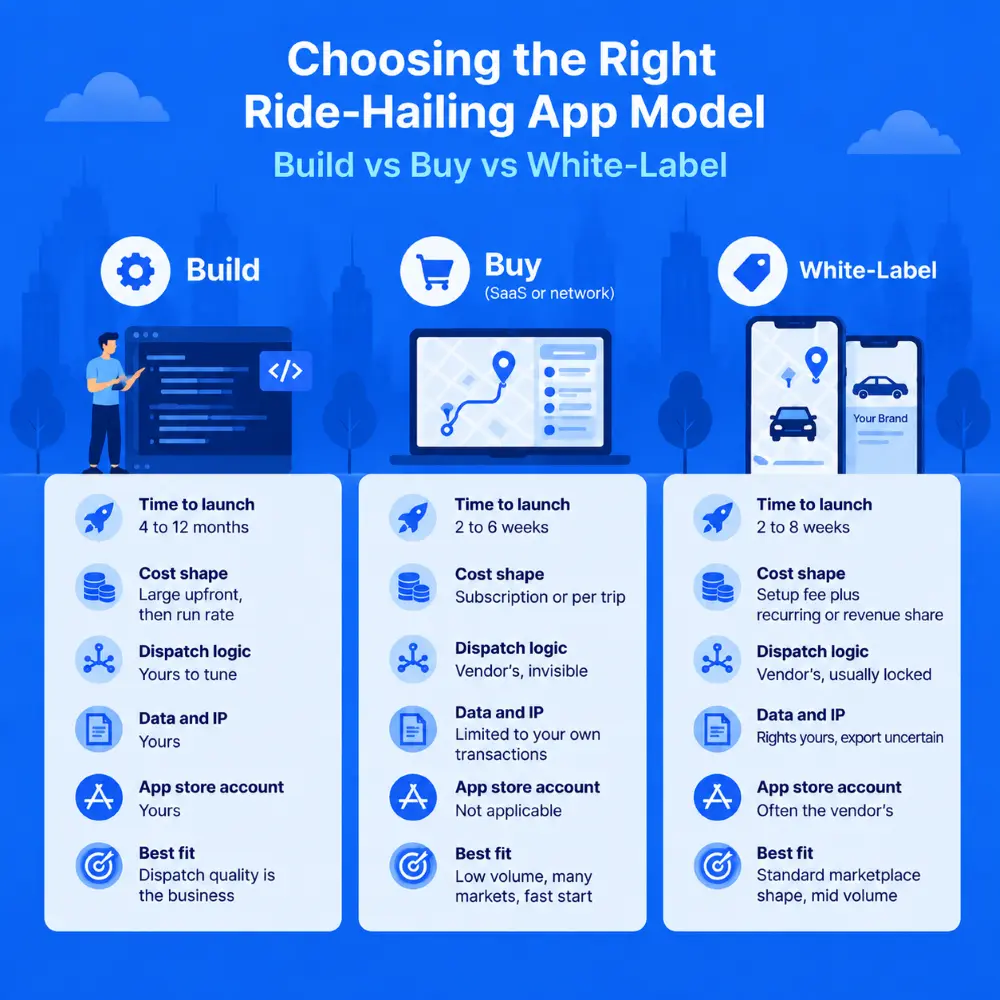
You own the codebase, the infrastructure, the database, the app store listings and the roadmap. You also own every 2am page and every regulatory change in every market you serve.
Ranges published by dispatch vendor Mobility Infotech put custom ride-hailing development between $25,000 for light work and $200,000 or more for a bespoke platform, at US developer rates of roughly $100 to $200 per hour, with annual maintenance of 15 to 20 percent of build cost (Mobility Infotech). Those come from a competing vendor's own blog, so treat them as a published position and corroborate before modeling on them.
Our own ride-hailing app development guide puts a production MVP at $60,000 to $150,000 across four to five months, and an enterprise-grade platform at $150,000 to $500,000 or more across eight to twelve months, with operational cost adding 40 to 60 percent in year one.
If the headcount side of that math is the part you are unsure about, our breakdown of what it costs to hire software developers in the US covers loaded rates and the hidden costs that sit behind a salary line.
"Buy" covers two commitments that share almost nothing, and conflating them causes most of the confusion in build vs buy ride hailing software discussions.
Buying a platform means subscribing to a hosted dispatch product. You configure it, you brand it within limits, you pay monthly or per trip, and the vendor runs the software.
Buying the network means putting your rides on someone else's driver supply through an enterprise API.
Buying the network shifts supply risk and platform risk onto someone else, and it takes the rider relationship along with them. Uber's Receipts API gives you access only to trips the rider designated as official business trips under your company profile (Uber developer docs).
You are buying fulfillment capacity, and the customer relationship stays on Uber's side of the API.
One scoping note before the models below. Enterprise network pricing is negotiated per account and neither provider publishes an API fee schedule, so the cost, customization, and ownership tables that follow compare build against SaaS and white-label only. The network option returns in the scorecard, where it wins on speed and regulatory coverage rather than on a modeled cost.
A licensed platform wearing your brand, faster to launch than a build and more configurable than a generic SaaS tier. Our own white-label ride-hailing platform work sits in this category, so the trade-offs below are ones we run into on live projects.
Pricing comes in one of three shapes, and the shape matters more than the sticker price, because a revenue share has no ceiling.
| Vendor | Shape | Published numbers |
|---|---|---|
| Onde | One-time fee plus revenue share | $4,500 to $23,000 one-time across three ride-hailing tiers, $99 per month on all three, plus an unpublished percentage of trip cost. A separate $259 per month Super App plan bundles delivery |
| Yelowsoft | Subscription plus metered trips | $79 to $649 per month on annual terms, 500 to 6,000 trips included, $0.13 to $0.20 per trip overage, $999 to $1,999 setup. Above 6,000 monthly trips moves to a quote |
| Jugnoo | Ride bundles | $0.075 to $0.10 per additional ride, plus $200 per month maintenance from year two |
Comparing a build quote against a monthly subscription is the modeling error we see most often. Both are different shapes of the same eight costs.
| Cost category | Build | Buy (SaaS) | White-label |
|---|---|---|---|
| Initial delivery | Development, QA, launch | Onboarding, config | Setup fee, branding, store submission |
| Recurring platform fee | Hosting only | Subscription tier | Base fee plus maintenance from year two |
| Variable transaction cost | None | Per-trip overage | Revenue share or per-ride metering |
| Third-party APIs and infra | Maps, SMS, payments, push, cloud | Often bundled, verify | Sometimes passed through at cost plus |
| Engineering run rate | 2 to 6 FTE depending on scope | 0.5 to 1 FTE for integration | 0.5 to 2 FTE for integration and config |
| Compliance and certification | Fully yours | Shared, liability still yours | Shared, liability still yours |
| Change cost | Sprint capacity | Vendor roadmap or paid custom work | Vendor roadmap or paid custom work |
| Exit cost | Migration only | Migration plus data extraction | Migration, data extraction, app store loss |
The infrastructure row is the one people underestimate on the build side. If you are sizing it, our guide to reducing an AWS bill covers the run-rate levers that matter at ride-hailing traffic patterns.
Google removed its $200 monthly credit on March 1, 2025 and replaced it with per-SKU free usage thresholds. It also moved automatic volume discounts for most Core Services from 100,000 monthly billable events up to 5,000,000.
Legacy APIs including Places, Directions, and Distance Matrix kept the old 100,000 threshold without the expanded benefit (Google Maps Platform). Any model written before that date has a wrong mapping line in it.
This is where the comparison flips, and the crossover is arithmetic:
Take a $99 monthly subscription, a 3 percent commission, and a $20 average fare. Commission costs $0.60 a ride, so $99 divided by $0.60 puts the crossover at 165 rides a month. Below that the revenue share is cheaper, and above it the subscription is.
Change any of those three inputs and the crossover moves a long way, which is the whole reason the number that counts is yours.
Regional fleet, 120 vehicles, 30,000 rides per month, $22 average fare.
Annual gross bookings land near $7.9M, or 1.8 million rides across five years.
| Option | Five-year cost | Working |
|---|---|---|
| White-label at 3% revenue share | ~$1.19M | $237,600 a year on $7.9M of bookings, before base fees |
| Metered SaaS | No published rate | Every vendor we checked moves to a quote above 6,000 trips a month |
| Custom build | ~$950,000 | $350,000 delivery, plus two engineers at a blended $60,000 each per year |
The build figure uses the midpoint of the enterprise range in our own guide above. Note what the table does and does not settle. The revenue share is the clear loser at this volume, and it gets worse every month you grow.
The real contest is between the build and whatever per-trip rate you can negotiate. You can solve for it: $950,000 across 1.8 million rides is $0.53 per trip. Any quote meaningfully under that beats building, and any quote above it does not. That single number is what your procurement conversation should be about.
One trap in the build column. Avoid adding a percentage-of-build maintenance line on top of the run team, since the 15 to 20 percent figure vendors quote describes the same two engineers. Charging for both is how a viable build case gets talked out of the room, and we have watched it happen in three separate vendor bake-offs.
Both the delivery figure and the engineering rate assume offshore or blended teams. At US onshore salaries the build column roughly doubles, the break-even rises past $1.00 per trip, and the ranking changes with it.
Corporate mobility program, 900 trips per month, $30 average fare, four countries, deep HR and expense integration.
| Option | Five-year cost | Working |
|---|---|---|
| Metered SaaS | ~$13,500 | $199 a month covering 1,500 trips, plus a $1,499 setup fee |
| White-label at 3% revenue share | ~$63,000 | $48,600 of commission on $1.6M of bookings, plus fees |
| Custom build | $450,000+ | Even a reduced $150,000 build plus one engineer |
Volume here is too low for a build to amortize and too low for a revenue share to hurt much. The binding constraints are integration depth and the number of regulatory regimes, neither of which appears in the cost column at all.
That is why buying the network deserves a look here even though it carries no modeled price. Four jurisdictions of licensing, insurance, and worker classification is a standing cost that a network provider has already absorbed.
Same three options, and the ranking inverts on volume alone.
Everything above reduces to a handful of inputs. The calculator below loads with Scenario A's figures, so you can watch the model work before replacing them with your own.
[TCO Calculator]
If you would rather rebuild this in your own spreadsheet, the arithmetic is three lines. Call rides per month A, average fare B, the quoted revenue share C, the one-time build or setup cost D, and your loaded annual cost per engineer times headcount E.
That last line is the one to take into a negotiation. It gives you the per-trip rate above which building is cheaper than buying, and any vendor quote below it beats building.
Cost tells you what each option charges. It says nothing about what each one lets you change, and that is the constraint people discover in year two.
Nobody switches platforms over a button color. The question that matters is whether you can touch the systems that set your unit economics.
| Capability | Build | Buy (SaaS) | White-label |
|---|---|---|---|
| Matching and dispatch algorithm | Full control | None | Locked, sometimes parameter-level config |
| Surge and pricing rules | Full control | Preset tiers | Config within vendor limits |
| Driver incentives and scoring | Full control | Rarely exposed | Varies, ask specifically |
| Rider app UX and flows | Full control | Theming only | Branding plus some layout |
| Third-party integrations | Anything with an API | Vendor marketplace | Vendor roadmap or paid custom work |
| Database access | Direct | None | Usually API only |
Matching and dispatch logic decides who gets the ride, on what radius, weighted by what. Two operators running identical fleets in the same city can post idle rates several points apart depending on how this logic is tuned, and idle time is the largest controllable cost in the business.
Dispatch engines, operator consoles and driver systems are the core of what we build in mobility and transportation software, and they are also the parts licensed platforms guard most closely.
On licensed platforms, both dispatch and pricing are usually off limits by contract. Onde's published terms for its Light product prohibit any attempt to "reverse engineer, decompile, disassemble or otherwise attempt to derive the source code, underlying ideas, know-how, structure or algorithms of the Service" (Onde Light terms).
The flagship product's terms describe the license as "non-exclusive, non-sublicensable, non-assignable, non-transferable, revocable, temporary" (Onde terms).
Read literally, that language rules out inspecting the algorithm or modifying it, and it lets the vendor withdraw the license.
That test often points toward a hybrid, where you license the commodity layer and build the differentiating service on top of it. If you want to validate the differentiating piece before committing to a full platform, an MVP-first approach is usually cheaper than discovering the answer in year two. For a sense of what full feature scope looks like before you scope anything, our list of must-have cab booking app features is a useful baseline.
Ownership in this category is decided by three documents that rarely get read together: the license grant, the data clause, and the developer account registration. Each one can quietly transfer an asset you assumed was yours.
Apple's App Store Review Guideline 4.2.6 states that apps created from a commercialized template or app generation service will be rejected unless submitted directly by the provider of the app's content, and that these services should not submit apps on behalf of their clients. Apple sanctions one alternative for template providers, a single binary hosting all client content in an aggregated or picker model (Apple).
A vendor publishing your branded iOS app from its own developer account is operating in the gap between those two positions, so ask in writing which one applies.
Either way, your ratings, reviews, install base and app store optimization equity sit in an account you do not control and cannot take with you when the contract ends.
Some tiers state this in the contract. Onde's Light terms distribute passenger apps on Android only, under Onde's developer accounts, and bar the client from publishing under its own (Onde Light terms). Make account ownership a written contract term and confirm the iOS listing sits under your own Apple Developer Program membership.
Retaining rights in your records still leaves open whether you can get them out in a usable form. Onde's Light terms say the vendor "may retain Client's account data for 90 calendar days after termination to permit possible reactivation or export, where technically available," after which it may delete or anonymize it.
Two hedges in one sentence, no named format, no service level.
Define the export artifact in the contract instead. Four things need naming:
Under GDPR you are almost always the data controller for rider and driver data, because you determine the purposes and means of processing. The platform vendor sits underneath you as a processor and needs an Article 28 data processing agreement.
That allocation does not move because the software belongs to somebody else. The Article 28 agreement is the only thing standing between you and direct liability, so read it before you sign it. Where the data physically sits matters too, and residency is a cloud infrastructure and security decision you should make deliberately rather than inherit from a vendor's default region.
This is the section that most often reverses a decision made on price alone, because none of these costs disappear when a vendor operates the software.
| Obligation | Where | What it costs or requires |
|---|---|---|
| TNC insurance | California | $50,000 per person, $100,000 per incident, $30,000 property damage in Period 1 with $200,000 excess, rising to $1,000,000 primary in Periods 2 and 3, plus $1,000,000 uninsured motorist in Period 3 |
| Accessibility levy | California | $0.10 per trip since July 1, 2019, plus annual WAV demand reporting |
| Market entry license | New York City | $380,000 for two years above 10,000 daily trips, non-refundable if denied |
| Payment security | Global | PCI DSS 4.0.1, every requirement mandatory since March 31, 2025 |
| Worker classification | EU | Platform Work Directive, national law due December 2, 2026 |
Sources for the table above: CPUC insurance requirements, CPUC Access for All, and the NYC TLC HVFHS application checklist alongside the TLC HVFHS overview.
New York City should be treated as a market entry decision in its own right. The $380,000 is billed as a $190,000 annual fee, and the application also requires a business plan, environmental and traffic impact analysis, a privacy and security policy, and ongoing biweekly submission of driver payment, trip, session, and breadcrumb location data.
The EU Platform Work Directive reaches into your product, well beyond the legal team. Adopted on October 23, 2024 and in force since November 11, 2024, it must be transposed into national law by December 2, 2026.
Two provisions matter for platform choice. It creates a rebuttable presumption of employment where a platform exercises direction and control. And it requires disclosure of automated monitoring and decision-making systems, with human review of significant automated decisions such as account suspension.
As of mid-2026, only Italy had a draft decree in parliamentary review, with Spain in public consultation (Remote Work Europe).
If a vendor contract stops you from inspecting your own matching and deactivation logic, then explaining that logic to a regulator becomes something you have to ask permission for.
Building regulatory obligations into a product is its own discipline, and the pattern is not unique to transport. Our work on HIPAA-compliant app development covers the same problem shape in healthcare, where the compliance surface has to be designed in rather than bolted on.
Every option carries an exit cost. It is rarely written down anywhere, and it is the number that separates a reversible decision from a permanent one.
Kansas City is the case worth knowing. KCATA ran a one-year microtransit pilot with Bridj starting in March 2016, committing $1.5M in local funds, with the agency supplying vehicles and union drivers while Bridj supplied the software.
Ridership came in under 1,500 rides across twelve months against a projection of roughly 200 riders per day. The pilot was not renewed, and Bridj ceased operations on April 30, 2017 (Shared-Use Mobility Center).
The agency owned the vehicles and employed the drivers, and none of that kept the service running once the software vendor was gone.
Termination rights run both ways. Onde's Light terms let the client terminate on 30 days' notice without stating a reason, and give the vendor the identical right. For an operator whose entire dispatch depends on that platform, symmetrical no-fault termination is an availability risk, whatever the clause calls it. The same terms allow material price and commission increases on 30 days' notice, and state no cap on the size of an increase.
Consolidation changes your counterparty. Modaxo, the people-transportation operating group within Constellation Software, agreed in May 2026 to acquire Conduent's public transit business in a $164M deal expected to close before the end of the year, subject to regulatory approval (Metro Magazine). Work on the assumption that the company you sign with may not be the company you renew with.
For a vendor-hosted platform, plain source code escrow will not save you, because code without the environment, configuration, and credentials cannot restore your dispatch.
SaaS access continuity is the product that fits, priced from around $5,995 per year against roughly $2,995 for standard code escrow, with verification services from $17,995 and normally paid by the beneficiary (The Escrow Company). Verification is what makes escrow real, so either fund it or take the line out of the budget and price the risk somewhere else.
Migration cost is not theoretical either. Our Salesforce to HubSpot migration guide documents a comparable platform switch at $15,000 to $50,000 across six to twelve weeks, and the data mapping phase is where most of that time goes. Moving off an aging dispatch platform is the same problem with more moving parts, which is the kind of work our digital engineering team handles.
Cost, customization, ownership, compliance, and exit risk do not weigh the same for every buyer. Putting explicit numbers on that is what stops the loudest person in the room from deciding by default.
Score each option 1 to 5 on every criterion, multiply by your weight, and total the columns. The default weights below suit a mid-size operator. Changing them is the entire exercise.
| Criterion | Default weight | What a 5 looks like |
|---|---|---|
| Time to first revenue | 15 | Live and transacting inside 8 weeks |
| Dependence on differentiated logic | 20 | Full control of matching, pricing, and driver incentives |
| Five-year TCO at forecast volume | 20 | Lowest modeled cost at your projected ride curve |
| Data and IP control | 15 | You own the code, the database, and both store accounts |
| Regulatory coverage across your markets | 10 | Handles every jurisdiction you operate in without custom work |
| Internal engineering capacity fit | 10 | Matches the team you already have and can retain |
| Integration depth available | 5 | Direct database and event-level access to your systems |
| Exit and continuity risk | 5 | Verified continuity escrow, defined export, capped escalation |
| Organization type | Weights they change | Winner |
|---|---|---|
| Venture-backed operator competing on dispatch quality | Differentiated logic to 35, time to revenue to 5 | Build |
| Corporate mobility or healthcare transport program | Regulatory coverage to 25, time to revenue to 25, differentiated logic to 5 | Buy the network |
| Taxi fleet modernizing off legacy dispatch | TCO and exit risk highest | White-label with negotiated exit, or a hybrid |
Rebalance the remaining rows so your weights still total 100, otherwise the columns are not comparable.
If your weighting produces a result that feels wrong, the weighting is surfacing a priority the room has yet to say out loud.

Building a ride-hailing platform requires more than comparing upfront costs. This episode explores the real differences between custom-built apps, SaaS platforms, and white-label solutions. Discover how enterprises should evaluate total cost of ownership, scalability, customization, data ownership, compliance, and long-term flexibility before choosing a ride-hailing software model.
Give yourself four weeks and a room with the authority to say no.
Fix your inputs. Forecast monthly rides for 60 months, average fare, market count, and the engineering headcount you can hire and keep. Nothing else in the model works until those are agreed.
Run the numbers. Model all three options at your figures, including mapping calls at current Google pricing, the revenue-share crossover formula, and an exit cost line you would defend to a CFO.
Put the diligence questions in writing. Every shortlisted vendor answers the red flags checklist above, plus four questions that checklist does not cover:
Score and document. Run the weighting twice with different stakeholders, then write down why you rejected the two you passed over. That document is what protects the decision when volume changes in year three.

We build custom ride-hailing platforms, deploy and extend white-label systems, and run migrations off legacy dispatch software. Having all three in-house means we carry no structural reason to push you toward any one of them, and we will say so when a build case fails to close.
Our EV charging driver app case study is a useful reference point for the driver-side engineering involved, built on Flutter and AWS for the Brazilian market.
Book a 30-minute scoping session Bring your ride forecast, your market list, and your current vendor contract if you have one. We will run the model with you on the call and tell you which of the three we would pick in your position, along with the reasoning.Book the scoping call
Related reading
White-label ride-hailing software is a finished dispatch platform that a vendor licenses to you and you run under your own brand. You get rider and driver apps, an operator console, and a matching engine, configured and skinned to look like yours.
What you are buying is a right to use the software for the term of the contract. The vendor keeps the source code, the algorithm, and usually the hosting, and on some tiers it also keeps the app store account the apps are published under. That distinction is the whole reason this guide exists
Metered SaaS is cheapest for most operators under roughly 6,000 trips a month. Above that it depends on contract shape. Revenue-share white-label deals get more expensive as gross bookings grow, while a build only amortizes at sustained high volume and only if you already carry the engineering team.
A production MVP runs $60,000 to $150,000 over four to five months, and an enterprise-grade platform runs $150,000 to $500,000 or more over eight to twelve months. Budget another 40 to 60 percent in year one for operations.
The build figure is the smaller half of the decision. A platform needs two to six engineers to keep running, so at a blended $60,000 per engineer per year, a $350,000 build becomes roughly $950,000 across five years. Divide that total by your five-year ride count to get the number that matters, which is the per-trip rate below which buying beats building.
White-label deployments typically go live in two to eight weeks. A custom MVP runs four to five months, and a production-grade enterprise platform takes eight to twelve months. Buying rides through an enterprise API can beat all three, though the clock starts when the vendor approves your API access, which is not self-serve.
Usually not. Most licensed platforms grant a limited right to use the software during the contract term while the vendor keeps all IP. Onde’s published Light terms go further and prohibit any attempt to derive the source code, structure, or algorithms. Some vendors advertise source code delivery. Get that promise into the signed agreement, because a marketing page is not a license grant.
Rarely. Matching and surge logic are the vendor’s core IP and are typically protected by an anti-reverse-engineering clause. Ask specifically whether parameters are configurable, such as search radius, ETA weighting, and driver scoring, since parameter access is sometimes available even when code access is not.
You do, and under GDPR you are almost certainly the controller, which puts the regulatory liability on you as well. The clause to check is export rather than ownership. Does the contract commit to a complete export, in a named format, on a defined timeline? A 90-day “where technically available” retention window is not an export guarantee.
Whoever holds the developer account. If the vendor publishes under its own, everything you accumulate on that listing stays with the vendor when you leave. Apple’s Guideline 4.2.6 also restricts template providers from submitting apps on a client’s behalf, so get the account question answered in writing before signing.
Your service stops. Bridj ceased operations in April 2017 partway through a pilot with Kansas City’s transit authority, which owned the vehicles and employed the drivers and still lost the platform. Acquisition is the quieter version of the same risk, since new owners reprice. The protections that matter are an assignment clause, a termination right on change of control, a cap on price escalation, and continuity escrow that has been verified.
There is no federal license. California requires a CPUC TNC permit with tiered insurance reaching $1,000,000 during passenger carriage, plus a $0.10 per-trip accessibility fee. New York City charges $380,000 for a two-year High-Volume For-Hire Service license for anyone dispatching more than 10,000 trips a day. None of it transfers to your software vendor.
Anywhere from about $3,100 to $380,000, and trip volume decides which end you land on.
Above 10,000 trips a day under one brand you need a High-Volume For-Hire Service license, which costs $380,000 for two years, billed as $190,000 a year and not refunded if the application is denied. Below that threshold an ordinary For-Hire Vehicle base license applies instead. A livery base costs $1,575 to apply plus $1,500 for a three-year license, with $75 per person to fingerprint anyone holding 10 percent or more of the shares.
The fee is rarely the real obstacle. New FHV vehicle licenses have been paused since November 2023, and the TLC’s February 2026 review continued the pause, concluding that additional licenses “would not be beneficial to the industry and the city as a whole at this time.” The only new FHV licenses currently available are restricted to wheelchair accessible vehicles. Budget for the license, then check you can actually put cars on the road.
Yes, and many operators plan for exactly that. The migration is only affordable if you negotiate for it at signing. Secure a complete data export clause, avoid revenue-share deals with long lock-ins, and keep the app store accounts in your own name so your install base and reviews survive the move, which some vendor tiers will not permit.
On price, coverage, or a defined niche, yes. Corporate accounts, medical transport and single-metro operators all compete successfully on licensed platforms. On dispatch efficiency or pricing sophistication it is much harder, since those are the exact systems licensed platforms keep locked, and you cannot out-tune an algorithm you are contractually barred from inspecting.

Are You Prepared for Digital Transformation?

Mobile App Development
Discover 15 ride sharing business ideas for US startups, from medical rides to airport transfers. See niche demand, costs, regulations and launch tips.
Mobile App Development
See where AI improves ride-hailing dispatch, pricing and forecasting, where deterministic rules belong, and how to add guardrails, audits and human override.

Mobile App Development
Discover how EV ride hailing dispatch software uses battery data, live charger availability and trip-fit checks to reduce downtime and improve fleet utilization.