In spring 2026, Consumer Reports had volunteers in 17 states order the same Uber and Lyft rides, minutes and sometimes seconds apart. On one Kansas City route, 55 riders saw 29 different prices.
Nobody typed those prices in. Pricing models produced them, doing exactly what they were built to do. What was missing was a rule saying where the model stops.
The same pattern, three times over:
Year
Where
What the algorithm did
2020
Seattle, Pike Place shooting
Kept surge running while people fled. A six-mile ride was quoted at $120
2023
Amsterdam Court of Appeal
Human review of automated driver dismissals was called "a symbolic act"
2026
30 US routes, Consumer Reports
Same trip, same minute, a median 42.4% gap between cheapest and priciest quote
Quick answer.AI in ride hailing earns its place in prediction: demand forecasting, ETA estimation, ranking driver and rider matches, fraud scoring, and support triage. Deterministic rules should control anything a rider, driver, or regulator can hold you to: the fare formula, surge caps, emergency pricing, driver pay floors, accessibility, and account deactivation. Models predict and rank. A rule layer you can audit makes the call, and a person can override it.
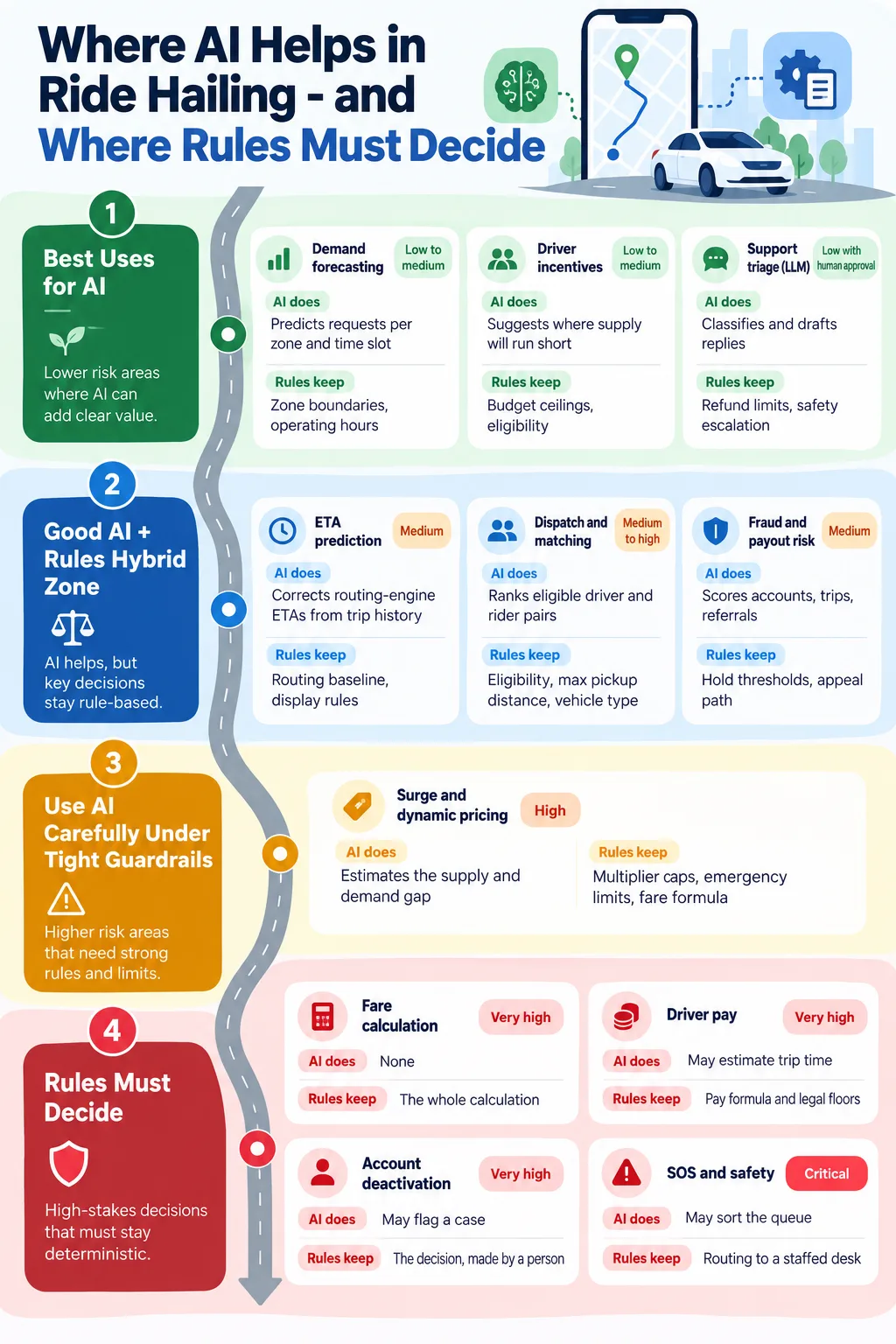
Where AI in ride hailing helps, and where it has no business deciding
Machine learning is good at estimating uncertain things. It is a poor fit for anything that must give the same answer to the same inputs every time.
The last four rows are where operators end up in the news. A model can feed them information. The decision belongs to a rule or a named person.
Four failures, and the rule each one was missing
None of these involved a broken model.
Incident
What the system did
The missing rule
Pike Place shooting, Seattle, January 2020
Surge ran for roughly an hour during an active emergency
An emergency pricing cap that ops or an official alert can trigger
Consumer Reports price tests, spring 2026
Same route, same minute, a median 42.4% price spread
Zone-level demand pricing kept apart from per-rider pricing, with disclosure
Driver pay opacity, leading to Colorado's 2024 transparency law
Drivers couldn't see what riders paid
Per-trip records of rider price and driver pay, plus pay floors
Uber and Ola dismissals, Amsterdam, April 2023
Automated fraud dismissals with symbolic human review
Human review with real evidence and a challenge path
The evidence on pay, in numbers:
1.5 million trips by 258 UK drivers, analyzed in a 2025 University of Oxford study
25% to 29%: the rise in the platform's average take after algorithmic pay arrived in 2023
Over 50%: the take on some individual trips
2025: Uber challenged Colorado's disclosure law in federal court. A judge declined to block it, and the dispute later ended in a settlement
Each failure could have been prevented by a few dozen lines of plain code and a clear owner. None needed a better model.
A four-question test for any AI feature
Run every proposed AI feature through these before anyone writes a spec.
Question
If the answer is yes
Why it matters
Would two people in the same situation expect the same answer?
A rule decides
Riders on the same corner expect the same fare. Consumer Reports showed what happens when they don't get it
Can someone dispute, appeal, or sue over the output?
A rule or a person decides, the model advises
"The model said so" doesn't survive a court or a regulator
Is the input uncertain, and a wrong guess cheap to reverse?
The model can decide
A bad demand forecast costs a few idle minutes and corrects itself next hour
Do you have months of outcome-labeled data?
The model can go live after shadow testing
A model trained on thin data learns noise
Sweet spot: features that pass question 3 and fail questions 1 and 2.
Data you need before question 4 is a yes:
Every request logged with time, pickup cell, and outcome, including requests that never became trips
Driver offers logged with accept, decline, or timeout
Price shown logged next to whether the rider booked
Zones on a stable spatial index such as H3
Holidays, events, and weather captured, even as flags
Uber's DeepETA system, described on its engineering blog, is the cleanest public example.
A routing engine computes a baseline ETA from the road graph and live traffic.
A deep learning model predicts only the residual, the gap between that baseline and real outcomes.
Deterministic guards clamp extreme outputs and force predictions to stay positive.
Why build it that way: the baseline stays predictable and explainable, and if the model misbehaves, the baseline still stands.
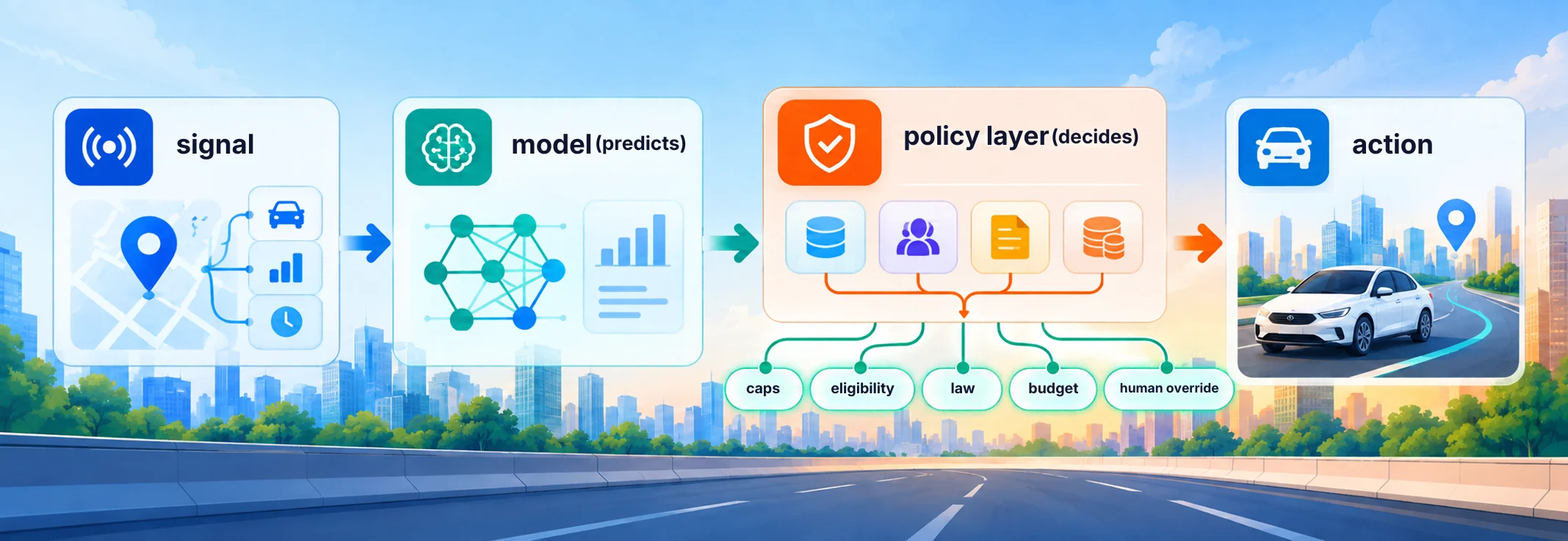
The same shape works across a ride-hailing platform:
Signal
The model predicts
The policy layer decides
Friday-night demand
140 requests in a zone in 30 minutes
Incentive size, inside a budget ceiling
Supply shortfall
A 2.8x supply gap
A multiplier, clamped to the city's cap for that hour
Suspicious payout
Fraud score of 0.93
Hold the payout and open a review ticket, never close the account
If you can't point to the line of code that turns a model score into an action, you don't have a guardrail. You have a hope.
Guardrails that belong in code
Keep these in a versioned, unit-tested policy service that sits apart from model serving. When someone asks how a decision was made, you export the rule version and the inputs.
Rule
Why a model can't own it
Fare formula (base, per-mile, per-minute, tolls, fees)
Riders and regulators expect the published tariff, applied the same way every time
Multiplier ceilings by city and product
Any ride hailing surge pricing algorithm will occasionally find a "correct" price that is unacceptable
Emergency pricing cap
Price-gouging laws apply in declared emergencies. After Hurricane Sandy, Uber agreed with the New York Attorney General to cap emergency prices at the normal range of the prior 60 days, excluding the three highest-priced days
Driver pay formula and legal floors
New York City, Seattle, and other US jurisdictions set minimums, and drivers need to predict their earnings
Per-trip price and pay records
Colorado already requires the disclosure, and more states may follow
Accessibility filters
Wheelchair-accessible requests are an obligation, never an optimization target
Protected attributes and their proxies
A model will find proxies for anything correlated with its target
Maximum pickup distance and wait
A model chasing a score can send a driver 14 miles for a $9 fare
Account deactivation
Livelihoods are at stake, and courts and cities now require real human review
Safety alert routing
An SOS goes to a staffed desk with a response SLA, whatever a triage model thinks
AI vs rule based dispatch in practice
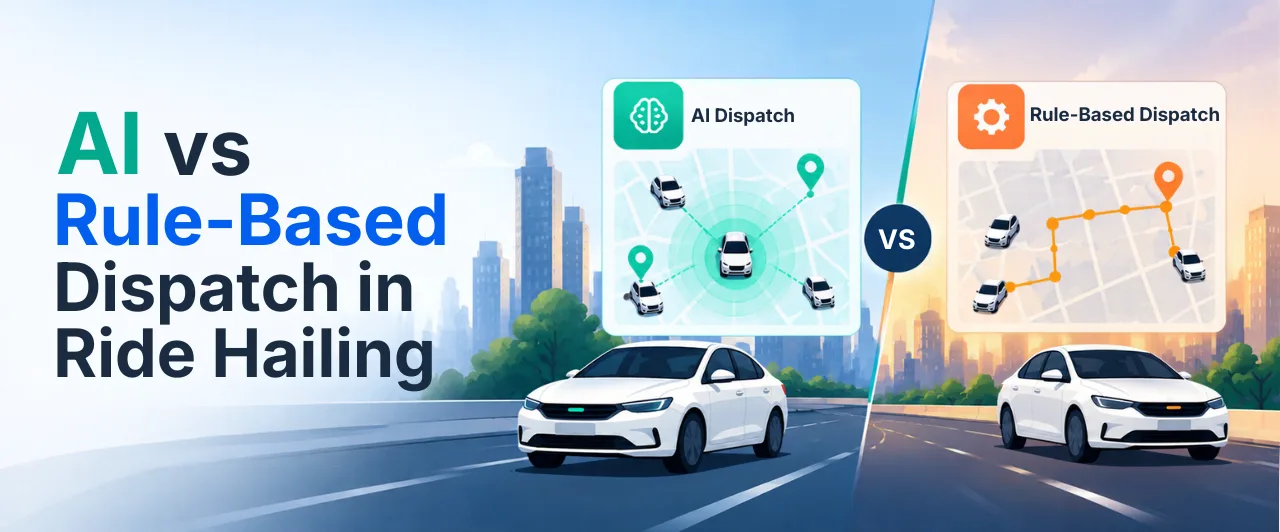
Rule-based dispatch offers the nearest available driver. AI ride hailing dispatch ranks candidates by predicted pickup time, acceptance probability, and the effect on the rest of the zone. DiDi and Uber have both published research on matching at this scale.
Pure rules
Pure ML
Hybrid
Who is eligible?
Fixed filters
Sometimes learned implicitly
Fixed filters, always
Who ranks first?
Distance or queue
Model score
Model score inside the eligible set
Explaining a skip to a driver
Easy
Rarely possible
Easy for eligibility, mostly for ranking
Launch day
Works
Needs history first
Runs on rules until the model earns trust
Busy Friday night downtown
Struggles
Handles it
Handles it
Best fit
Small fleets, prebooked work
Research settings
Most production platforms
Why the hybrid wins: the two things drivers dispute most, eligibility and skipped offers, stay explainable. The model only does what it is good at, which is ranking under uncertainty.
Framed as AI vs rule based dispatch, the debate misses the point. Production systems use both.
What robotaxis and AI agents change
Where things stand now
Why rules matter more
Rules to add
Robotaxis
Waymo was giving about 500,000 paid rides a week across 10 US cities by March 2026. Motional robotaxis appear in the Uber app in Las Vegas
Dispatch decisions now have physical consequences, with no driver to refuse a bad job
Operating zones, weather limits, remote-assistance handoff, a controller view of stalled vehicles
AI agents in support and booking
LLM agents answer tickets, rebook trips, and issue credits
Language models can be talked into things
Per-action permissions, refund limits, human approval above a threshold
Autonomy in the vehicle or in the chat window raises the cost of a wrong call. It doesn't change where the rule layer belongs.
The US rules already touching ride-hailing AI
There is no federal AI law for ride-hailing. State and city rules are filling the gap, each landing on a different part of the stack.
Notice, opt-out, and access rights when automation drives significant decisions, including work allocation, pay, suspension, and termination of independent contractors
Compliance by January 1, 2027 for systems already in use
TNC Transparency Act (SB24-075)
Colorado
Per-trip disclosure of rider price and driver pay
In effect since 2025
Algorithmic Pricing Disclosure Act (GBL § 349-a)
New York
A set disclosure when prices use a consumer's personal data
In effect since November 10, 2025
App-Based Worker Deactivation Rights Ordinance
Seattle
Notice, stated reasons, and a challenge process for deactivations
In effect since January 1, 2025
Driver minimum pay rules
NYC, Seattle, others
Pay floors per mile and per minute
In force, rates vary
State price-gouging statutes
Most states
Pricing during declared emergencies
Long-standing, applies to surge
Dates to put in your roadmap:
December 2, 2026: EU Platform Work Directive transposition deadline, if you operate in Europe. Account suspensions and terminations must be decided by a human
June 1, 2027: Seattle can start investigating whether deactivations had a permissible reason
Ongoing: Connecticut and Maryland have banned some forms of personalized pricing, according to Consumer Reports, with other states considering the same
This is general information. Talk to counsel in each market before you ship pricing or pay features.
Human override that holds up to scrutiny
The Amsterdam court's point: a person clicking "approve" isn't oversight if they lack the evidence or authority to disagree.
Symbolic oversight
Real oversight
Reviewer sees the model's verdict only
Reviewer sees the evidence, the model's reasons, and the driver's side
Approve button, no reject path
Reject, reverse, and escalate paths with reason codes
Overrides disappear
Overrides are logged and fed into retraining
Emergency changes need an engineer
A city-wide emergency cap in one click, the control missing in Seattle
Pricing and dispatch are all-or-nothing
A zone-level switch back to pure rules
Staffing rule of thumb: our ride-hailing app development guide suggests one human dispatcher for every 200 to 300 concurrent rides, however good the AI gets. It shifts with prebooked, airport, and medical work.
Overrides are training data. If dispatchers keep reassigning airport jobs, the model is missing something they know.
Bias checks for riders and for drivers
Removing race, gender, or age from features doesn't settle it. Pickup zone, device type, payment method, and cancellation history can all act as proxies.
Run before every model release:
Price parity by area. Compare multipliers across zones with similar supply and demand. An unexplained gap is how the Consumer Reports findings start
Service parity. Compare wait times and unfulfilled requests across neighborhoods
Pay parity. Compare per-minute pay and take rate across driver cohorts and trip lengths
Counterfactual replays. Rerun a request with one proxy feature changed and confirm the price or ranking holds
Feature store separation. Zone-level demand features and per-rider personal features live apart
Legal line to watch: New York exempts location data used solely to compute a fare from mileage and duration. Rider history, device, or behavior can trigger its disclosure duty.
Monitoring and rollback after launch
Models degrade quietly. A stadium opens, a bridge closes, a competitor leaves town.
Metric
What it catches
Example starting trigger
Forecast error vs seasonal baseline
Drift, broken features
Model loses to baseline 3 days running
Share of prices hitting the cap
Model pushing against guardrails
Over 15% of trips in a zone
Dispatcher override rate
Model missing local knowledge
Doubles in a zone
Take rate by driver cohort
Pay drift
Moves more than 2 points without a pricing change
Feature freshness
Silent pipeline failure
Weather or event feed older than 30 minutes
Triggers are starting points to tune against your own data. AI development services that include drift monitoring and retraining make this routine.
Rollout order, and the question each stage answers:
Shadow. The model logs decisions without acting. Is it better than the rules?
Assist. Dispatchers see it as a suggestion. Do the people closest to the streets agree?
Canary by zone. It controls one or two zones. Does it hold up when its decisions change behavior?
Widen. Zone by zone. Does it generalize?
Kill switch. A per-zone flag hands control back to rules without a deploy. Can the 2 a.m. shift stop it?
The rule baseline is permanent infrastructure. You'll need it for new cities, outages, and the night the weather feed breaks.
Building AI powered ride hailing software with the rule layer first
Demand forecasting, ETA prediction, and fraud detection run as models. Fares, commissions, and surge multipliers are set in a pricing console by zone, vehicle class, or time of day
Caps on surge
Multiplier caps are configurable per zone, vehicle class, or account, wherever local rules require them
Fixed eligibility rules
When a driver's license, insurance, or permit lapses, dispatch stops offering them work automatically
Human override
Controllers can override any job the dispatch logic assigns
Reviewable account actions
Every approval, suspension, and offboarding carries a timestamped audit trail
A documented model
Each model ships with a record of what it optimizes, how it behaves before there is trip history, and what it falls back to
A fallback during rollout
One city or contract goes live while the old system stays up, then markets move across one at a time
Podcast: Where AI Fits in Modern Ride-Hailing Dispatch
Ride-hailing platforms increasingly use AI to forecast demand, estimate arrival times, and improve driver-rider matching. These capabilities can make dispatch faster and more efficient, especially during busy periods.
In this episode, we explore where AI adds the most value and where fixed rules should remain in control. Pricing limits, emergency rules, driver eligibility, pay policies, and safety actions all require clear logic that operators can review and regulators can understand.
We also look at why a hybrid dispatch architecture works best. Models handle prediction and ranking, while rules define the boundaries and people remain available to review, override, and manage important decisions.
Conclusion, letting models work without handing them the keys
Kansas City's 29 prices, Seattle's $120 ride, and the Amsterdam ruling tell one story. The models did their jobs. Nobody had decided where those jobs ended.
Key takeaways:
Models predict and rank. Rules and people decide anything someone can dispute
Build the rule baseline first, and keep it forever
Ship in shadow, then assist, then zone by zone, with a kill switch in reach
Log the model and rule version behind every decision
California's January 1, 2027 deadline is about three months out
The platforms that get this right can add a smarter model every quarter without ever reopening the question of who is in control.
Plan the rule layer before your first model ships
VT Netzwelt runs a free scoping session for mobility operators adding AI to a new or existing platform. You leave with a clear view of which decisions should learn and which should stay fixed.
What the session covers:
Which of your pricing, dispatch, and pay decisions pass the four-question test
Whether your trip and request data is ready to train a model
Where caps, eligibility rules, and human override belong in your stack
How California, Colorado, New York, and Seattle rules apply to your markets
A rollout path from shadow mode to live, zone by zone
Mostly for prediction: demand forecasts by zone, ETA refinement, match ranking, fraud scoring, and support triage. Much of what vendors label AI here is a well-configured rules engine, which is often right for smaller fleets.
Rule-based dispatch picks the nearest eligible driver. AI-based dispatch ranks candidates by predicted pickup time and acceptance probability. Strong systems combine them, with rules deciding eligibility and a model ranking inside that set.
Fare arithmetic, surge caps, emergency pricing, driver pay floors, accessibility, account deactivation, and safety handling. A model can advise. The call belongs to a rule or a person, and in California you will soon have to document it.
It sees demand before requests arrive. A machine learning demand forecasting ride hailing model combines request history with events, weather, and holidays, so incentives move drivers ahead of the spike. Multi-service platforms can share one forecast across rides and deliveries.
Separate the model from the decision and log both: features, model version, and rule version for every assignment. Keep eligibility rules readable and give dispatchers a per-zone switch back to rules.
It estimates the supply gap well. Fairness comes from what surrounds it: caps, emergency limits, parity checks, and keeping rider-level personal data out of the price. Custom ride-hailing platforms can set multiplier caps by zone, vehicle class, and account.
Gurpreet Singh is a seasoned Software Professional with over 16 years of experience in project planning, software development, and delivering complex web and mobile applications using Agile methodologies. He has extensive experience with Scrum and Kanban across eCommerce, Healthcare, Event Management, and Ride Aggregation domains, along with expertise in client interaction, requirement gathering, invoicing, project planning, and solution design. Gurpreet is proficient in Node.js, PHP, Python, JavaScript, MySQL, MariaDB, and MongoDB, with hands-on experience integrating third-party APIs, developing API endpoints, and designing AWS-based microservices architectures.
Discover how EV ride hailing dispatch software uses battery data, live charger availability and trip-fit checks to reduce downtime and improve fleet utilization.
Design one app that feels native on iOS and Android. Compare navigation, gestures, design systems, Flutter and React Native, then use the launch checklist.
Compare build, SaaS, and white-label ride-hailing software by 5-year TCO, control, compliance, data ownership, and exit risk to choose the right model.