AI is no longer a standalone software trend. It is becoming a core layer of business infrastructure. In the world of artificial intelligence, an AI model lands every week, governments revise policy frameworks, and start-ups become billion-dollar and enterprises scramble to understand what will still be relevant 6 months down the road.
Just in the past few weeks, the industry has witnessed the introduction and launch of frontier models, government security measures and interventions, the deployment of AI agents in enterprises, and unprecedented-scale infrastructure deals. The rate is astounding. Companies initially toy with the idea of copilots and soon after they begin to reimagine workflows and processes around autonomous AI.
By the time it becomes time-consuming to ignore the news on AI, it might be too late to catch up for businesses seeking to stay one step ahead. From startups to enterprises and CTOs to generative AI development, staying informed about the AI panorama is crucial for any product strategy, infrastructure planning, and staying competitive.
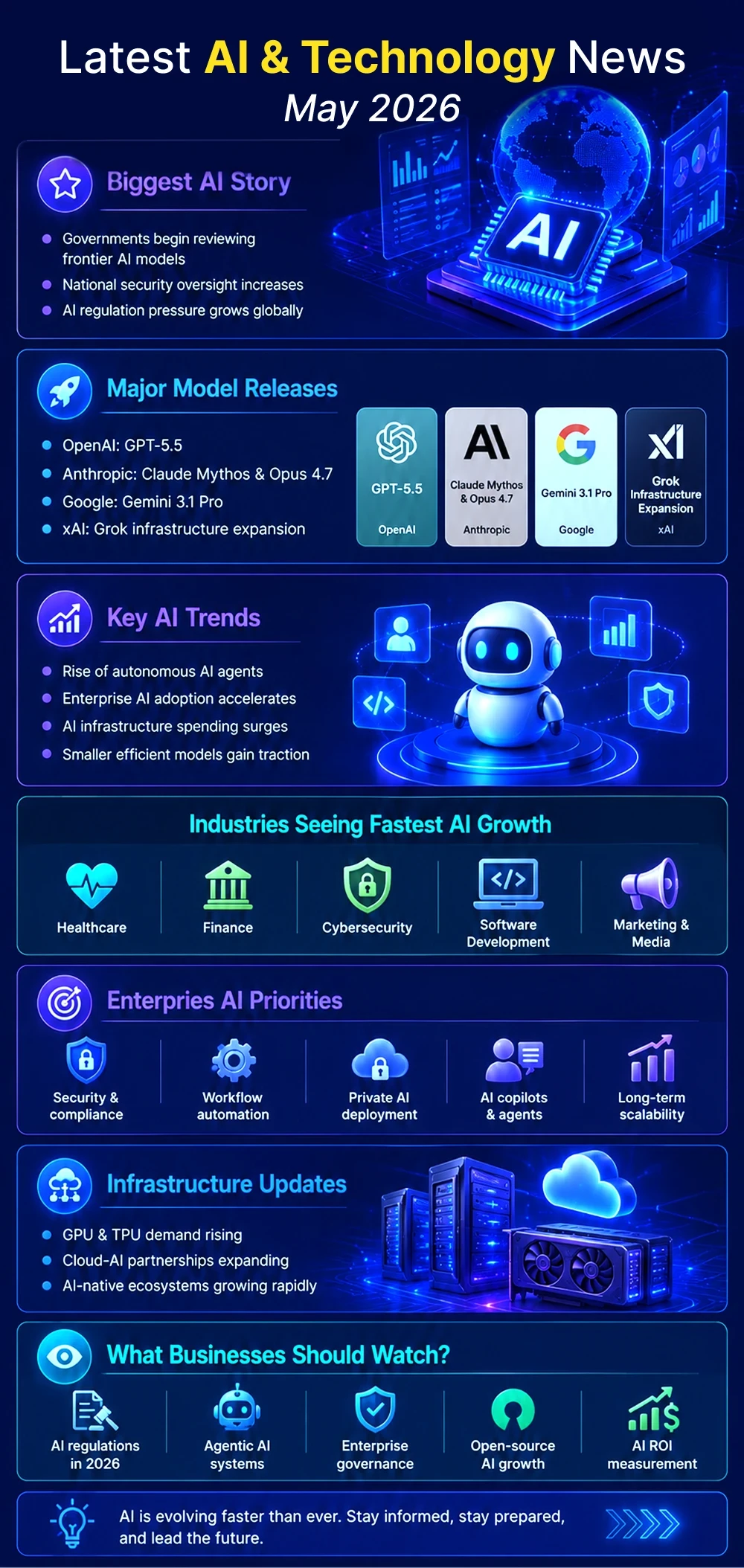
The ai news may 2026 highlights that the governments have most prominently been involved in reviewing high skilled AI models before the public deployment.
Top AI Story of the Month: Government AI Security Reviews Reshape the Industry
The latest ai news 2026, Microsoft, Google DeepMind, and xAI committed to sharing with the U.S. government their latest state-of-the-art AI systems for conducting a series of tests for national security purposes. This effort is being run in the Department of Commerce's Center for AI Standards and Innovation (CAISI).
Prompting the formation of these agreements seems to be related to increased worries about sophisticated reasoning systems like Anthropic's Mythos model. Security agencies and regulators have growing concerns on the potential use of the strong capabilities of a frontier model for cyberattacks, infrastructure disruption or an automated security vulnerability.
The Headline Story: Frontier Models Face Pre-Release Security Testing
Meanwhile, the DoD was beefing up more AI partnerships with tech firms including OpenAI, Google, Microsoft, NVIDIA, Amazon, and xAI in a bid to speed up its use of AI in the military. Significantly, Anthropic was not a part of some of these protection pacts, because of disagreements in the area of military AI safeguards.
These changes may have important repercussions on enterprise AI deployments in the next year or two.
Finally, with the improved expertise of AI systems, businesses may possibly see increased compliance demands in the future for cybersecurity, model transparency, and data governance. Enterprise buyers are also gaining a greater awareness of the need to avoid an AI vendor that does not have solid documentation of security policies and infrastructure protection policies.
For any generative AI development company, it means that, going forward, building trust, governance, auditability and enterprise-grade security readiness are all essential factors to consider for future success beyond the performance of the model.
For the AI sector, it's an age that's dominated by not just the capabilities, but the quality. The whole concept of reliability is the new competitive moat.
Model Releases: OpenAI, Anthropic, Google, and xAI
April and May 2026 delivered the most aggressive model release cycle the industry has ever seen. Here is what each major lab shipped.
OpenAI: GPT-5.5
OpenAI released GPT-5.5 on April 23, 2026, calling it their “smartest and most intuitive model yet.” GPT-5.5 excels at agentic coding, computer use, knowledge work, and scientific research. It is priced at $5/$30 per million input/output tokens with a 1M context window. On May 5, OpenAI followed with GPT-5.5 Instant — a lighter version that reduced hallucinations by 52.5% compared to its predecessor on high-stakes prompts in medicine, law, and finance.
Anthropic: Claude Mythos Preview and Claude Opus 4.7
Beyond Mythos, Anthropic continues to lead in enterprise reasoning and long-context tasks. Claude Opus 4.7 is now the generally available frontier model, and Anthropic announced plans to integrate Mythos-class cybersecurity safeguards into upcoming Opus releases. According to Sacra’s revenue analysis, Anthropic hit $30 billion ARR in April 2026 — up from $9 billion at end of 2025 — with over 500 companies spending more than $1 million annually and eight of the Fortune 10 as Claude customers.
Google DeepMind: Gemini 3.1 Pro
Google continues to lead in lightweight deployment and infrastructure-scale optimization. Gemini 3.1 Pro is positioned as the cost-efficient option for enterprises deploying at scale, particularly those already embedded in the Google Cloud ecosystem.
xAI: Grok and Infrastructure Expansion
xAI is competing through speed of iteration and tight integration with the X (formerly Twitter) ecosystem, offering rapid product cycles and competitive pricing.
Model Comparison: Who Is Leading Right Now?
OpenAI maintains its dominance in the multimodal landscape, among consumers and in productivity tools.
Anthropic is very strong in reasoning and analysing long contexts, as well as enterprise trust.
Google DeepMind is the front runner when it comes to optimizing infrastructure scale and optimized deployment of a lightweight version.
As with competing with other WhatsApp AI partners, xAI is doing it in a gritty way with speed of its product, integration with the X ecosystem, and a rapid iteration approach.
2026 Is the Year of AI Agents
In a number of reasoning categories in the enterprise market, Anthropic has recently been seen as an alternative or outperforming OpenAI in several benchmark trackers and industry reports.
What's the upshot of this? An AI market is now set up as a series of niche, leadership areas, instead of a one-player-will-win-all ecosystem.
Copilots dominated the landscape this year, and multimodal AI was and is all around in 2025, now 2026 is quickly claiming to be the year of AI agents.
The transition from enterprise AI systems assisting with tasks to enterprise AI systems automatically running tasks. Now, rather than just answering prompts, AI agents are in charge of scheduling meetings, generating reports, conducting financial analysis, reviewing legal documents, composing production code and coordinating internal workflows in tools.
Anthropic provides one of the best recent illustrations, with their Wall Street push. Investment banking and financial operations saw most routine tasks take significantly less time with the launch of AI agents tailored for these functions.
Key AI Infrastructure Trends in May 2026
TPU and GPU shortages continue affecting enterprise deployment timelines
Open-source models are becoming more enterprise-friendly
Smaller optimized models are growing for edge AI deployment
AI agent orchestration frameworks are expanding rapidly
Infrastructure strategy has become inextricably linked with the business scalability among companies providing these types ai development services. Enterprises are not solely focused on the benchmark scores, but long-term operational costs, deployment flexibility and layers of security have become a major concern.
Enterprise AI Adoption & Business Impact
In recent months, conversations around enterprise AI have undergone a dramatic change. No longer are businesses asking if they should use AI, it's now a necessity. Now they are attempting to see how fast they can do the integration without any governance issues, security concerns or losing productivity.
Especially the areas of healthcare, cyber security, retail and SaaS companies continue to be among the fastest adopters of enterprise AI workflows.
Within the healthcare industry, AI copilots are driving greater automation in patient documentation, diagnosis and other administrative tasks.
Within the finance sector, AI systems help analysts in processing massive quantities of data, creating forecasts, automating reporting and so on. In the meantime, law firms are forcefully pilots with AI systems checking agreements and doing due diligence.
AI agents are also impacting the hiring process. Businesses are starting to create new business units and roles with an AI-focused model instead of a department-based model.
The actual problem many organizations face these days is not access to AI but, how to leverage it. The challenge comes when it comes time for real world business systems integration and there's chaos involved.
It's not about what models can do anymore, that's the charm of what's currently happening with AI. It's the place they are deployed really.
AI in the Real World
Only two years ago, the integration of AI systems was not as pervasive as it is today, in any number of industries that seemed pristine.
Healthcare
Patient summarization, diagnostics support, and appointment automation are just a few applications that have made their way into the hospital setting and the health-tech company, utilizing AI.
Finance
AI bots are being used by investment companies in the valuation analysis, audit procedure, fraud detection and portfolio research.
Defense & National Security
Governments are incorporating frontier AI systems in classified networks, in analyzing intelligence and in cybersecurity operations.
Software Development
Debugging, testing, and infrastructure management are just some of the tasks coding copilots are continuing to learn, to become self-sufficient interactive engineering assistants.
Marketing & Media
AI video generations, images, and automated marketing systems are revolutionizing the creative process faster and quicker than anyone expects.
The ubiquitous appearance of the tension between openness and control is one of the significant trends in latest ai news 2026. The worrisome tone of governments has grown and contrasts with the accelerating need for innovation among companies. The next step in the AI sector will probably be a balancing act of this sort.
What Businesses Should Watch Next?
Much of the battle in the AI landscape will probably be decided over the next six months, around the adoption curve by enterprises. Key areas to watch include:
AI regulation frameworks in the U.S. and Europe
Enterprise AI security standards
Expansion of autonomous AI agents
Infrastructure competition between cloud providers
Open-source AI acceleration
AI-native hardware ecosystems
Real-world ROI measurement for enterprise AI deployments
But the firms who enter into this cycle winning may not be the smartest. They can just develop the most successful and growing, safe and reliable ecosystems they can. This is becoming more and more apparent on all the major fronts of the AI market.
Conclusion
May 2026 in the AI industry is akin to living in a city where the maps can't keep up with the rapid development. Frontier labs are progressing at lightspeed, governments are more enthusiastically and forcefully getting involved, and infrastructure costs are skyrocketing, as well as enterprises rapidly transforming their processes as per the AI system.
The most significant thing small companies engaged in ai information technology news realized this month is this, AI is actually a software space any longer. It is increasingly becoming the underpinning infrastructure of the new generation of business.
Note that the combination of the rise of in-house AI offerings, the exploration of automation potential, and businesses' collaboration with a generative ai development firm all significantly contributes to the ongoing collaboration between companies and AI providers, which is expected to define the next ten years of enterprise AI.
🎧What GPT-5.5 and Claude Mythos Mean for Business
May 2026 brought one of the biggest shifts in AI yet. OpenAI, Anthropic, Google, and xAI pushed new model releases while governments increased security reviews around frontier AI.
In this episode, we break down GPT-5.5, Claude Mythos, AI agents, infrastructure pressure, and what these changes mean for business leaders planning their next AI move.
Turn AI Into Advantage
Curious how to apply this month's AI shifts inside your business? Explore custom AI solutions and ai development services designed for the next generation of intelligent operations.
Partner with VT Netzwelt to design, develop, and scale secure AI systems tailored to your business goals, workflows, and industry requirements.
Frequently Asked Questions (FAQs)
Some of the most significant developments in May 2026 in the realm of artificial intelligence were related to security concerns by the U.S. government in the realm of frontier AI models, such as the recent deal between Microsoft, Google, and xAI, which permits security assessments of these models by the U.S. government prior to their public launch.
None really has control of the group at this time. OpenAI is ahead in the multimodal space and Anthropic has been doing a great job with enterprise reasoning and long-context analysis. Google DeepMind still holds its own in the competition under light-weight deployment formulations like infrastructure scale.
Companies need to be vigilant and keep an eye on new entrants into the scene of AI governance for cyber testing, transparency of AI models, enterprise data protection and deployment use of high-risk AI models. Advanced models of this nature are increasingly being researched, assessed and rejected by governments prior to their launch, particularly when it comes to any threats to national security.
Off-the-shelf tools work well for general productivity, but custom AI solutions are better when businesses need workflow integration, domain-specific knowledge, data control, compliance, or proprietary automation.
Dushyant Takhar is a Web App Development Expert, passionate about building robust and scalable applications. His focus is on creating innovative solutions that streamline business processes and set companies up for long-term digital success.