You spent months building the app. Launch day arrived, a handful of friends installed it, and then the graph went flat. Now you open App Store Connect hoping the number moved overnight, and it hasn't. That quiet is the hardest part, because nothing tells you which of a dozen possible things went wrong.
The short answer: an app not getting downloads almost always traces back to one of nine problems: no real market need, weak app store optimization, a forgettable icon and screenshots, too few reviews, the wrong audience, no marketing outside the store, ignoring the new wave of AI-driven app discovery, stale updates, or expectations that were never realistic to begin with. Most of these are fixable in weeks. Below is how to work out which one is hurting you, and how to increase app downloads without pouring your budget into ads that only mask the real issue.
If you read nothing else: search drives most installs, so weak metadata and weak creative quietly cap your ceiling before marketing ever gets a chance. Around 65% of installs start with a store search, according to Sensor Tower's 2026 data, with Apple reporting closer to 70% on the App Store and Google Play nearer 60%.
Reason 1: No one really needs your app yet
This one stings, so let me be blunt about it. The most expensive assumption in software is "build it and they will come." Plenty of beautifully built apps sit near zero downloads because they solve a problem nobody was losing sleep over, or one that three free apps already handle just fine. Product-market fit shows up in the numbers before it shows up in your gut, and retention is the honest signal. If close to half of your new installs disappear inside a month, and AppsFlyer's uninstall data puts 30-day churn in that range for many categories, then downloads are not your first problem. Retention is. Pushing more people toward a product they leave quickly just burns acquisition money faster.
Fix it: Before you touch marketing, talk to fifteen people in your target group and watch what they do in a first session, weighing that above what they tell you in a survey. Check whether anyone is even searching for what you built. If the core loop does not hold attention, repair that first. Our team walks through this kind of demand validation in a guide to building a fitness app without wasting budget, and the same discipline carries to any category.
Reason 2: Your app store optimization is too thin to rank
Think of app store optimization as writing your listing for two readers at once: the ranking algorithm, and the human thumbing through results. Both need to grasp what your app does and who it is for within a second or two. A weak ASO strategy usually means the obvious fields got attention and the rest were left blank. The app name and subtitle carry heavy ranking weight. The iOS keyword field is a plain 100-character list that many teams waste on plurals or category names the store already indexes. On Google Play the short and long descriptions feed relevance directly. One shift worth knowing for 2026: both stores now lean on semantic, intent-based matching, so a description that reads like a person wrote it tends to beat a keyword-stuffed one.
Sensor Tower's 2026 work suggests thorough optimization can lift organic installs by roughly 60%, with title keywords alone driving something like 15% to 25% of ranking impact. Here is where that weight sits, and where teams tend to leave value on the table:
Listing field
Character limit (iOS)
What it does
Common mistake
App name
30
Strongest keyword signal, first thing scanned
Only the brand name, no benefit or keyword
Subtitle
30
Second keyword slot, sets the value in a glance
Left empty or filled with a slogan
Keyword field
100
Feeds search relevance, invisible to users
Plurals, spaces, category names, competitor names
Description
4,000
Ranking signal on Google Play, conversion on iOS
Wall of text with no first two lines that hook
Promotional text
170
Updatable without a new build
Ignored, so timely offers never surface
Fix it: Rewrite the name and subtitle around the one clearest benefit plus your top keyword, fill the keyword field with distinct terms, and open your description with two lines that hook. Read the platform guidance from the source: product page and keywords work, and store listing assets. If auditing all of this sounds like a project on its own, it is the core of our app store optimization service.
Reason 3: Your icon and screenshots don't earn the tap
Ranking gets you in front of someone. Whether they tap comes down to your icon and the first couple of screenshots. On the results screen, before anyone reads a single line of your description, those thumbnails carry the entire pitch, and most people judge them in about a second. Screenshots pull real weight in conversion, in the range of 20% to 30% of the impact on whether a browser installs, and Apple shows the first one to three directly in search results when there is no preview video. A screenshot of a clean, empty dashboard tells a shopper nothing about why their life gets better.
Fix it: Redesign the icon so the category reads at thumbnail size, then reorder screenshots so the first two promise a clear benefit rather than show raw UI. A quick test: flash the icon alone for one second and see if someone can name the category, then set your first two screenshots beside your top three competitors on a phone screen and check that yours stand out. Prove the change with the stores' built-in A/B testing instead of guessing, using Apple's custom product pages or Google Play's store listing experiments to run real variants against live traffic. This is design work, which is why our UI/UX design team treats store creative as part of the product rather than an afterthought bolted on at launch.
Reason 4: Too few reviews, and the ratings are shaky
Reviews do two jobs at once. They reassure a nervous first-time visitor, and they feed the ranking algorithm. So a 3.6-star app with 40 reviews is fighting uphill twice over. The store reads that score, and so does every person deciding whether to trust you with space on their phone. Apps generally need to hold around a 4.4-star rating to compete for top-ten placement in search, per Sensor Tower's 2026 benchmarks, and roughly 79% of users read at least one review before installing, according to Apptentive. In 2026 recency counts for more than it used to, since Apple's search now weights fresh ratings more aggressively, so a burst of praise six months ago carries less than a steady trickle this month.
Fix it: Ask for a rating after a genuine win, an order placed, a workout logged, a level cleared, when goodwill is at its highest, never on first open before the user has felt any value. Reply to negative reviews in public, fix the bug they flagged, then ship it and name the fix in your release notes. To find which moments line up with your happiest users, you need event data, which is where mobile app analytics tools earn their place in the stack.
Reason 5: You're reaching the wrong people
This one is sneaky. Downloads from the wrong people look like progress and behave like failure. They install, poke around once, and vanish. Your ratings dip because the app was never built for them, and your ranking quietly softens because the store is watching how those new users behave. It usually traces to broad keywords that pull mixed intent, a category or region chosen for reach over fit, or paid campaigns tuned for cheap installs rather than the users who stick. A budgeting app that ranks for "money" will draw floods of the curious and very few of the committed. One lever most teams underuse here is localization: in 2026 the stores treat a properly localized listing as a relevance signal, and localized pages tend to outperform plain machine translations.
Fix it: Rewrite metadata around the outcomes buyers search for instead of the features you are proud of, narrow your keywords to real intent even when the volume looks smaller, and localize your top markets properly. In our work the pattern repeats: a listing describes what the app has, while the audience searches for what the app gets them. Aligning those two is often the change that reopens discovery.
Reason 6: Nothing pulls users in from outside the store
Waiting for the store to hand you users is a bet that gets worse every year. There are roughly 5.7 million apps across the two stores in 2026, per Statista, all elbowing for the same shelf space. Store search matters, but on its own it rarely fills the top of your funnel. The two directions also feed each other: when people search your brand by name and install, the store reads that as a strong relevance signal, so the work you do outside compounds inside.
Fix it: Build a small spread of channels that each does a distinct job, content and SEO that answers what your users Google before they reach a store, one community where your audience already gathers, a landing page that ranks and converts, and paid campaigns used to test messaging. Treat paid installs with suspicion, because they hide product problems for exactly as long as the budget lasts. If you want a team to run the SEO, content, and paid side properly, that is our digital marketing service.
Reason 7: AI assistants don't know your app exists
Here is the shift almost no launch plan accounts for yet. A growing share of people decide which app to install before they open a store at all, by asking ChatGPT, Gemini, Perplexity, or Apple Intelligence which tool is best for the job. That conversation is a new front door to your app, and it does not read your keyword field. It reads the open web: reviews, roundups, comparison articles, community threads, and documentation that describe what your app does and who it helps. If your app is missing from those sources, the assistant confidently recommends a competitor that is present in them.
Fix it: Make sure your app shows up in the places these models learn from. Publish a clear, factual page about what your app does and who it is for, earn mentions in "best app for X" roundups and the communities your users trust, and keep your own site content specific and current. This is the same muscle as classic SEO, pointed at a new reader, so treat your content and reputation as part of the growth stack rather than a side project.
Reason 8: You almost never ship updates
Each store favors apps that show signs of life. A steady cadence of updates signals an active, maintained product, and it hands you fresh "What's New" text, bug fixes that lift your rating, and reasons for the algorithm to re-crawl your listing. An app that has not shipped in eight months reads as abandoned to the store and to returning users. You do not need a major release every week.
Fix it: Set a reliable rhythm of small improvements, a fixed bug here, a refined screen there, and let each release refresh your ratings and your "What's New" text. Pair it with the review timing from Reason 4, since fresh ratings and fresh builds reinforce each other. This is the cheapest reason on the list to fix, and one of the most neglected.
Reason 9: Your expectations were never realistic
Some apps are not failing at all. They are being measured against a fantasy. "Not getting downloads" means one thing for a niche B2B tool and something completely different for a consumer game, and holding yourself against a viral outlier is a quick way to convince yourself a healthy app is broken. Global downloads reached roughly 257 billion in 2026 by data.ai's count, but that number belongs to a handful of giants. A useful new app in a specialized category might grow in the hundreds of installs a month, and that can be a real business.
Fix it: Set benchmarks against apps your size in your category rather than the top of the charts. Decide in advance what week-one, month-one, and month-three numbers would count as on-track, instrument the app so you can watch leading indicators, and hold off on aggressive acquisition until the product retains. A post-launch plan is what separates an app that grows from one that stalls and gets quietly relaunched a year later at twice the cost.
How to increase app downloads, fix by fix
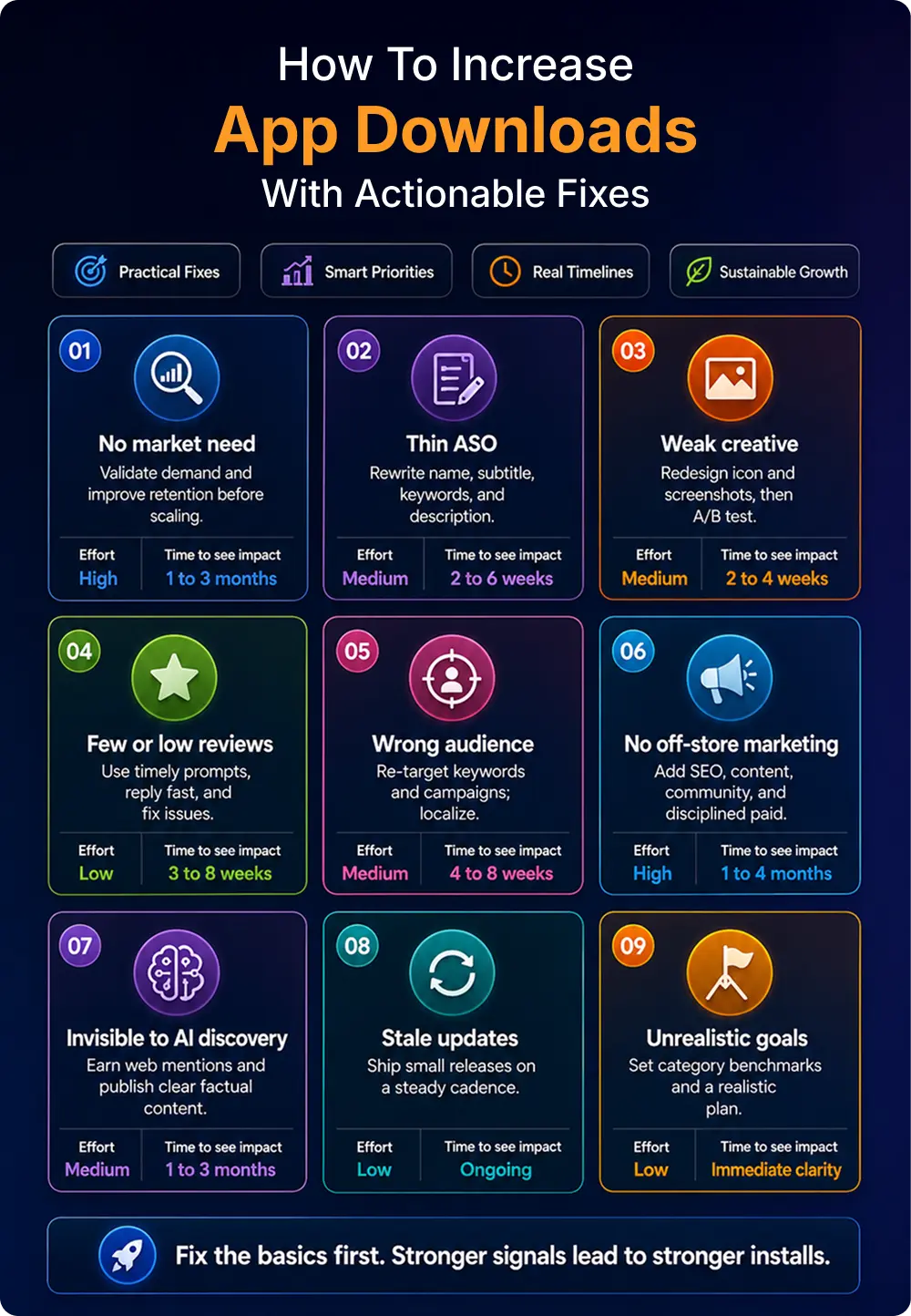
Diagnosis only helps if it turns into an ordered plan. This roadmap maps each reason to its fix, the effort involved, and how quickly you should expect to see results as you work to increase app installs. Start at the top, because a listing fix with no product-market fit underneath it just accelerates churn.
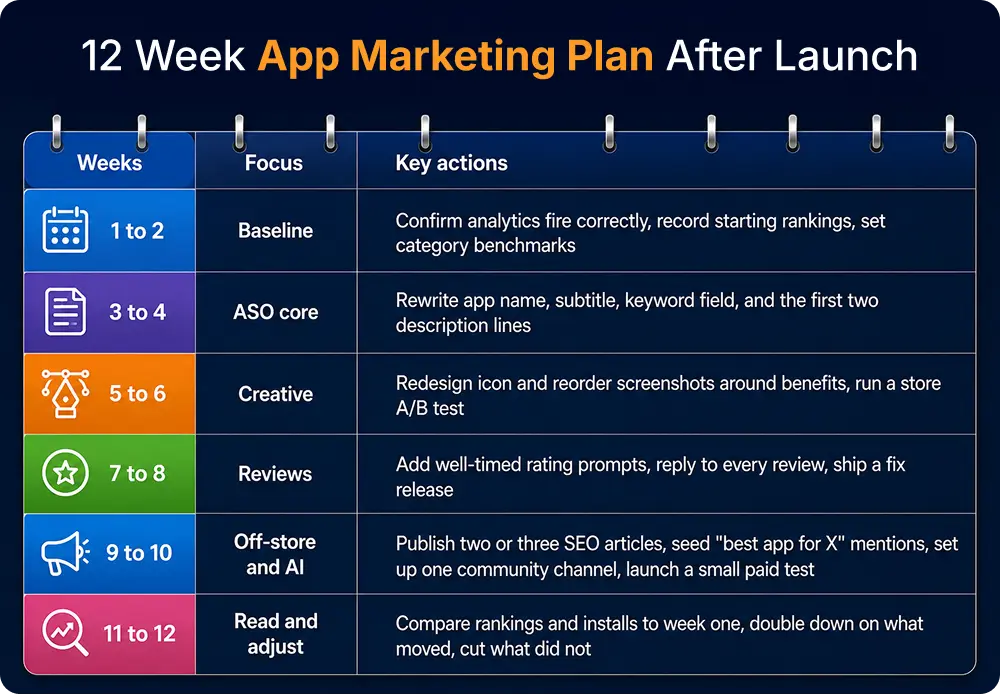
A 12-week post-launch growth calendar
A launch is a starting line. This calendar gives a small team a realistic order of operations for the first three months, assuming the product already retains the users it gets. If it does not, spend these weeks on Reason 1 instead.
🎧Your App Is Live… So Why Isn't It Growing?
The Real Reasons Apps Struggle to Get Downloads:
Launching an app is only the first milestone. Long-term success depends on how easily users can discover your app, trust it, and find enough value to keep coming back. From App Store Optimization and creative assets to user reviews, AI-powered discovery, and post-launch marketing, every stage plays a role in driving sustainable growth.
In this episode, we uncover the biggest reasons apps fail to gain traction after launch and share practical strategies to improve visibility, increase downloads, and build long-term app success.
Where to start this week
If your app is quiet right now, hold off on throwing money at ads. Open your store listing and read it the way a stranger would. Does the name say what the app does? Do the first two screenshots promise a clear benefit? Is your rating sitting above 4.4, and have you asked a happy user for a review this month? Most teams find two or three fixable gaps in a single afternoon, and those gaps are usually what has been capping downloads all along.
Sort out the free things first. Give them a few weeks to show up in your rankings, then decide whether paid acquisition earns its keep. An app that converts organic search traffic is worth advertising. One that does not will only lose money faster behind a bigger budget.
If you would rather hand this to a team that audits the listing, reworks the creative, and builds the off-store and AI-era demand that feeds it, that is the work our app store optimization and mobile app development specialists do every week. Book a free 30-minute consultation, tell us where your app is stuck, and we will point you to the highest-return fix first.
Frequently asked questions
Usually because search can’t surface it, and the few people who do see it aren’t convinced to install. Around two-thirds of installs begin with a store search, so weak metadata and dull first screenshots quietly cap your numbers. Start with your app store optimization if the product already keeps the users it gets.
Start with your metadata. Rewriting the app name, subtitle, keywords, and first two screenshots costs only time and often lifts organic installs within weeks. After that, ask happy users for reviews, ship updates regularly, and earn clear mentions on the open web so AI assistants recommend you too. None of it needs a media budget.
Yes. Thorough ASO has been linked to around 60% more organic installs (Sensor Tower, 2026), because most downloads flow through search. A good ASO strategy is ongoing work, though, since rankings shift as competitors and algorithms change. If you would rather not run it in-house, that is our app store optimization service.
Around 65%. Apple reports closer to 70% on the App Store and Google Play nearer 60% (Sensor Tower, 2026). Since two out of three users find apps by searching, your listing is effectively your storefront window.
Usually a few weeks. ASO and creative changes typically show in rankings within two to six weeks and help increase app downloads, while SEO and content take one to four months to compound. Anyone promising overnight scale is selling paid installs, which stop the moment the budget does.
It depends on your category and model, so any single number misleads. A niche B2B tool with a few hundred qualified installs a month can be healthy, while a consumer app at that level may be struggling. Benchmark against apps your size rather than the charts, and always pair downloads with retention. Comparable projects in our case studies make a better yardstick than the leaderboard.
Usually not. A full rebuild is rarely necessary if the core product retains users. More often the real problem was distribution: thin ASO, weak creative, no off-store presence, or the wrong benchmark. Fix those and you capture most of the upside at a fraction of the cost. Reserve a true relaunch for when the product truly fails to hold attention, confirmed with real retention data.
As an Associate Director of Digital Marketing with over 18 years of experience, I bridge the gap between complex web technology and high-impact strategy. I specialize in scaling growth across eCommerce, services, and SaaS-based product portfolios through a mix of advanced SEO, AEO, SXO, GA4 analytics, and paid channels like Google and Meta—all while empowering high-performing teams to deliver measurable, real-world business results.
Compare build, SaaS, and white-label ride-hailing software by 5-year TCO, control, compliance, data ownership, and exit risk to choose the right model.
VT Netzwelt supports young minds at IIT Roorkee’s STC Tech Fair 2026 through student innovation, AI learning, research exposure and education-focused CSR.