
Ten platform types, each with its own operating model, regulations and unit economics. We build them separately because a taxi fleet and a medical transport operation share very little underneath.

You run the fleet and the dispatch desk already. We add the passenger booking app, the driver app, and an admin layer that talks to the backend you have.

A rider and driver marketplace runs across several cities, vehicle types and services. We build the matching, pricing and operations layer so adding the next city is a configuration change.

Branded passenger and driver apps built on a platform that already works. You go live in weeks, publish under your own Apple and Google accounts, and keep the branding entirely yours.

Commuters and campuses share journeys on a fixed schedule. Matching works on origin, destination and timetable, with split contributions, verified profiles and seat limits handled inside the app.

We build two-wheeler passenger apps for dense cities. These need low-fare slabs, helmet and licence verification, motorcycle-aware navigation, and cash or mobile money as first-class payment options.

Employee transport reports to finance as much as travel. Approvals, travel policies, cost centres and a single monthly invoice sit alongside shift booking and live duty-of-care tracking.

Bookings are made days ahead and flights move. The platform tracks flight status, shifts the pickup time automatically, and handles terminals, meet-and-greet instructions and hotel or agency bookings.

We build premium booking platforms for chauffeur operators. Fixed quotes by route and vehicle class, corporate account handling, and the affiliate and farm-out arrangements travel agents work through.

NEMT platforms handle eligibility, vehicle level of service, and proof that the trip happened. Recurring appointments, standing orders, no-show rules and broker billing run through the same system.

One app carrying rides, deliveries and rentals on a shared driver pool, wallet and rating system. Commission, subscription and bidding models are configurable, and each service can launch city by city.









Case Study


Discover how we built a Flutter and AWS powered EV charging driver app for Ambare e, covering home, semi public and public charging at scale globally.

Passenger apps cover booking, scheduling, fare estimates, live tracking and trip sharing. We build them to hold up on a weak signal, since riders open them in car parks and tunnels.

The driver app carries onboarding, document capture, navigation and earnings. Drivers keep it open for ten hours a day on a mount, so battery use and one-handed operation drive the design.

One console for dispatch, pricing, zones, driver management and reporting. Occupancy, cancellation and emissions figures are included as standard, and access is controlled by role for larger teams.

Matching balances rider wait time against driver utilisation, with geofencing, zone rules and multi-stop routing on top. We tune the weighting against your own trip history, city by city.

This layer covers dynamic pricing, wallets, local payment methods, invoicing and driver payouts. Payout is where fraud concentrates, and reconciliation, limits and audit trails go in at the start.

Riders open the app and expect drivers to be online. We build the incentive schemes, demand forecasting and churn signals that keep enough supply available in each zone at each hour.

Passengers get SOS, trip sharing, ratings and masked calling. Operators get identity, licence, vehicle and insurance verification with expiry tracking, alongside audit logs and role-based access for inspections.
We use models for demand forecasting, ETA prediction and fraud detection. For each one we document what it optimises, how it performs before there is trip history, and what it falls back to.

Projects connect to dispatch backends, payment gateways, mapping providers, SSO and HR systems, flight feeds and NEMT brokers. Most of the schedule goes into that work, and we scope it first.

PHV and TNC licensing, PCI DSS, accessibility rules and GDPR vary by market, and healthcare transport adds HIPAA. We scope your regime before development starts, then handle store submission and city rollout.
Our Expanded Expertise
Build a scalable Uber-like app with seamless rides, payments & tracking.
Customize Your Uber CloneLaunch a multi-service app for rides, delivery, payments & more.
Customize Your Gojek CloneBuild secure, scalable mobile apps designed for business growth.
Build Your Mobile AppCreate high-performance iOS apps with intuitive designs and features.
Build Your iOS AppDevelop scalable Android apps with powerful features and smooth UX.
Build Your Android AppBuild feature-rich apps for iOS and Android from a single codebase.
Build Across PlatformsTestimonials
Don't Just Take Our Word For It
Their technical response and depth of thinking have completely amazed us multiple times.
VT Netzwelt delivered high-caliber, scalable products that are highly rated in both the App Store and Google Play. The team expanded in-house capabilities to increase the pace of development and shorten time-to-market. Innovative and knowledgeable, they solve complex challenges with ease.
Benjamin Thym
CEO, Offerista Group GmbH

I rest easy knowing that I have VT Netzwelt backing me up.
In addition to strengthening the overall quality of the mobile apps, VT Netzwelt has grown to assume the responsibility of maintaining and updating the products. With a wealth of valuable development experience, they have proven to be a reliable vendor that strives to provide standout service.
Anonymous
Owner, Meal Planning Service
They turn out quality work every time, with very little need for revisions.
VT Netzwelt has delivered a project plan, a finished app, regular updates, and consistent site uptime. The team is responsive to emergencies and has adapted to the project's progress with communication scalability. They're dedicated and eager to tackle new challenges and understand users' needs.
Anonymous
Executive, So Dialed Racetech
They were highly accommodating, transparent, and attentive to detail.
The app performed well and has been downloaded more than 15,000 times. VT Netzwelt offered helpful feedback, responded quickly to inquiries, and delivered assignments on time. Their technical knowledge and structured methodology were both outstanding.
Anonymous
Founder, MindSurf
have worked with Netzwelt team for the past two years on three large-scale apps
they consistently delivered fantastic results. They are extremely responsive to all inquiries and work tirelessly to deliver a fantastic project. Because of their efforts, my app is ranked in the top 10 on 7 different search terms on iTunes. As always, thanks!
Matthew Ohm
CEO
Your Riders Are Ready. Is Your Platform?
We build the booking, dispatch, and driver systems behind taxi, ride-hailing, corporate, and medical transport operations.
Step Into TomorrowFAQs
Transportation software development is the building of systems that plan, book, dispatch and track journeys. For passenger transport that means rider and driver apps, matching and dispatch engines, fare and payment layers, and the operator console behind them.
It depends on the model. A taxi fleet needs booking, dispatch and driver apps. A marketplace adds matching, dynamic pricing and multi-city configuration. Corporate programmes need approvals and invoicing. Medical transport needs eligibility, level-of-service matching and broker billing.
Five things move the number: cities, integrations, KYC and local payment methods, dispatch complexity, and your regulatory regime. As a guide, a branded white-label launch runs $12,000 to $25,000, a custom single-market platform $30,000 to $70,000, and a multi-city marketplace from $80,000.
White-label gets you live in weeks on a proven base and suits operators testing a market. Custom makes sense when your matching logic, pricing model or compliance requirements need building specifically for you. Many clients start white-label and rebuild the parts that become differentiating.
You do. Source code, repositories, cloud credentials and app store accounts are yours, transferred at handover, with no revenue share and no royalty on rides. Check this with any vendor, because several in this market license a platform and describe it as ownership.
It depends where you operate. Most markets require PHV or TNC operator licensing, driver background checks and commercial insurance. Card payments bring PCI DSS. Accessibility rules apply in the US and EU. Medical transport adds HIPAA and broker reporting.
In three places, mostly. Forecasting demand so supply is positioned before it is needed, predicting ETAs from your own trip history, and catching payout and referral fraud. A lot of what is labelled AI in this category is a rules engine.
Blogs
Mobile App Development
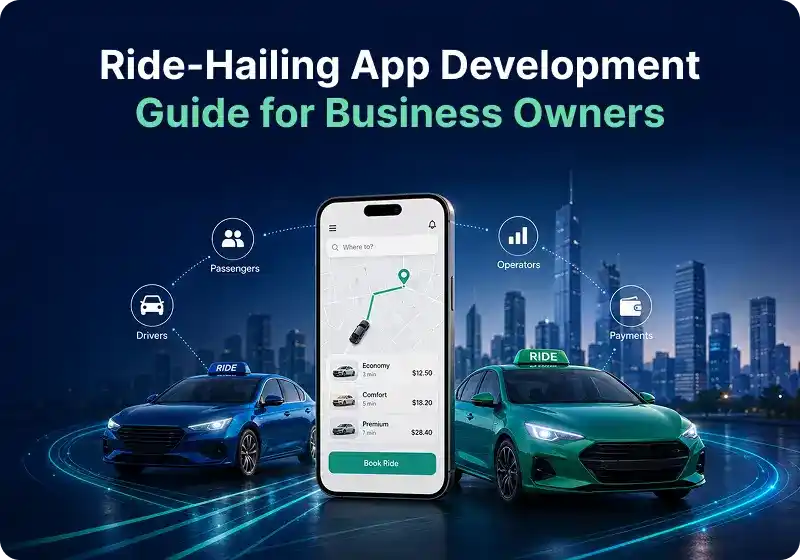
Ride-Hailing App Development, Costs, Tech, and How to Launch
Mobile App Development
Top 10 Innovative Mobile App Ideas for Startup Success in 2026
Mobile App Development
