Quick answer: The most common IoT use cases for businesses are predictive maintenance, remote patient monitoring, fleet tracking, smart metering and real-time inventory. The smartest way to start is small: pick one costly problem, put sensors on it at one site, and prove the payoff before you scale.
20 IoT Use Cases and Real-World Examples by Industry (2027)
November 27, 2026
Listen to Audio Version
Somewhere in a Frito-Lay plant right now, a small sensor is listening to a motor.
It's picking up heat, vibration and tiny changes in magnetic fields. When the pattern starts to look like a part on its way out, the maintenance team hears about it before the line stops and before thousands of bags of chips go unmade.
Nobody on that factory floor calls this "the Internet of Things." They just call it a good week.
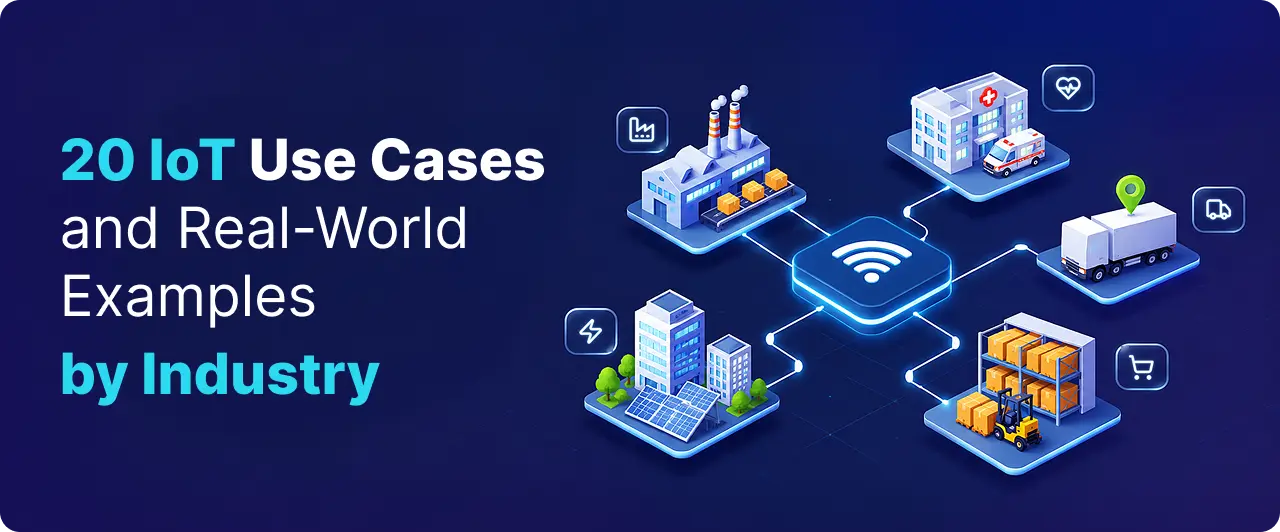
Below, you'll find 20 of them across five industries, with real companies using each one.
First, what does IoT mean for a business?
Think of a smoke alarm. It senses something, it makes noise, and someone acts. IoT is that same idea applied to everything you care about: a fridge, a truck, a pump, a patient's blood pressure.
The only difference is that the alarm doesn't just beep in an empty room. The reading travels over Wi-Fi or cellular to software in the cloud, which decides who needs to know and tells them on their phone.
And it's no longer niche. IoT Analytics counted 21.1 billion connected IoT devices at the end of 2025, and 45% of them were business connections. It expects the enterprise IoT market, worth $324 billion in 2025, to grow another 14% in 2026.
The big shift for 2027 is where the thinking happens. IoT Analytics describes AI moving into the edge devices themselves, so more sensors can spot a problem on the spot instead of waiting for the cloud.
Key Takeaway: If you can name the reading you want, who should see it and what they'll do about it, you already have the start of an IoT project.
Use cases in manufacturing
On a production line, one stopped machine stops everything behind it. That's why factories still produce the clearest industrial IoT examples.
| # | Use case | What it does | Where you'll see it |
|---|---|---|---|
| 1 | Predictive maintenance | Spots the vibration and heat patterns that come before a breakdown | Food, packaging and chemical plants |
| 2 | Connected heavy equipment | Machines report hours, location and health back to the maker | Caterpillar grew its connected fleet to more than 1.6 million assets in 2025 |
| 3 | Production line monitoring | Shows when each machine runs, slows or stops, live on a dashboard | Plants connecting existing PLCs and retrofitting older machines |
| 4 | Worker safety wearables | Detect falls, impacts or entry into danger zones and alert supervisors | Plants, warehouses and job sites |
Spotlight: how PepsiCo stopped guessing. Maintenance used to be a judgment call. A technician would listen to a machine, check a schedule and hope for the best. PepsiCo went looking for a better way and found Augury, whose sensors now monitor critical equipment in Frito-Lay plants for heat, vibration and magnetic fields. Software turns those readings into early warnings, so repairs happen on the team's schedule instead of the machine's.
If you're thinking about something similar, the first step usually isn't buying sensors. It's connecting the machines you already have, which is where manufacturing software comes in.
Use cases in healthcare
Take an 80-year-old who lives alone. Her daughter lives two states away. Her doctor sees her every three months. In between, nobody really knows how she's doing.
That gap is exactly where the most useful iot in healthcare examples live.
| # | Use case | What it does | Where you'll see it |
|---|---|---|---|
| 5 | Remote patient monitoring | Connected cuffs, scales and glucose sensors send readings to the care team | Primary care, cardiology and diabetes programs, including the euGlide platform we built |
| 6 | Fall detection wearables | Detects a fall or SOS press and alerts caregivers by app, text or call | The SmartHip Guardian wearable platform, which our team helped plan |
| 7 | Hospital asset tracking | Tags show where pumps, wheelchairs and monitors are on a live map | Hospitals where, per HIMSS, studies put nurses' search time at 21 to 60 minutes per shift |
| 8 | Vaccine storage monitoring | Loggers record fridge temperatures and alert staff when they drift | Clinics in the Vaccines for Children program, which requires digital data loggers |
What changed in 2026?
Remote patient monitoring got a lot more practical this year. The 2026 Medicare Physician Fee Schedule added a new code, CPT 99445, so providers can now bill for months when a patient sends readings on just 2 to 15 days. Before that, the patient needed at least 16 days of readings in the month. For our 80-year-old, that means her doctor can get paid to watch her blood pressure even in the months she forgets the cuff now and then.
Connected devices can go further than reporting, too. For the McGill Diabetes Technologies Lab, our team built euGlide, a mobile app that connects over Bluetooth to a continuous glucose sensor and an insulin pump, and adjusts insulin delivery based on the readings. It stores data offline and syncs to the cloud when the phone reconnects, so a dropped signal never means lost readings.
And for vaccines, CDC guidance is clear: the Vaccines for Children program requires digital data loggers that record at least every 30 minutes.
Pro Tip: In healthcare IoT, the device is the easy part. Give security, consent and alert routing at least as much attention. Our HIPAA-compliant app development guide covers the rules, and our healthcare app development company team builds with them in mind.
Use cases in logistics and fleets
Most trucks on US highways are already IoT devices, and their drivers may not even think of them that way. Since December 18, 2017, most commercial vehicles over 10,000 pounds (model year 2000 or newer) have had to use a registered electronic logging device. The hardware is already on board. The question is what you do with the data.
| # | Use case | What it does | Where you'll see it |
|---|---|---|---|
| 9 | Fleet telematics | Tracks location, driving hours, idling and engine faults | Nearly every interstate trucking fleet |
| 10 | Refrigerated container monitoring | Reports temperature, humidity and location from inside the box | Ocean carriers such as Maersk |
| 11 | Pallet and inventory tracking | Battery-free tags report where each pallet is as it moves | Walmart's supply chain |
| 12 | EV charging and fleets | Shows live charger status, starts and stops sessions remotely, and matches trips to battery levels | Charging networks like Ambare-e (below) and fleets using charging-aware dispatch |
By the numbers:
- 270,000 refrigerated containers fitted with remote monitoring by Maersk
- About 12 minutes for a pre-trip inspection afterward, down from up to six hours, according to Maersk
- 4,600 Walmart stores and 40-plus distribution centers in its planned 2026 national rollout of Wiliot's battery-free sensors
From our work: For Ambare-e, an EV charging network in Brazil, our team built a Flutter driver app that talks to chargers in real time through AWS IoT Core over MQTT, with Bluetooth and Wi-Fi as backups. Drivers can find a free charger on a map, start or stop a session from their phone, watch live power and progress, and pay per session. The chargers ran custom firmware with no standard protocol, so we designed the system to support OCPP later without a rebuild. Read the Ambare-e case study.
If you run vehicles, our mobility and transportation software page shows how telematics, dispatch and driver apps fit together.
Use cases in energy and buildings
Ever driven 40 miles to check a gauge, only to find everything was fine? Energy and building operators have, many times. These iot applications exist to end those trips.
| # | Use case | What it does | Where you'll see it |
|---|---|---|---|
| 13 | Smart meters | Report energy use to the utility automatically, at least hourly | About 140.5 million US smart meters in 2024, according to EIA data |
| 14 | Remote SCADA | Field sensors report pressure, flow and equipment status to one screen | Oil fields, gas sites and water systems |
| 15 | Smart HVAC and lighting | Sensors adjust heat, cooling and lights to how rooms are used | Offices, campuses and hotels |
| 16 | Leak and equipment alerts | Water, boiler and freezer sensors warn maintenance right away | Apartment buildings and commercial properties |
From our work: For an industrial client in oil and gas, our team built SimpliScada, a SaaS SCADA platform that collects pump-jack sensor data every two minutes. When a reading stays out of range or a site stops checking in, it alerts technicians and admins by email and SMS. The client's legacy systems were too valuable to rip out, so we kept them and built translators for their old data formats. We also supported both proprietary and standard sensors so they'd never be locked into one vendor. It runs on React Native, AWS Lambda and Amazon RDS. Read the SimpliScada case study.
Utilities and energy companies building on this kind of data can see what's possible on our energy and utilities software page.
Use cases in retail and warehouses
Ask any store manager what keeps them up at night, and "the system says we have 12, but the shelf is empty" will be near the top.
| # | Use case | What it does | Where you'll see it |
|---|---|---|---|
| 17 | Fresh-food RFID | Lets staff count fresh items in seconds and spot what's about to expire | Walmart's meat, bakery and deli departments |
| 18 | Cooler and freezer monitoring | Watches every cooler and alerts staff before food spoils | Grocers, restaurants and convenience stores |
| 19 | Forklift and asset tracking | Tracks where equipment is, how much it's used and who's driving | Large warehouses and distribution centers |
| 20 | Shelf and foot-traffic analytics | Counts visitors and flags empty shelves | Retailers staffing around real busy hours |
Before and after at Walmart.
Before: fresh food was the hardest part of the store to count. RFID tags struggled in cold, damp cases, so meat and bakery items were tracked by hand. After: in October 2025, Walmart announced RFID labels from Avery Dennison built to read reliably in those cold, wet conditions, starting in meat, bakery and deli. The goal is faster counts and less food going in the bin.
Which IoT use case fits your business?
Not sure where to begin? Start with your biggest headache.
| If your biggest headache is... | Start with... |
|---|---|
| Machines breaking down without warning | Predictive maintenance (#1) |
| Patients you can't see between visits | Remote patient monitoring (#5) |
| Staff hunting for equipment | Asset tracking (#7 or #19) |
| Spoiled food or medicine | Cold storage monitoring (#8, #10 or #18) |
| Wasted trips to remote sites | Remote SCADA (#14) |
| Stock counts you can't trust | RFID or pallet tracking (#11 or #17) |
How to start small with an IoT pilot
After 20 iot examples, it's tempting to do everything at once. Resist it. The projects that succeed usually start narrow.
- Pick one expensive problem, such as downtime on one line or spoilage in one cooler.
- Define success in numbers before you buy a single sensor.
- Start with one site to keep variables low.
- Decide where alerts go and what happens next.
- Plan for scale, because device management and cloud costs grow fast.
Pro Tip: Model your cloud bill at 10 times the pilot's size. Our AWS cost optimization guide shows where those bills creep up.
What can go wrong (and how to avoid it)
Most IoT projects don't fail because the sensors break. They stall for more ordinary reasons.
| Risk | What it looks like | How to avoid it |
|---|---|---|
| Stuck in pilot | The demo works on 10 devices but nobody plans for 1,000 | Agree on the scale-up plan and budget before the pilot starts |
| Alert fatigue | Phones buzz all day, so people start ignoring them | Fewer, smarter alerts, each with a clear owner |
| Weak security | Default passwords and unpatched devices on your network | Unique device credentials, encryption and a plan for updates |
| Legacy equipment | Old machines can't share data in modern formats | Use gateways or translators instead of ripping out equipment |
| Patchy connectivity | Basements, ships and rural sites lose signal | Devices that store data offline and sync later |
IoT project cost ranges
These ranges come from several published 2026 industry cost guides. Estimates vary widely by scope, so use them as a starting point.
| Stage | Published 2026 range | What you typically get |
|---|---|---|
| Proof of concept or pilot | About $15,000 to $95,000 | One device type, basic connectivity, a simple dashboard |
| Production build | About $80,000 to $220,000 | Device management, mobile apps, integrations, security |
| Enterprise platform | About $180,000 to $500,000+ | Multiple sites, multi-tenant setup, advanced analytics |
| Platform fees (ongoing) | About $200 to $3,000 per month | Cloud IoT platform, depending on device volume |
Hardware, connectivity and installation are usually extra. Secure hosting matters as much as the app, which is why our cloud, infrastructure and security team gets involved early.
🎧 Where IoT Actually Pays Off: 20 Real-World Use Cases Across Five Industries

Connected sensors are no longer an experiment. From Frito-Lay plants that hear a failing motor before the line stops to Maersk containers that report their own temperature, IoT has quietly become part of how factories, hospitals, fleets, utilities and stores run every day.
This episode walks through 20 practical IoT use cases across manufacturing, healthcare, logistics, energy and retail, with real examples from PepsiCo, Walmart, Maersk and Caterpillar, plus projects such as euGlide, SmartHip Guardian, Ambare-e and SimpliScada. It also covers what changed in 2026, including the new remote patient monitoring billing code, and why AI is moving into edge devices.
Finally, it explains how to pick the right first use case, run a focused pilot, avoid common pitfalls like alert fatigue and weak device security, and budget realistically, so businesses can prove the value of IoT before they scale.
Where should your business start with IoT?
You don't need to connect everything. Look at the headache table again, pick the one that costs you the most, and run a single focused pilot.
If it works, you'll have the numbers to scale. If it doesn't, you'll have learned something cheaply. Either way, you'll know more than you did when you were guessing.
Ready to turn your data into decisions?

Have a use case in mind? Tell us the problem, and we'll help you plan a pilot that proves its value before you scale. Let's Connect.
Related reading
FAQs
Predictive maintenance, remote patient monitoring, fleet tracking, smart metering and real-time inventory. Each one replaces a manual check with live data.
The smart meter on your building, the ELD in a delivery truck and the logger in a pharmacy fridge are all IoT. Bigger iot examples include Walmart’s pallet sensors and Maersk’s 270,000 monitored reefer containers.
Healthcare uses it for patient monitoring and equipment tracking, manufacturing to predict machine failures, and logistics to track trucks and cold cargo.
Fewer expensive surprises. A small business can catch a failing freezer, machine or delivery early without hiring people to watch everything, and a focused pilot keeps the risk small.
Published 2026 estimates put a proof of concept at about $15,000 to $95,000, depending on scope. Hardware and connectivity are usually extra. Our IoT development services team can help you scope a pilot that fits your budget.
You’re ready if you can name one costly problem, the reading that would reveal it, and the person who’d act on it. When you choose an iot development company, look for one that asks about those three things before it talks about hardware.
Dushyant Takhar is a Web App Development Expert, passionate about building robust and scalable applications. His focus is on creating innovative solutions that streamline business processes and set companies up for long-term digital success.
Table of Content
Are You Prepared for Digital Transformation?