If you have spent any time researching Salesforce lately, you have probably run into a small problem: the product names you found in a 2023 article do not match what a Salesforce rep says on a call today. Search for "Sales Cloud" and you will land on a page now titled "Agentforce Sales." Look up "Data Cloud" and you will find "Data 360" instead.
That confusion is the reason this guide exists. Below, we break down every major Salesforce cloud, what each one does, what it costs in 2026, and how to figure out which one your business actually needs. We will use the names people still search for, and we will tell you what Salesforce calls them now, so you are not caught off guard mid-conversation with a vendor.
Let's start with the basics.
What Is a Salesforce Cloud?
A Salesforce cloud is a bundle of tools built for one specific job, all running on the same underlying Salesforce platform. Sales teams get a cloud built for closing deals. Support teams get one built for resolving tickets. Marketers get one built for campaigns. Each cloud shares the same customer data, the same automation engine, and the same security model, which is what lets them work together instead of as separate apps.
So when someone asks "what is a Salesforce cloud," the honest answer is that it is less a piece of software and more a packaged set of capabilities aimed at a department or a business outcome.
Here is the part most older articles leave out. At Dreamforce in October 2025, Salesforce officially started retiring the word "Cloud" from its core product names. The whole portfolio now sits under a single banner called Agentforce 360, and the AI agents inside the platform have become the headline feature. The products themselves did not disappear. Sales Cloud still does what Sales Cloud always did. It just answers to a new name now.
That matters for one practical reason. When you compare Salesforce cloud services across vendors, blogs, and Salesforce's own site, you will see both the old and new names used interchangeably for at least the next year or two. Knowing both keeps you from buying the same thing twice or thinking a "new" product is something you have already evaluated.
Old Cloud Names vs New Names in 2026
Here is the quick reference. Bookmark this section, because the rename trips up almost everyone evaluating Salesforce right now.
What it used to be called
What Salesforce calls it in 2026
Sales Cloud
Agentforce Sales
Service Cloud
Agentforce Service
Marketing Cloud
Agentforce Marketing
Commerce Cloud
Agentforce Commerce
Data Cloud
Data 360
The platform as a whole
Agentforce 360
The logic behind the change is straightforward once you see it. Salesforce is betting its future on AI agents, software that can take action on its own rather than just store information and wait for a human. By folding the clouds under the Agentforce name, the company is signalling that every product now ships with these agents built in, not bolted on.
Data Cloud's journey is the funniest example of Salesforce's habit of renaming things. Before it became Data 360, the same underlying product had been called Customer 360 Audiences, Salesforce CDP, Marketing Cloud Customer Data Platform, and Salesforce Genie. That is six names for one product in roughly six years. The technology kept maturing each time, but the buyer and the core job stayed the same.
A couple of products kept their names. Experience Cloud and Analytics Cloud were not folded into the Agentforce rebrand, so you will still see those referred to the old way.
The Main Salesforce Clouds Explained
There are more than twenty products in the Salesforce catalogue, but most businesses only ever touch a handful. These are the ones worth understanding in detail. For each, we have led with a real use case rather than a feature list, because a feature list rarely tells you whether something fits your business.
Agentforce Sales (was Sales Cloud)
This is the flagship and the product most people picture when they hear "Salesforce." It is built for teams that win new business: tracking leads, managing a pipeline, forecasting revenue, and keeping every customer conversation in one place.
Picture a B2B sales team juggling forty open deals. Agentforce Sales shows each rep which deals are stalling, suggests the next move, automates the follow-up emails nobody has time to write, and gives the manager a forecast that is not just a guess on a spreadsheet. The AI layer now scores leads and drafts outreach, which is the part that used to eat a rep's morning.
Best for: companies with a defined sales process and more than a few salespeople to coordinate.
Agentforce Service (was Service Cloud)
Where Sales is about getting customers, Service is about keeping them. This cloud runs support operations: case management, a knowledge base, live chat, phone support, and self-service portals.
A retailer fielding thousands of "where is my order" messages a week is the classic candidate. Agentforce Service routes each query to the right agent, surfaces the answer from the knowledge base automatically, and increasingly resolves the simple ones with an AI agent before a human ever sees them. One Salesforce customer reported its agents autonomously resolving around 70 percent of chat conversations during a peak tax week.
Best for: any business where customers contact you after they buy, and volume is high enough to need structure.
Agentforce Marketing (was Marketing Cloud)
This is the engine for planning, automating, and personalising campaigns across email, mobile, web, and ads. It handles the journeys a customer moves through, from a first sign-up to a re-engagement nudge eighteen months later.
A subscription brand might use it to send a welcome series, then quietly adjust what each subscriber sees based on what they click. The agentic features now help write copy, decide send times, and optimise paid media spend without a marketer babysitting every step.
Best for: marketing teams running campaigns across more than one channel who need them to talk to each other.
Agentforce Commerce (was Commerce Cloud)
This powers online storefronts for both B2C and B2B. Product catalogues, checkout, promotions, and the connective tissue between a sale online and the rest of the business all live here.
If a brand sells direct to consumers and also wholesale to retailers, Commerce can run both experiences from one system and feed every order straight into the customer record.
Best for: retailers and brands whose revenue runs through a digital storefront.
Data 360 (was Data Cloud)
Data 360 is the unifying layer underneath everything else. It pulls customer information from every source you have, your website, mobile app, point of sale system, marketing tools, and third party data, then stitches it into a single real time profile that every other cloud can act on.
This one has become genuinely important rather than nice to have. The reason is blunt: AI agents are only as smart as the data behind them. As one ecosystem leader put it, data quality is suddenly everyone's problem, because you cannot run good AI on a messy foundation. Data 360 is how companies clean up that foundation before turning agents loose.
Best for: organisations whose customer data is scattered across systems that do not currently talk to each other.
Experience Cloud
Experience Cloud builds the customer-facing portals, communities, and websites that sit on top of your Salesforce data. Think a customer login area, a partner portal, or a self-service help centre.
A B2B company might give its dealers a private portal to check inventory, place orders, and log support cases, all reading from the same data the internal team uses.
Best for: businesses that need to give customers or partners controlled access to their own data.
Analytics Cloud (CRM Analytics / Tableau)
This is the reporting and business-intelligence layer. It turns the data sitting across your other clouds into dashboards and visualisations that a leadership team can actually read.
A sales director who wants to see win rates by region, rep, and product without exporting anything to Excel is the obvious user here.
Best for: teams that have outgrown standard reports and need real analysis.
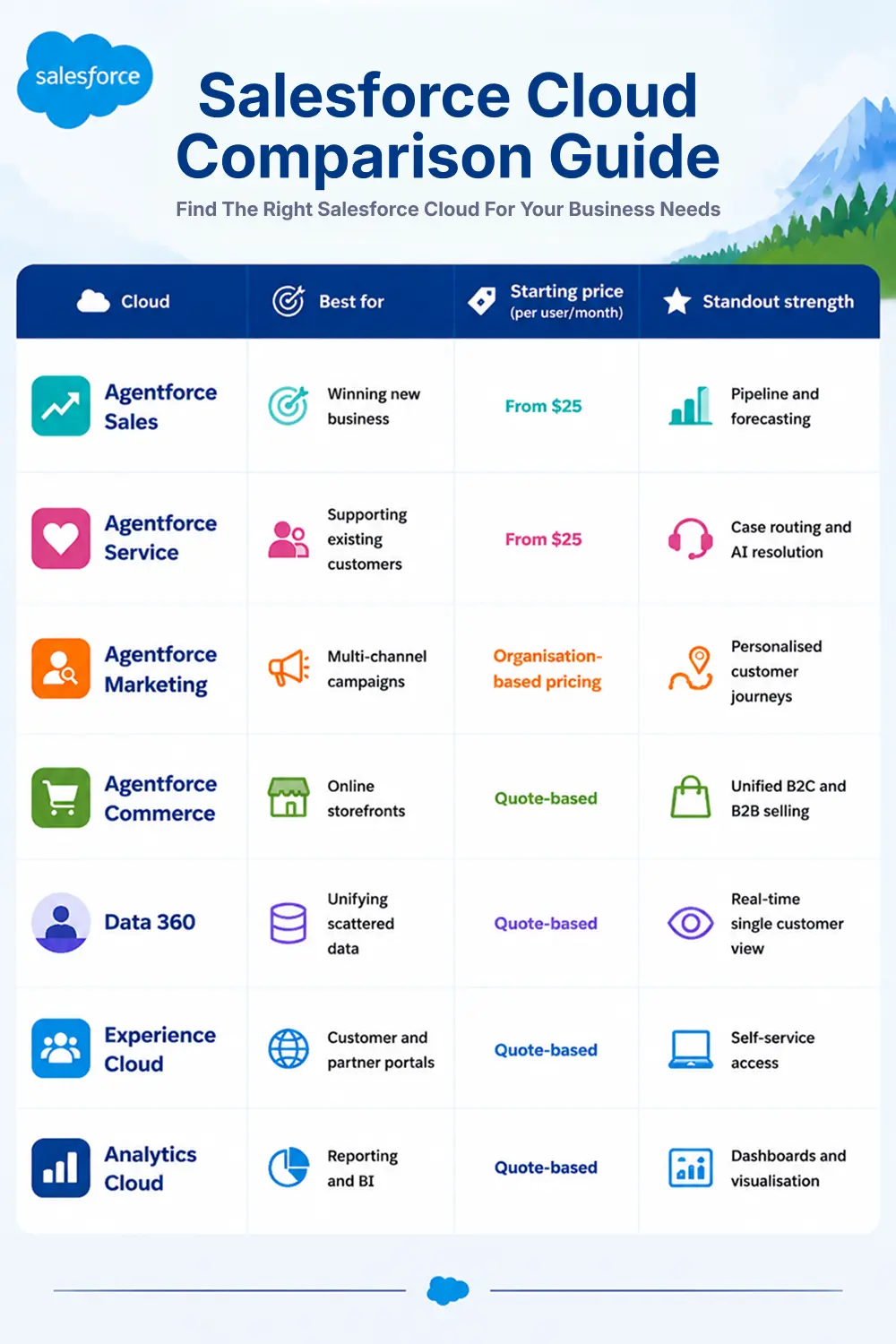
Salesforce Clouds Compared
Here is a side-by-side view to help you place each cloud at a glance. Pricing above the entry tier is quote-based, so treat starting figures as a floor number.
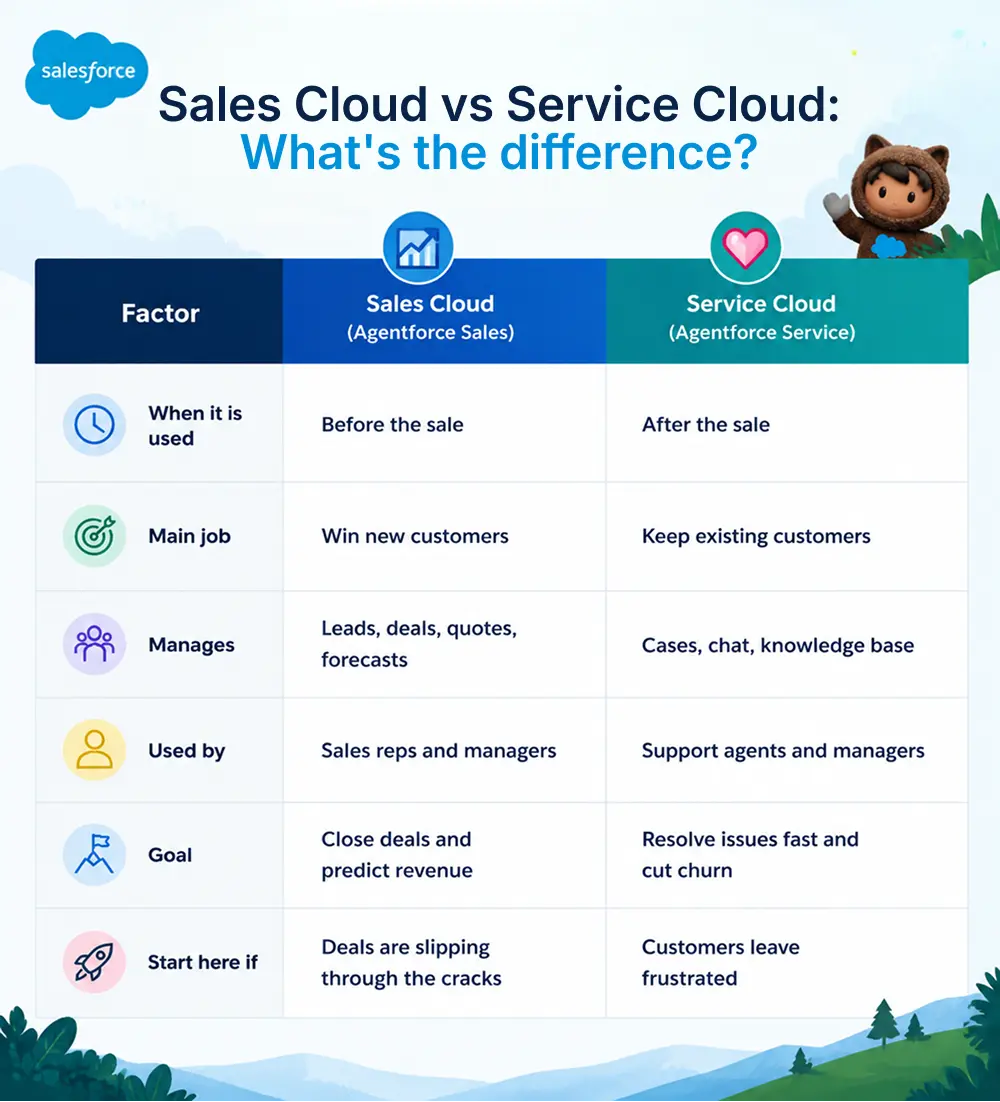
Sales Cloud vs Service Cloud: What's the Difference?
This is the single most common comparison businesses ask about, partly because the two clouds look similar at first and cost roughly the same to start.
The difference comes down to which side of the customer relationship you are on.
Sales Cloud (Agentforce Sales) is for the period before someone becomes a customer. It manages leads, opportunities, quotes, and forecasts. Its whole job is to help you close more deals and predict revenue.
Service Cloud (Agentforce Service) takes over after the sale. It manages support cases, knowledge articles, and service channels like chat and phone. Its job is to resolve problems quickly and keep customers happy enough to stay.
Plenty of companies run both, and they share the same customer record, so a support agent can see the deal a salesperson just closed and vice versa. The practical question is not "which one is better" but "which side of the relationship is costing me the most right now." If deals slip through the cracks, start with Sales. If customers leave frustrated, start with Service.
What Is Agentforce?
Agentforce is the name for Salesforce's AI agents, and as of late 2025 it is also the name stamped across the entire platform.
An agent here means software that can carry out a task end to end, not just answer a question. Older Salesforce AI, branded Einstein, mostly made suggestions: here is a lead score, here is a draft email. Agentforce goes further. An agent can read a customer's history, decide what needs to happen, and do it, such as resolving a support ticket or qualifying a lead, with guardrails set by you.
It comes two ways. You can buy it as an add-on to your existing setup for around $125 per user each month, or it comes bundled into Salesforce's most advanced plans. Either way, it relies heavily on Data 360 underneath, because an agent making decisions on bad data is worse than no agent at all.
A grounded take: Agentforce is real and adoption is climbing fast, but it is not magic. Companies seeing value from it almost always sorted out their data foundation first. If your customer records are a mess, fix that before you buy agents.
How Much Does Salesforce Cost?
Salesforce pricing is simple at the entry point and genuinely complicated above it. Here is the honest picture for 2026.
The core editions, priced per user per month and billed annually, look roughly like this:
Starter Suite: $25. Basic sales, service, and marketing for small teams. There is also a free plan for up to two users.
Pro Suite: around $100. Adds products, quotes, and more automation.
Enterprise: around $165 to $175. The tier most mid-sized and large deployments land on, after a 6 percent price increase Salesforce applied in August 2025.
Unlimited: around $330 to $350. Higher limits, more sandboxes, and premium support.
Top AI-integrated tiers: up to roughly $500 per user per month.
A few things the headline price does not tell you. Everything above Starter is quote-based, so your real number depends on edition, seat count, and add-ons. Agentforce, if you want the AI agents, is typically another $125 per user per month on top. And the licence fee is only part of the bill. Implementation, the work of setting the system up, migrating your data, and training your team, ranges from around $10,000 for a small rollout to well over $500,000 for a complex enterprise project.
The most common budgeting mistake is planning only for licences. A realistic first-year budget should include consulting, customisation, data migration, training, and ongoing support. Many businesses underestimate the total by a wide margin precisely because they only counted the seats. A trusted Salesforce consulting partner can help you scope the real costs upfront.
Which Salesforce Cloud Is Most in Demand?
If you are wondering which Salesforce cloud is in demand right now, the answer splits into two parts: what is most widely used, and what is growing fastest.
Sales Cloud and Service Cloud remain the most deployed by a comfortable margin. They are the bread and butter of the platform, and most Salesforce projects still start with one or both.
The fastest-rising area is Data 360. As AI moves from pilot to production, companies are realising they cannot do anything useful with agents until their data is clean and unified, which has pushed Data 360 to the centre of nearly every serious Salesforce conversation in 2026. Demand for people who understand it has climbed sharply.
Revenue Cloud is also gaining ground, driven by the growth of subscription and usage based pricing models that need careful handling of complex billing and revenue recognition.
So the short version: Sales and Service for sheer adoption, Data 360 for momentum.
Salesforce Clouds by Industry
Salesforce also sells industry-specific clouds that pre-package the workflows a given sector needs, which saves the effort of building them from scratch. A few common patterns:
Healthcare and life sciences:Health Cloud manages patient relationships, care coordination, and compliance-sensitive records.
Financial services: purpose-built tools for client onboarding, wealth management, and regulatory needs.
Retail and consumer goods: Commerce and Marketing clouds dominate, often sitting on Data 360 for a unified view of the shopper.
Manufacturing: account-based forecasting, partner portals through Experience Cloud, and field service tooling.
Communications, media, and automotive: dedicated clouds that reflect the specific sales and service cycles of each sector.
If your industry has heavy compliance or unusual workflows, an industry cloud is often cheaper and faster than customising a general one. If your needs are fairly standard, a core cloud usually does the job.
Which Salesforce Cloud Is Right for Your Business?
There is no universal answer, but the decision usually comes down to where your biggest pain is and how big your team is. A simple way to think it through:
You are a small business or just starting with a CRM. Begin with the Starter Suite. It bundles sales, service, and marketing at a low entry price, and it is the most sensible Salesforce cloud for small businesses because you get the essentials without committing to a heavy enterprise edition you will not use.
Your sales team is growing and deals are slipping. Lead with Sales Cloud (Agentforce Sales).
Your customer data lives in five disconnected systems. Fix the foundation first with Data 360, especially if AI is on your roadmap.
Most growing companies end up with two or three clouds working together rather than one. The trick is to start with the one that solves today's most expensive problem, prove the value, then expand. Buying everything at once is the fastest route to an under-used, over-priced setup.
How to Choose a Salesforce Consulting Partner
Salesforce out of the box is rarely the same as Salesforce that fits your business. The gap between the two is where a good partner earns their fee, and it is also where a bad one drains your budget. If you are evaluating Salesforce consulting services, here is what actually separates the two.
Look for genuine, current certifications and, more importantly, experience in your industry and with the specific clouds you are buying. A team that has implemented Service Cloud for a dozen retailers will see problems coming that a generalist will not.
Ask how they scope a project. A trustworthy partner pushes back on your assumptions, asks about your data quality before they quote, and gives you a realistic number rather than the cheapest one. The cheapest quote is often the one that balloons later.
Check what happens after go-live. Implementation is the start, not the finish. You want a partner who stays for adoption, training, and the inevitable adjustments once real users get their hands on the system.
This is the standard we hold ourselves to at VT Netzwelt: honest scoping before a quote, and a team that stays through adoption and the adjustments that come after.
Where to Start
Here is the reassuring part: this is less daunting than the product catalogue makes it look. The hard part is rarely the software. It is cutting through the noise around it, the rebrands, the AI hype, and the pressure to buy the biggest edition on day one.
So hold on to one thing. The names will keep changing. The Agentforce rebrand is proof of that, and there will be another eventually. What each cloud actually does has stayed steady through every rename, so anchor your decision to the job you need done, not the label on the box.
🎧 Inside Salesforce in 2026: How Agentforce Is Reshaping Every Cloud
Salesforce has evolved from separate cloud products into a unified AI-driven ecosystem powered by Agentforce 360.
Across Sales, Service, Marketing, Commerce, and Data 360, AI agents are now helping teams automate tasks, improve decisions, and work more efficiently.
In this episode, we explain what changed in Salesforce, how Agentforce works across different clouds, and what it means for businesses choosing Salesforce in 2026.
Get Your Salesforce Setup Right the First Time
Picking the wrong cloud, or paying for more than you need, is an expensive thing to unwind a year in. Our Salesforce consulting services take the guesswork out of it: we help you choose the right clouds, set them up around the way your business actually runs, and stick around for the parts that matter after launch.
Seven cover most businesses: Sales Cloud (now Agentforce Sales), Service Cloud (Agentforce Service), Marketing Cloud (Agentforce Marketing), Commerce Cloud (Agentforce Commerce), Data Cloud (Data 360), Experience Cloud, and Analytics Cloud. Salesforce sells plenty more, including industry-specific ones for healthcare, finance, and manufacturing, but those seven are the ones you will actually run into.
Salesforce does not publish a fixed number, and the count keeps shifting anyway. There are 20-plus products that have been called clouds over the years, now grouped under the Agentforce 360 platform. In practice, most companies use two or three.
Sales Cloud and Service Cloud, by usage. They are where most projects start. The one growing fastest is Data 360, because you cannot run AI agents well until your data is clean and in one place.
Sales Cloud helps you win customers. Service Cloud helps you keep them. One manages leads and deals, the other manages support cases. Plenty of companies run both on the same customer data.
It is the layer that pulls your customer data out of every system and turns it into one real-time profile the rest of Salesforce can use. Salesforce renamed it Data 360 in late 2025. You might also know it as Genie or Customer 360 Audiences, since it has been renamed a few times.
It starts at $25 per user per month for the Starter Suite. Above that, pricing is quote-based and climbs to around $500 per user per month for the AI-heavy tiers. Budget for implementation and support too, not just the licences.
Agentforce is Salesforce’s AI agents, software that does a task for you instead of just suggesting it. Since late 2025 it is also the name on the whole platform. It runs about $125 per user per month as an add-on, or comes bundled with the top plans.
The Starter Suite. At $25 per user per month it bundles sales, service, and marketing without the enterprise price tag, and there is a free version for up to two users.
Shivika Kaushik spends her time at the intersection of business, technology and transformation asking not just “Can we build it?” but “Should we, and will it create value?” With 16+ years across Salesforce, HubSpot, AI, Claudeforce and enterprise technologies , she writes about the ideas and realities shaping modern businesses.
When sales and marketing don’t talk to each other, leads slip through the cracks. Connecting Agentforce with Salesforce Marketing Cloud helps teams act faster, follow up smarter, and personalize every step of the customer journey. It’s not about more tools — it’s about making the ones you have work better together.
Salesforce currently tops the charts being the #1 CRM platform. The revenue of Salesforce in the 2024 fiscal year is $34.86 billion which marks an increase of 11.2% from the previous year.
In today’s fast-paced digital world, businesses—whether small or large—are always on the lookout for smarter ways to streamline their operations, connect with customers, and fuel growth.