About the Platform
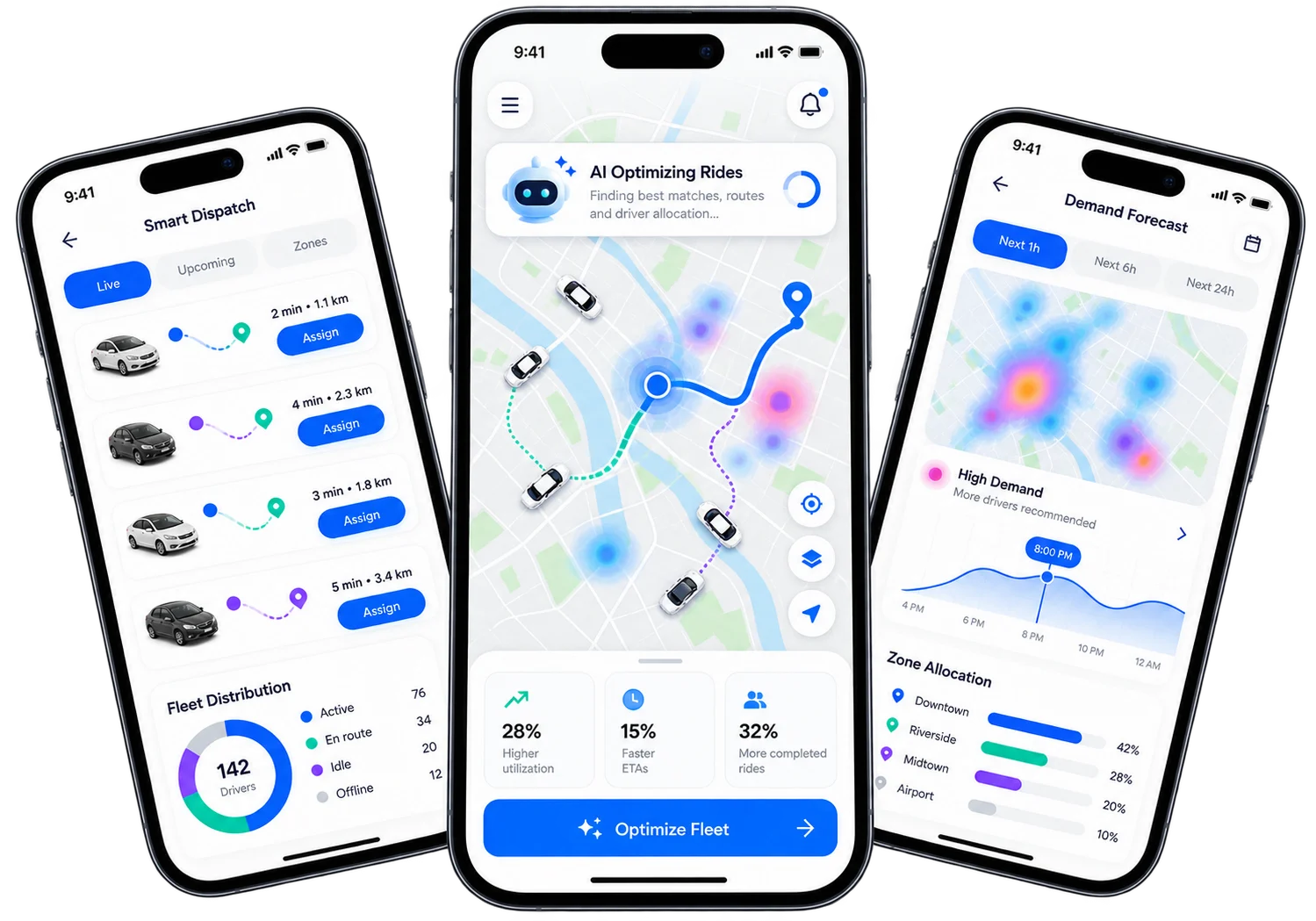
AI-powered ride-hailing software replaces fixed rules with models that predict what happens next: where requests will appear, how long a pickup will take, which driver should take which trip and what fare clears the market. The platform acts on those predictions for every request, and your team sets the limits.
VT Netzwelt builds AI dispatch optimization, demand forecasting and pricing models for operators who already run a working platform. Each capability ships as a separate model you can measure and roll back on its own.
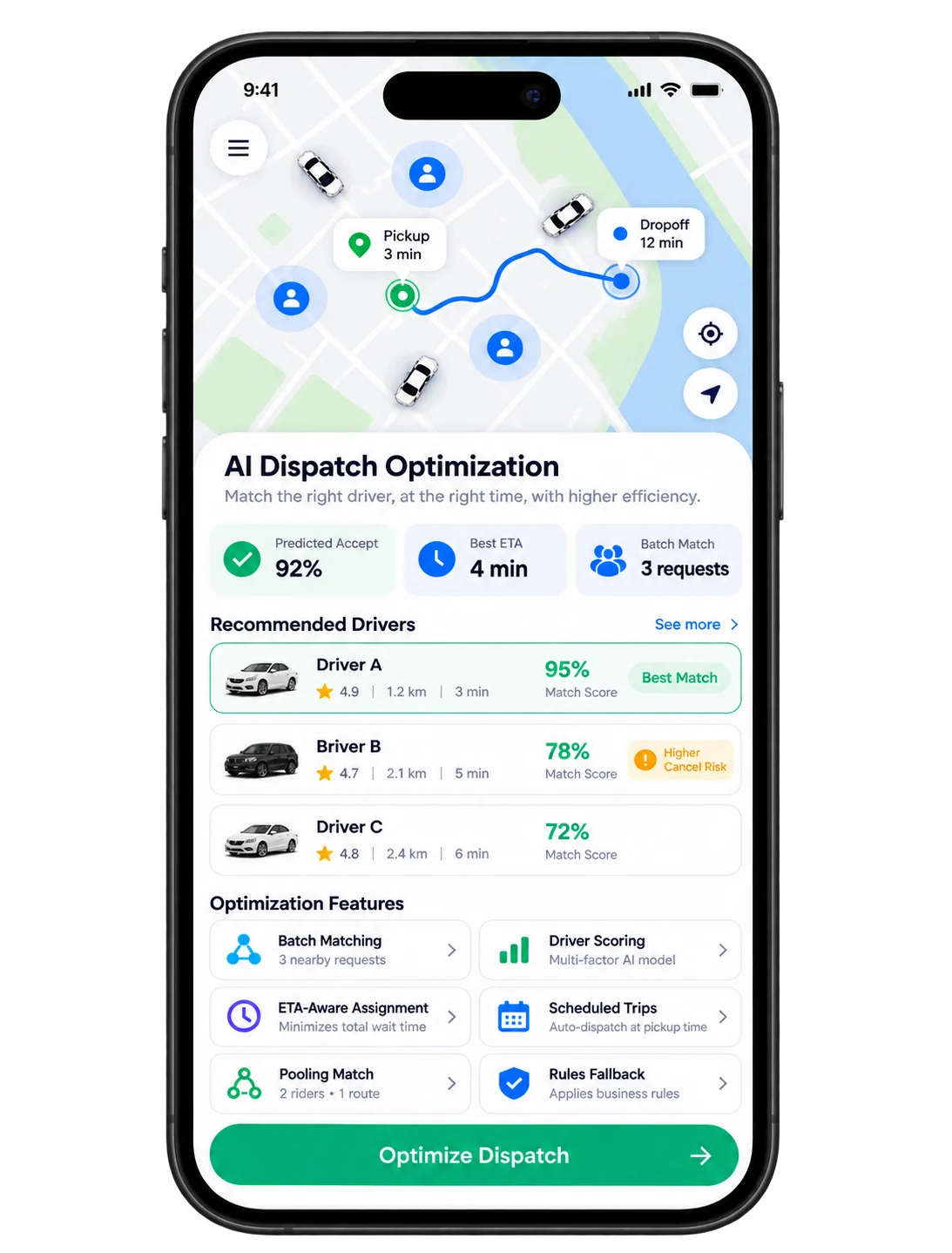
Matching that weighs pickup time, trip value and driver idle time together, tuned against your own trip history city by city.
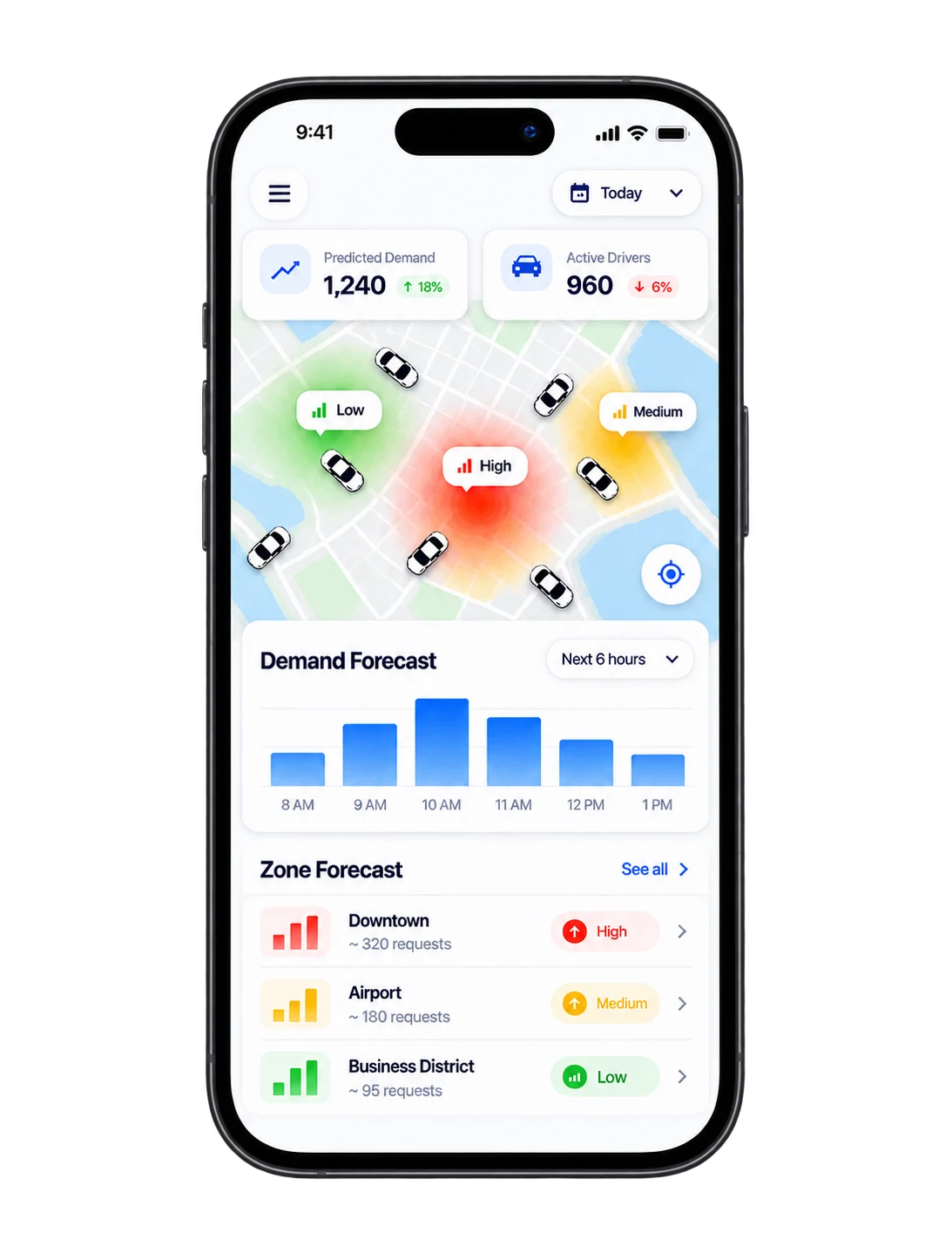
Zone-by-zone forecasts of requests for the next hour and the next day, built from past trips, time of day, weather and local events.
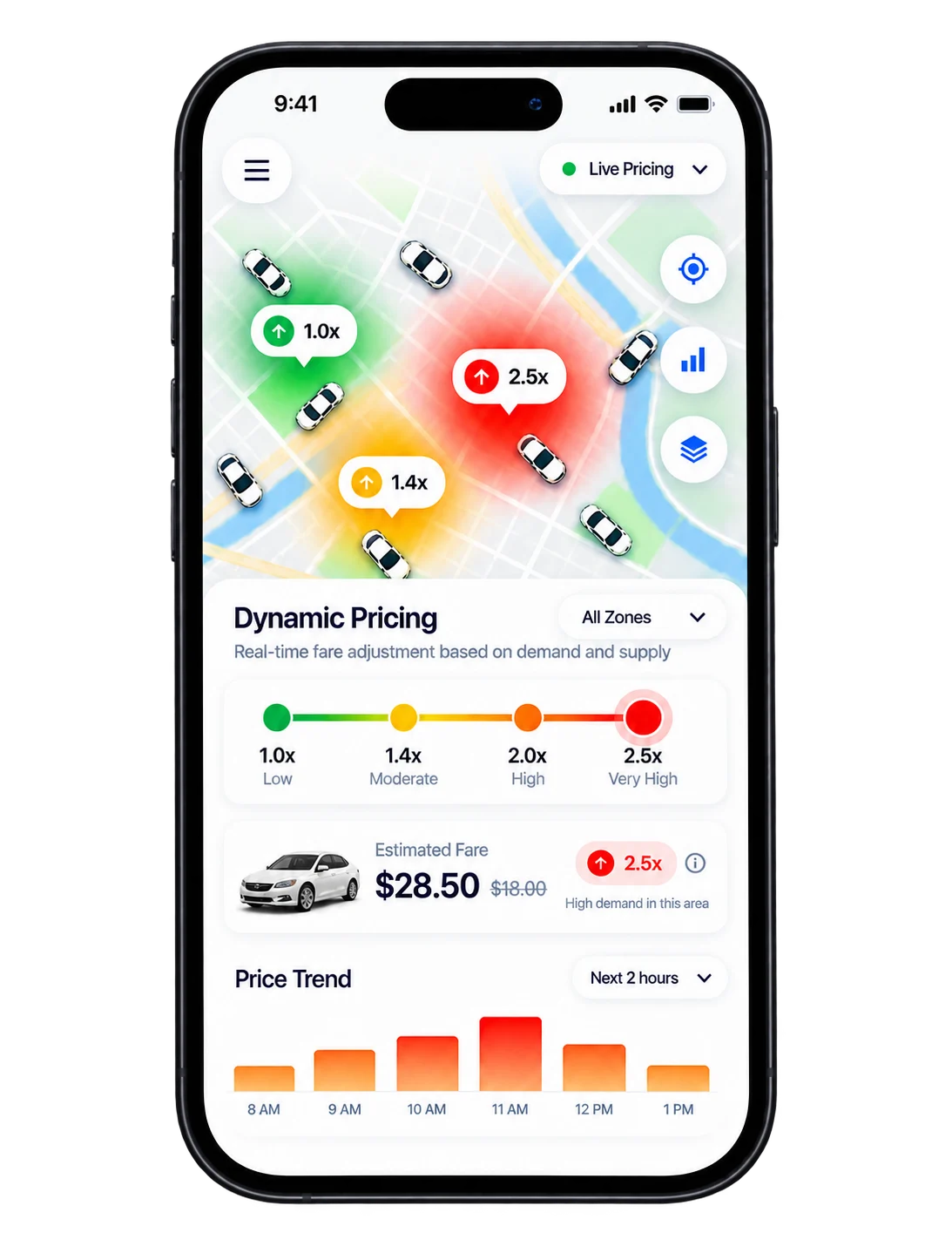
Dynamic pricing software for ride-hailing that responds to supply and demand by zone, inside the caps, floors and disclosure rules you set.
Models that correct your routing engine's estimate using real arrival times from your own trips, so quoted pickups match what riders see.
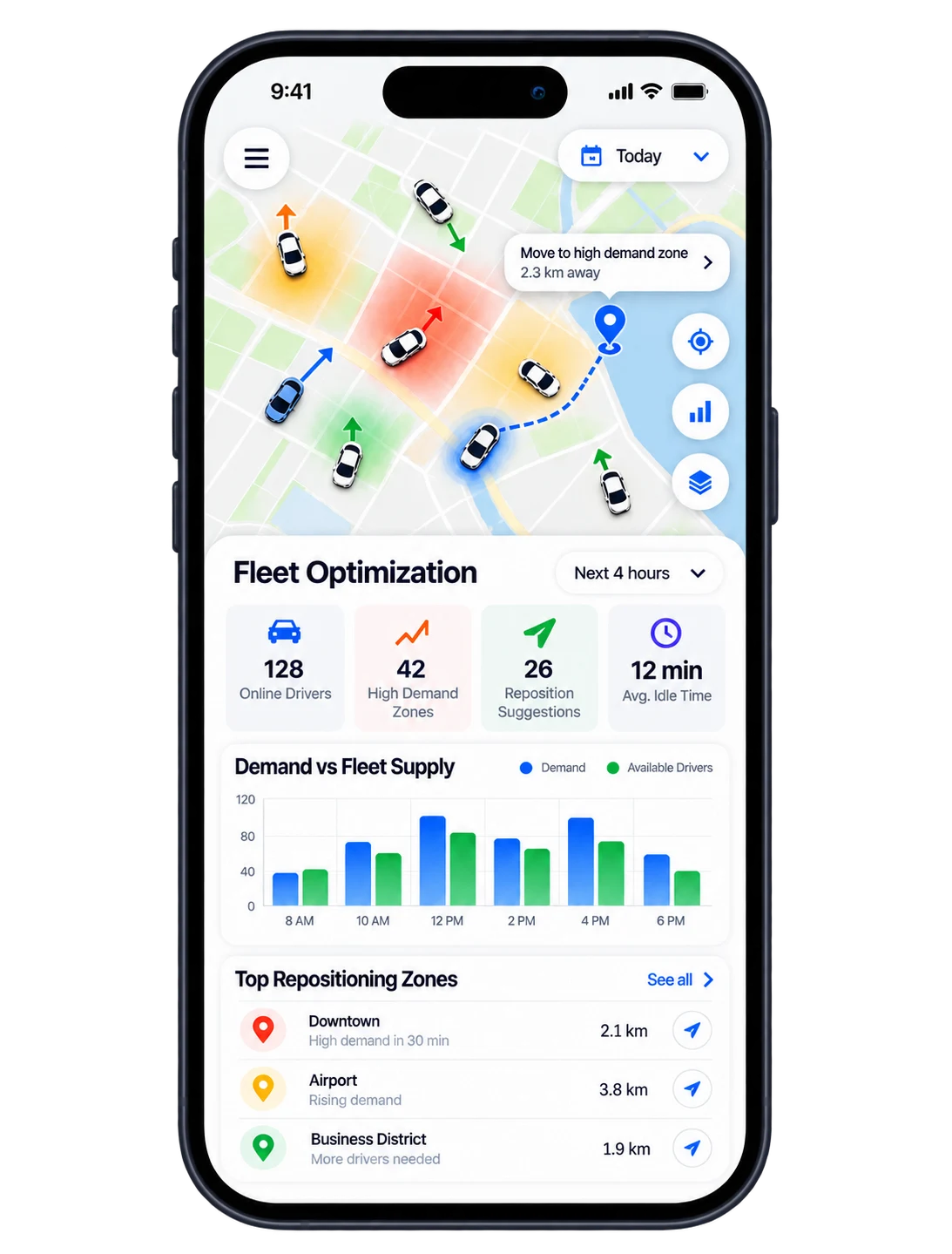
Repositioning suggestions and shift planning that place drivers where demand is forecast, to reduce empty miles between trips.
We review your trip data and current rules, then build a working prototype on your history before any full build is committed.
Requests arriving within a short window are matched together, so a distant driver is never sent while a closer one waits.
Each candidate driver is scored on pickup time, acceptance history, vehicle type and trip length, with weights your team controls.
The model estimates how likely each driver is to accept an offer and sends it to the driver most likely to take it.
Trips with a high chance of rider or driver cancellation are flagged, so dispatch can reassign early or line up a backup.
Assignment uses predicted pickup time from your own trip history, which captures traffic patterns your map provider can miss.
Prebooked airport and appointment trips are placed into driver schedules ahead of time and re-planned when a flight or delay moves them.
Shared rides are matched on route overlap and detour limits, so no rider's trip stretches past the threshold you set.
If a model is unavailable or unsure, dispatch falls back to your existing rules automatically and logs the switch.
Expected requests per zone in short intervals, refreshed through the day as new trips come in.
Concerts, games, holidays and rain are fed in as model inputs, so spikes show up in the forecast before they reach dispatch.
Forecasts built from flight arrival schedules show when terminal demand will peak and how many drivers it needs.
Operations sees which zones will be short of drivers in the next hour while there is still time to act.
New cities and services start on patterns from similar markets, then shift to their own data as trip history builds.
Every forecast is compared with what happened, and accuracy is reported by zone and hour.
Longer-range forecasts for holidays and seasonal shifts support driver recruitment and incentive budgets.
When demand patterns change, monitoring flags it and triggers retraining before forecasts go stale.
Fare multipliers respond to the gap between open requests and available drivers in each zone.
Maximum and minimum multipliers are set per market and hold at any demand level.
Multipliers change gradually between updates, so riders never see fares jump and drop within minutes.
Planned events get their own pricing rules, set in advance and reviewed after the event closes.
New pricing rules run on a share of trips first, with conversion and wait times compared against current pricing.
Every input the pricing model uses is listed and versioned, so you can show a regulator exactly what sets a fare.
Pricing runs on trip and marketplace data alone, with no rider-level personal data in the model.
Driver earnings rules sit alongside rider pricing, so a fare change and its effect on pay are reviewed together.
Machine learning fleet optimization shows idle drivers where demand is forecast next and how far away it is, then lets them choose whether to move.
Recommended driver counts by zone and hour, for fleets that schedule their drivers in shifts.
For electric fleets, dispatch checks battery level and the nearest charger before assigning a long trip.
Distance driven without a passenger is tracked by driver and zone, so repositioning results can be measured.
Driver incentives go to the zones and hours the forecast shows short, so budgets land where supply is missing.
Models flag unusual payout, referral and trip patterns for review before money leaves the platform.
Drivers whose activity is dropping are flagged early, so operations can reach out before they stop driving.
Occupied time, idle time and trips per hour by vehicle, zone and shift, updated daily.
Tech & Integrations
Model Development
Data and Features
Maps and Location
Real-Time Services
Cloud and MLOps
Monitoring
Audit
We map your trip data, dispatch rules and pricing logic, and agree the metric each model must move.
Prototype
A working prototype is trained on your past trips and compared against your current rules.
Document
Each model gets a written objective, its behavior before trip history exists and the rule it falls back to.
Shadow
The model runs alongside live dispatch without acting, and its decisions are checked against real outcomes.
Rollout
Switched on one zone at a time, with drift monitoring, retraining and rollback in place.
Where AI Pays Back
From dispatch models to dynamic pricing software for ride-hailing, every model is tied to a number your finance team already tracks and measured against your current rules.
01
Forecasts put drivers where requests will appear, so fewer riders open the app and find no car nearby.
02
Driver bonuses go to the zones and hours the forecast shows short, so spend stops leaking into zones that already have supply.
03
Pickup times that match the quote give riders less reason to cancel and rebook with another app.
04
Unusual payout and referral patterns are flagged for review before money leaves the platform.
Prototype on Your Data First
We train a working prototype on your trip history before full scope is agreed, so feasibility is settled with your own numbers.
Every Model Documented
Each model ships with its objective, its behavior before trip history exists and the rule it falls back to if something fails.
One Team From Data to Dispatch
Data engineering, model development, backend and cloud work sit on one team that also builds complete ride-hailing platforms.
Straight Answers on AI
If fixed rules or an existing hosted model already solve your problem, we tell you before anything gets built.
Testimonials
Don't Just Take Our Word For It
Blogs
Mobile App Development
Build vs Buy vs White-Label Ride-Hailing App: An Enterprise Decision Framework
Mobile App Development
Ride-Hailing App Development, Costs, Tech, and How to Launch
Mobile App Development
FAQs
Don't see your question? Add it to the consultation form and we'll cover it on the call.
Contact Us
Have Questions? Let's Talk!
Fill out this form to drop us an email, and we will reach out to shape something extraordinary.