
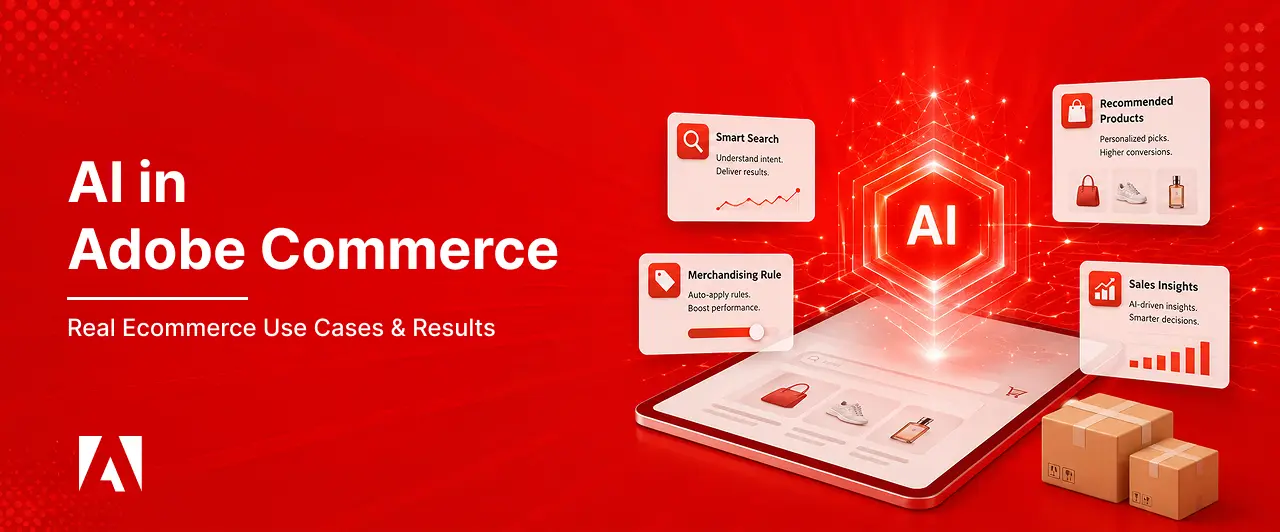
Ecommerce in 2026 no longer revolves around static storefronts and simple product catalogs. Today's online shopping experiences resemble smart digital sales systems that can predict customer intention, automate merchandising and personalize each customer interaction in real time. Much of this change stems from AI in Adobe Commerce.
Adobe Commerce has gone beyond the typical ecommerce infrastructure, integrating AI-powered features into product discovery, customer segmentation, search optimization, analytics, and merchandising processes. AI is no longer a fringe technology for enterprise businesses. It is turning into an operational layer driving conversions, personalization and scalability.
AI in Adobe Commerce uses Adobe Sensei to make online shopping more personal and easier to manage. It studies customer behavior, such as searches, clicks, product views, and purchases, to help stores show the right products at the right time.
Beyond recommendations, it can support better search results, customer groups, inventory planning, pricing choices, and fraud checks. This helps ecommerce teams save time while giving shoppers a better path to purchase.
Adobe Sensei is the power behind a number of Adobe Commerce AI capabilities. It weaves machine learning capabilities, predictive analytics, automation and personalization into the ecommerce core.
Manual merchandising decisions can now be automated on a large scale for recommendations, search optimization, customer targeting and behavioural analysis.
With Adobe Sensei, ecommerce teams can dynamically tailor the customer storefront experience across devices and channels with the ability to analyze vast amounts of customer data and pinpoint purchase trends.
The expectations of consumers have shifted greatly in recent years.
Customers today are looking for platforms that know their preferences, predict their needs, customize product recommendations and provide seamless search experiences. AI-driven marketplaces can optimize customer journeys continually, in real time, and are hard to compete with generic storefronts.
In today's digital landscape, AI is turning into a must-have rather than a luxury for enterprise businesses investing in Adobe Commerce Development Services.
Personalisation, driven by AI, has emerged as one of the biggest competitive edges within today's ecommerce environments.
Behavioral analytics and predictive algorithms help Adobe Commerce personalize product suggestions for customers according to purchasing behavior, customer interests, customer engagement, and browsing habits.
AI systems make dynamic recommendations for each shopper versus the static “related products.”
In traditional ecommerce search systems, customers who type vague queries, conversational words, differently spelt words or otherwise use bad queries typically suffer.
Modern Adobe Commerce AI features improve live search by considering shopper intent rather than matching search queries with exact keywords.
AI enables shoppers to be dynamically segmented by behavior, purchase frequency, browsing habits, geography, and customer engagement for Adobe Commerce stores.
This allows brands to automatically develop intelligent campaigns, segment prices, and narrow down promotions.
Today, AI has transformed Adobe Commerce to support a majority of key ecommerce workflows.
AI is increasingly being adopted by fashion retailers to offer personalized product feeds, suggest style combinations, forecast seasonal demand and increase cross-selling to propel retail productivity. AI systems can use data on browsing habits and purchasing intent to provide products that are more likely to convert with particular customers.
Keeping big ecommerce catalogs balanced with inventory from region to region, warehouse to warehouse, and seasonal demand cycles can be a challenge. Predictive inventory systems are emerging as one of the most valuable Adobe Commerce AI capabilities as businesses adopt enterprise commerce ecosystems.
AI pricing systems keep track of market demand, competitor pricing, customer behavior, and stock levels to dynamically adjust pricing. This enables brands to stay competitive, without having to manually edit pricing for thousands of SKUs.
AI can now automate product tagging, product metadata, product categorisation and visual merchandising ideas. This helps to save time on manual catalog management, and also aids the discoverability experience on large ecommerce stores.
Personalization of B2B ecommerce based on company size, order history, contract pricing and customer behaviour is becoming more common for B2B operations using AI. Likewise, B2C brands employ similar systems to optimize their loyalty and personalize campaigns.
AI chatbots are rapidly evolving and increasingly sophisticated in the context of ecommerce. Modern conversational systems can automate answering product queries, walk customers through buying processes, support customer returns and customer cart recovery without human participation.
One of the top enterprise ecommerce priorities is fraud prevention. Automated fraud detection platforms using AI-powered technology can detect abnormal transaction behaviour, device fingerprints, location deviations, and behavioural patterns in real-time.
Some of Petmate's operational challenges were B2B purchasing processes, customer segmentation and e-commerce personalization issues.
A challenge that arose as operations grew was ensuring efficient management of product discovery and customer experiences given that there are hundreds of products to deal with.
This is how the buying experience got transformed with AI-driven personalisation.
Through the transformation, the company was able to achieve about $400K in business impact and greatly enhanced the customer experience and operational scalability.
It was later recognized during Meet Magento NYC 2024, underscoring the power of AI-informed strategies to improve ecommerce performance.
This case study, offers a clear example of the impact strategic Adobe Commerce Development Services can have on enterprise ecommerce growth.
Adobe Commerce provides much more flexibility for enterprise-scale customisation, complex B2B workflows, multi-store ecosystem, and personalisation through the use of AI.
Many large businesses seek greater scalability, API flexibility and more infrastructure control, all of which are offered by Adobe Commerce.
Adobe Commerce typically offers greater flexibility for more complex AI workflows for businesses.
Shopify Plus is suitable for businesses which prefer simplicity, quicker deployment, and better management of running operations.
For smaller teams that do not have a lot of technical infrastructure, Shopify Plus might be more favorable given the lack of complexity and maintenance.
But as enterprise businesses grow, they may encounter Shopify's limits, particularly in terms of customization and AI-driven operations.
Building AI implementation successfully is not about haphazardly adding automation capabilities on top of the other, but about a plan of action.
This ensures that there will be no unnecessary complexity in initial stages of implementation by starting with measurable business outcomes.
Prices for basic AI personalization implementations range from $15,000 to $40,000; this variability depends on the necessity for integrations and customization.
For enterprise-grade platforms that feature more sophisticated AIs and AI ecosystems, such as predictive analytics, AI search, fraud systems, and automation workflows. The price tag starts over $100,000.
Typically, once you implement, you spend 2-8 months depending on the level of complexity of the platform.
Agentic Chatbots are the next generation of ecommerce intelligence.
AI agents could soon not just suggest products, develop and give advice to users for comparing products, negotiating prices, and automating buying choices. This also includes managing entire shopping processes independently.
AI shopping agents are starting to seem like smart electronic shopping assistants.
These systems can automatically find out what the customer might be hoping for, assess the different products, compare the features, summarize reviews, and be a guide in purchasing.
This might change the means through which customers interact with ecommerce stores within the next couple of years.
As AI shopping systems become more commonplace, brands leveraging Adobe Commerce's AI capabilities will likely be better positioned.
Commerce platforms that can deliver structured information about products, smart personalization, and dynamic experiences can be much more effective when embedded in AI-powered discovery environments.
For more than a decade, VT Netzwelt has been designing and developing scalable ecommerce ecosystems for enterprise brands in various industries.
Our team has expertise in AI-powered commerce architecture, personalized experiences, enterprise ecommerce modernization, and B2B workflows.
Built on the highest-rated and award-winning ecommerce solutions for growth.
VT Netzwelt is a reliable Adobe Commerce development company in the USA that provides commerce solutions with a focus on performance, flexibility and sustainable growth of your business.
Whether it's AI-powered personalization or enterprise-scale integrations, our team is here to support brands in creating future-ready eCommerce ecosystems designed to meet shifting customer demands.
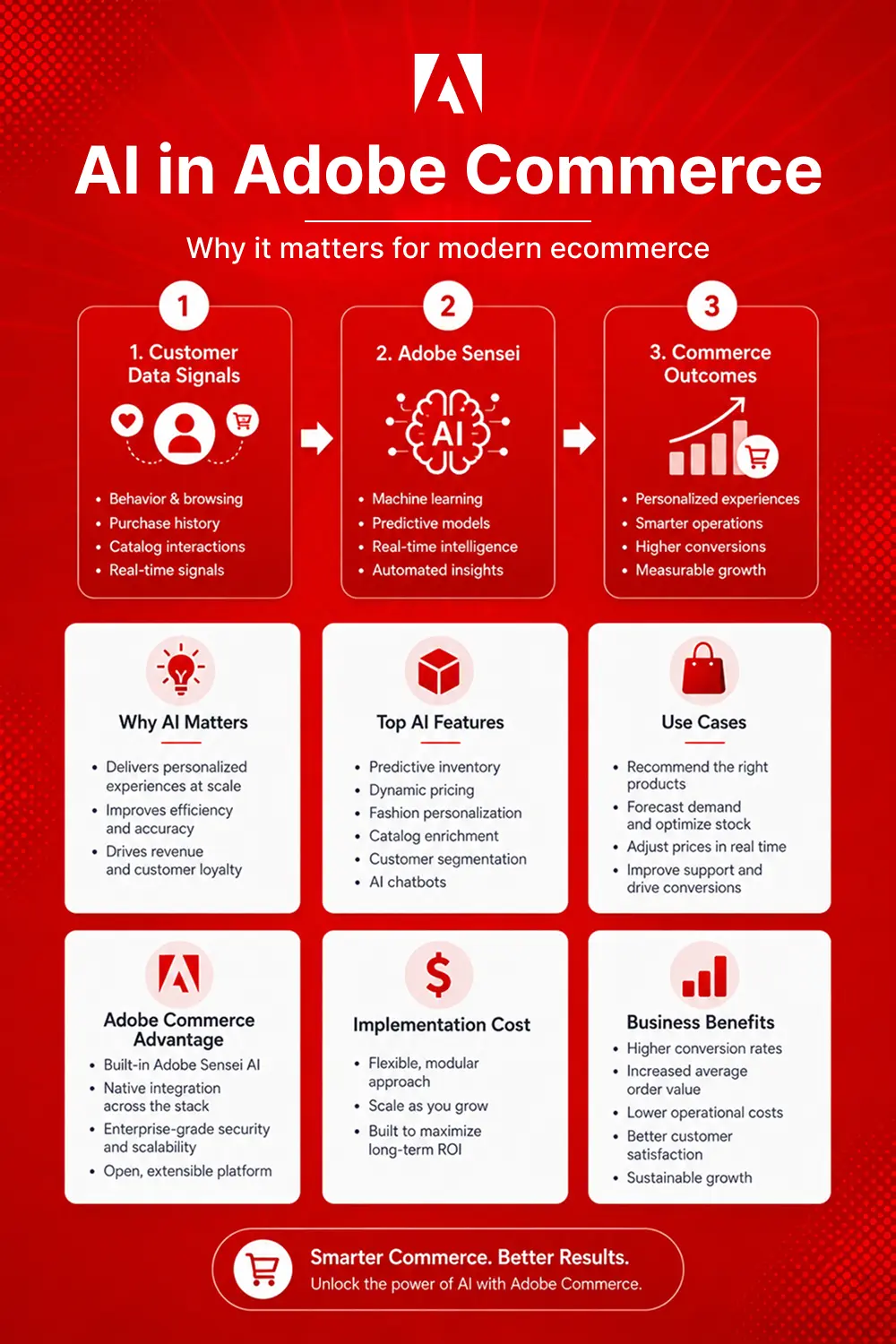
AI is quickly revolutionizing ecommerce, moving beyond storefront management to provide smart, data-driven experiences for customers. Today, everything from customised product suggestions to predictive stock management tools and AI-powered search. It is driven by automation and real-time data analysis, important to maintain competitiveness in the ecommerce landscape.
AI in Adobe Commerce are seeing increased customer interactions, improved conversion rates, and more efficient work processes. But there's no doubt that ecommerce is progressing toward AI-powered experiences, and organizations can position themselves for future success and digital competitiveness by embracing intelligent commerce systems early on.

Ecommerce in 2026 is becoming smarter, faster, and more personalized through AI in Adobe Commerce. Modern ecommerce platforms now use intelligent systems to understand customer behavior, improve product discovery, automate merchandising, and deliver real-time shopping experiences that increase engagement and conversions.
In this episode, we explore how Adobe Commerce uses AI-powered features like personalized recommendations, intelligent live search, predictive analytics, dynamic customer segmentation, inventory forecasting, and AI-driven automation to help businesses scale efficiently. We also discuss real ecommerce use cases across fashion, B2B commerce, catalog management, and customer support.
We’ll also uncover how VT Netzwelt helped transform ecommerce experiences using AI-driven Adobe Commerce solutions, generating significant business impact through personalization and operational optimization. Whether you are an enterprise brand or a growing ecommerce business, this episode explains why AI-powered commerce is becoming essential for future-ready digital growth.
Gain a smart ecommerce ecosystem with intelligent Adobe Commerce Development Services for personalization, automation and enterprise growth.
Get in touch with VT Netzwelt to create commerce experiences with AI to improve conversions, customer engagement and long-term efficiency.
Adobe Commerce AI features, such as AI product suggestions, live search optimization, predictive merchandising, dynamic customer segmentation, and fraud detection systems, are among the best.
Yes. Personalized product suggestions, AI-based search optimization, and segmentation enhance engagement rates, boost average order value and boost conversion rates overall.
The choice between Adobe Commerce and Shopify Plus depends on your company’s needs. You may prefer Shopify Plus if simplicity and quick time to market are your goals, but choose Adobe Commerce for more flexibility in enterprise AI workflows, customization, and scalability.
This depends on the complexity of the task, and the costs will vary accordingly. Basic personalization AI systems can begin at only $15,000, and enterprise AI ecosystems, where automation and predictive analytics are included, can go over $100,000.
Adobe Sensei provides machine learning and behavioural analytics capabilities to a range of personalisation, search optimisation, product recommendation, customer targeting and intelligent merchandising within the Adobe Commerce store.

Are You Prepared for Digital Transformation?
Adobe Commerce Development
A practical guide to Magento 2 ERP integration for growing brands. Compare connectors, middleware, and custom builds. See real results from our Oracle ERP project.
AI Development
GPT-5.5, Claude Mythos, AI agents, and new government security reviews. Here’s what May 2026’s AI shifts mean for your business strategy.

Adobe Commerce Development
Compare Adobe Commerce and Shopify Plus pricing, features, and scalability for 2026. See real strengths, weaknesses, and which fits your business.